


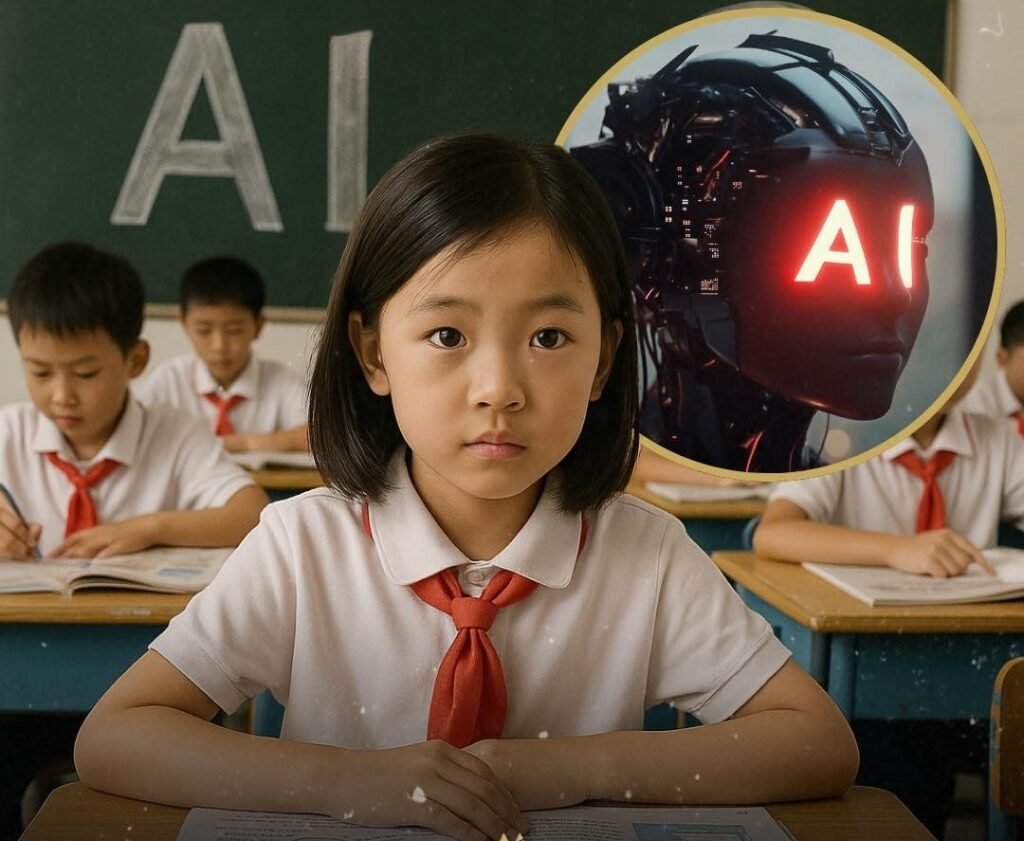
Come September 1, 2025, classrooms across Beijing will buzz with a new kind of lesson: artificial intelligence . In a trailblazing move, the city’s primary and secondary schools will roll out at least eight hours of AI education each academic year, targeting students as young as six. From mastering chatbots to grappling with the ethics of algorithms, China’s capital is betting big on grooming the next generation to dominate the global AI race.
The Beijing Municipal Education Commission laid out the plan, giving schools the freedom to weave AI into subjects like science or information technology or to teach it as a standalone course. The initiative doesn’t stop at lesson plans—it’s a full-scale vision. The city aims to craft a multi-year AI curriculum, build a robust training system for teachers, and spark excitement about AI among students. This isn’t just about coding; it’s about shaping young minds to think critically about technology’s role in society.
China’s AI Dreams Take Root
This push builds on momentum from China’s Ministry of Education, which last December tapped 184 schools nationwide to test-drive AI programs. These pilots are the foundation for a national rollout, with Education Minister Huai Jinpeng calling AI the “golden key” to unlocking a future-ready education system. The goal? To churn out innovators who can keep China competitive in a world where AI is reshaping economies and societies.
Beijing’s move comes hot on the heels of DeepSeek’s meteoric rise. The Chinese AI startup stunned the tech world in 2025 with a model that rivals U.S. giants while using fewer resources—a feat that’s fired up China’s ambition to lead the AI charge. Beijing’s schools are looking to Zhejiang University in Hangzhou for inspiration, where tech stars like DeepSeek’s Liang Wenfeng and Unitree’s Wang Xingxing cut their teeth. By starting AI education early, Beijing hopes to spark an innovation boom that could ripple across the globe.
From Playful Bots to Big Ideas
China’s AI curriculum is designed with growth in mind. Primary schoolers will dip their toes into AI through hands-on fun—think programming simple robots or exploring voice assistants. By junior high, students will dig into the nuts and bolts of machine learning and learn to spot biases in AI outputs. High schoolers will tackle real-world projects, designing algorithms and blending AI with fields like biology or art. It’s a step-by-step approach that aims to make AI as familiar as math or literature.
Teachers won’t be left behind. The Ministry of Education is rolling out training to help educators guide students through this new frontier. But there’s a firm line: no passing off AI-generated work as original. Schools are tasked with fostering critical thinking, ensuring kids don’t just use AI but understand its limits and possibilities.
A Global Race and Local Buzz
Beijing’s not alone in this push. Across the globe, countries are racing to integrate AI into education. Estonia’s secondary schools are already using tools from OpenAI, while California has mandated AI literacy programs. Closer to home, Zhejiang province is charging ahead, with Wenzhou planning 1,000 AI-focused experimental schools by year’s end. On X, Beijing parents are buzzing about the surge of AI and coding classes popping up in local malls, though some wonder if the focus on tech might sideline other skills like creativity or critical reasoning.
The road ahead isn’t without bumps. Data privacy, ethical concerns, and the risk of over-reliance on AI tools are real challenges. Tang Liang of the Beijing Academy of Educational Sciences emphasized the need for strict guidelines and robust oversight to keep AI education safe and effective. Teachers will play a crucial role in guiding students to use AI responsibly, balancing innovation with integrity.
With China projected to pour nearly $27 billion into AI by 2026—nearly 9% of global spending—Beijing’s classrooms are a testing ground for a bigger vision. If the city pulls this off, it could redefine how the world approaches AI education, producing not just coders but thinkers who can shape AI’s future with wisdom and creativity. For now, as six-year-olds tinker with chatbots and teens dream up algorithms, Beijing is planting the seeds for a tech revolution—one classroom at a time.