


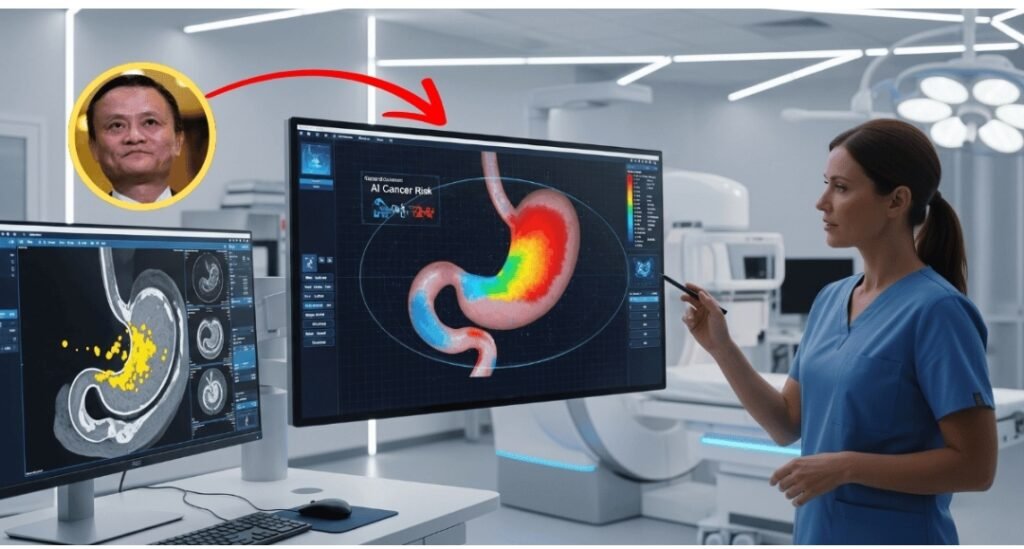
In an era where artificial intelligence is reshaping industries, Alibaba’s launch of GRAPE (Gastric Radiology AI for Precision Evaluation) AI, developed in collaboration with Zhejiang Cancer Hospital, stands as a monumental leap forward in the fight against gastric cancer. This AI-powered tool, designed to detect early-stage stomach cancer using non-invasive CT scans, is not merely a technological achievement but a transformative force that could redefine cancer diagnostics globally. By offering a less invasive, highly accurate alternative to traditional endoscopy, GRAPE exemplifies how AI can bridge critical gaps in healthcare, particularly in regions like East Asia, where gastric cancer remains a leading cause of mortality. As we unpack the implications of this innovation, it’s clear that GRAPE AI is more than a tool—it’s a beacon of hope for millions and a testament to the power of technology to save lives.
The Science Behind GRAPE AI
A study published in Nature Medicine highlights GRAPE’s remarkable capabilities. The GRAPE AI achieved a sensitivity of 85.1%, meaning it correctly identified 85.1% of early-stage gastric cancer cases, and a specificity of 96.8%, indicating its ability to accurately rule out non-cancerous cases. These figures are not just impressive—they represent a 20% improvement over the diagnostic accuracy of human radiologists, who often struggle to detect subtle signs of early gastric cancer due to the disease’s asymptomatic nature in its initial stages. For context, gastric cancer is notoriously difficult to diagnose early, with global five-year survival rates hovering around 20-30% due to late detection. In East Asia, where the disease accounts for nearly 50% of global cases (approximately 1.1 million new diagnoses annually, according to the World Health Organization), this breakthrough could dramatically shift outcomes.
GRAPE’s success lies in its ability to analyze vast datasets of CT scans using advanced machine learning algorithms. Trained on thousands of imaging samples, the AI identifies patterns and anomalies—such as minute lesions or irregular tissue densities—that are often imperceptible to the human eye. This precision is critical, as early-stage gastric cancer can be treated with less aggressive interventions, significantly improving patient prognosis. By contrast, traditional endoscopy, while effective, is invasive, costly, and often inaccessible in resource-constrained settings, leading to low screening compliance. GRAPE’s non-invasive approach, requiring only a CT scan, removes these barriers, making it a scalable solution for mass screenings.
Alibaba’s decision to deploy GRAPE AI for large-scale screenings in Zhejiang and Anhui provinces is a strategic move that aligns with China’s pressing healthcare needs. Zhejiang, with a population of over 60 million, and Anhui, with nearly 70 million, face significant cancer burdens, with gastric cancer ranking among the top five causes of cancer-related deaths in China. The Chinese National Cancer Center reported over 400,000 new gastric cancer cases in 2020 alone, with mortality rates exacerbated by late diagnoses. By integrating GRAPE AI into regional healthcare systems, Alibaba is addressing a critical public health challenge, enabling early detection at a scale previously unimaginable.
This initiative builds on Alibaba’s prior success in AI-driven diagnostics, notably its work on pancreatic cancer detection, which also leveraged imaging-based AI to achieve high accuracy. The company’s expertise in processing large-scale data, honed through its e-commerce and cloud computing ventures, has been deftly applied to healthcare. GRAPE’s deployment in these provinces could serve as a model for other high-burden regions, both in China and globally. For instance, countries like Japan and South Korea, where gastric cancer incidence is similarly high, could benefit from adopting similar technologies. The potential for GRAPE AI to be adapted for other cancers—such as lung or liver cancer, which are also prevalent in Asia—further amplifies its significance.
Redefining Healthcare Equity
Beyond its technical prowess, GRAPE AI raises profound questions about healthcare equity and access. In many parts of the world, advanced diagnostic tools are concentrated in urban centers, leaving rural populations underserved. In China, where over 40% of the population lives in rural areas, access to specialized care like endoscopy is limited. GRAPE’s reliance on CT scans, which are more widely available than endoscopic equipment, democratizes access to cutting-edge diagnostics. Moreover, its ability to process scans quickly and accurately reduces the burden on overworked radiologists, allowing healthcare systems to handle larger patient volumes without compromising quality.
This innovation also highlights the growing synergy between technology companies and medical institutions. Alibaba’s collaboration with Zhejiang Cancer Hospital is a blueprint for how public-private partnerships can drive progress in healthcare. By combining Alibaba’s AI expertise with the hospital’s clinical knowledge, GRAPE AI represents a fusion of technological innovation and medical rigor. This model could inspire similar collaborations worldwide, encouraging tech giants like Google, Microsoft, or Tencent to invest in AI-driven health solutions.
Challenges and Ethical Considerations
While GRAPE’s potential is undeniable, its rollout is not without challenges. Integrating AI into clinical practice requires robust validation across diverse populations to ensure its accuracy across ethnicities, age groups, and comorbidities. The Nature Medicine study, while rigorous, was conducted in a controlled setting, and real-world variables—such as variations in CT scanner quality or patient health profiles—could affect performance. Additionally, the reliance on AI raises ethical questions about data privacy. Medical imaging datasets are sensitive, and Alibaba must ensure stringent safeguards to protect patient information, especially given China’s complex regulatory landscape around data security.
There’s also the risk of over-reliance on AI at the expense of human expertise. While GRAPE AI outperforms radiologists in detecting early gastric cancer, it is not a replacement for clinical judgment. Doctors must remain integral to the diagnostic process, using AI as a tool to augment, not supplant, their expertise. Training healthcare professionals to work alongside AI systems will be critical to maximizing GRAPE’s impact.
A Vision for the Future
Looking ahead, GRAPE AI could catalyze a broader transformation in global healthcare. If Alibaba expands the technology to other cancers or integrates it with emerging tools like liquid biopsies or genomic profiling, the possibilities for precision medicine are staggering. Imagine a future where AI-powered diagnostics are seamlessly integrated into routine health checkups, catching cancers before symptoms even emerge. Such a paradigm shift could reduce global cancer mortality rates, which currently exceed 10 million annually, according to the WHO.
Moreover, GRAPE’s success could inspire investment in AI for other non-communicable diseases, such as cardiovascular conditions or neurodegenerative disorders, which also benefit from early intervention. Alibaba’s commitment to using AI for social good, as evidenced by its healthcare initiatives, sets a precedent for other tech companies to prioritize societal impact over profit alone.
Alibaba’s GRAPE AI is more than a diagnostic tool—it’s a symbol of what’s possible when technology and compassion converge. By enabling early, non-invasive detection of gastric cancer, GRAPE has the potential to save millions of lives, particularly in high-risk regions like East Asia. Its deployment in Zhejiang and Anhui is just the beginning, with the promise of global scalability on the horizon. However, realizing this potential requires addressing technical, ethical, and logistical challenges while fostering trust between patients, clinicians, and AI systems.
As we stand at the cusp of an AI-driven healthcare revolution, GRAPE serves as a clarion call to embrace technology’s capacity to transform lives. For patients facing the specter of gastric cancer, for healthcare systems strained by rising disease burdens, and for societies striving for equitable access to care, GRAPE AI offers a glimpse of a brighter, healthier future. Alibaba has thrown down the gauntlet—now it’s up to the global community to pick it up and run.