


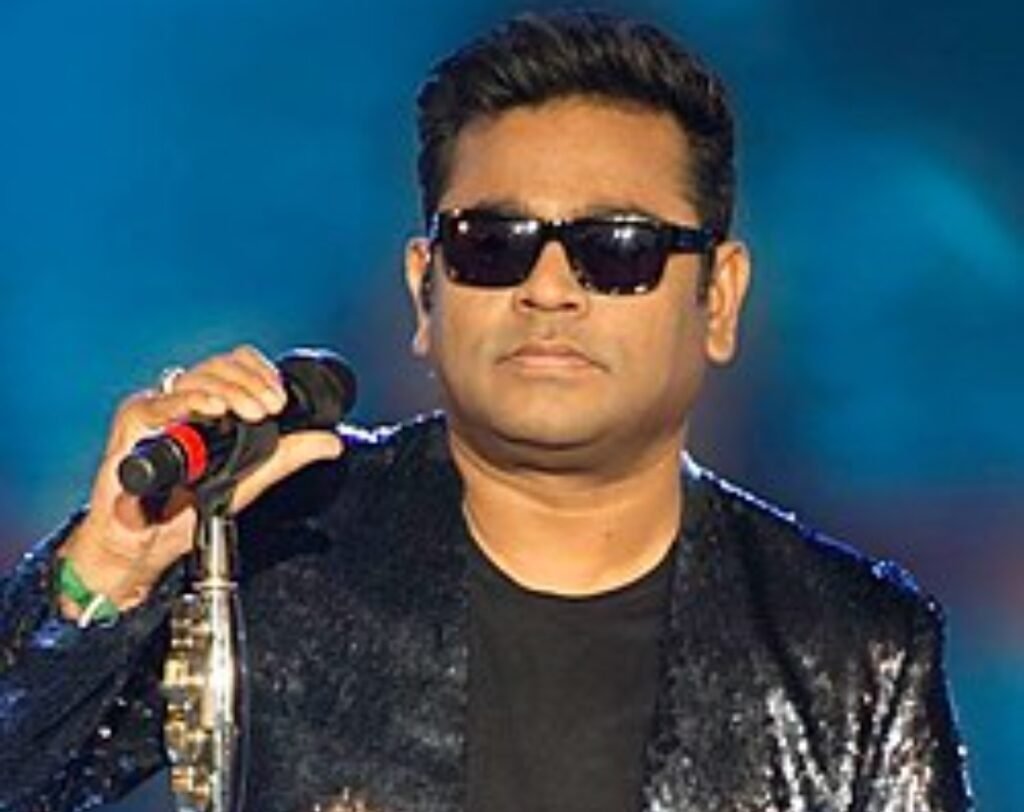
The recent uproar over AR Rahman’s role in composing for Nitesh Tiwari’s epic Ramayana—coupled with his honest insights into communal biases affecting his Bollywood career—exposes a disheartening pattern where exceptional talent is dragged into the muck of division.
As a Muslim artist boldly scoring a film steeped in Hindu mythology, Rahman stands as a shining example of unity, innovation, and boundary-breaking artistry. Yet, this has predictably ignited backlash from small-minded critics, especially BJP leaders and their Hindutva affiliates, who appear determined to distort his message into communal bait.
It’s time to stand firmly with Rahman, honoring his unmatched brilliance while calling out the bigotry of those who attack him.First and foremost, let’s celebrate AR Rahman for the national treasure he is: a composer whose work has not only propelled Indian cinema onto the world stage but has also knit together the diverse threads of our society.
AR Rahman, born as AS Dileep Kumar (also referred to as Dileep Kumar Rajagopala) on January 6, 1967, in Madras (now Chennai), Tamil Nadu, grew up in a Hindu family with deep roots in music.His father, R. K. Shekhar, belonged to a Vellalar (Tamil) family and was a respected film score composer and conductor, primarily working in Malayalam and Tamil cinema.
From a very young age, Dileep showed musical talent, beginning piano lessons at age four and assisting his father in the studio.Tragedy struck early when his father passed away from cancer when Dileep was just nine years old. This left the family—including his mother (originally named Kashturi, later Kareema Beegum after conversion), Dileep, and his siblings—in financial hardship.
They survived partly by renting out his father’s musical equipment.Raised in this challenging environment, young Dileep was immersed in music, playing keyboards, joining bands, and eventually pursuing it professionally, even dropping out of school to focus on his career as a musician. He came from a practicing Hindu household influenced by his mother’s spiritual inclinations, which later led the family toward Sufism before their conversion to Islam in 1989, when he was 23.
But his music has always championed inclusivity. Think of the electrifying Jai Ho from Slumdog Millionaire, which earned him Academy Awards in 2009 and showcased Indian beats to global audiences, or spiritual gems like Kun Faya Kun in Rockstar, and the stirring patriotism of Vande Mataram.
His partnership with Jewish legend Hans Zimmer on Ramayana—a story drawn from ancient Hindu scriptures—is a powerful nod to his open-hearted approach.
During his BBC Asian interview, Rahman shared how his time at a Brahmin school exposed him to the Ramayana and Mahabharata, instilling lessons in virtue and lofty ideals that go beyond religion. He referenced Islamic teachings on valuing knowledge from any corner, whether from a monarch or a pauper, and called for transcending “small-mindedness and selfishness.”
This isn’t mere music-making; it’s a heartfelt plea for cultural synergy in a nation enriched by traditions like the Sufi-Bhakti blend.Rahman’s disclosures about a “communal thing” slowing his Bollywood trajectory since 2018—leading to fewer Hindi projects amid his thriving Tamil and international work—hit close to home in our increasingly divided times.
He didn’t point fingers or whine; he simply noted the evolving power structures in the industry. This isn’t unfounded suspicion—it’s a mirror to wider societal issues where artists from minority backgrounds encounter quiet barriers.
With a resume boasting over 300 films, Grammys galore, and a legacy that has elevated India’s global profile, suggesting his dip is purely about talent ignores the obvious: the surge in majoritarian attitudes that favor uniformity over diversity.
By voicing this, Rahman displays bravery, inspiring others to confront these imbalances. He merits our solid backing, not only as a tunesmith but as an emblem of endurance against efforts to flatten India’s colorful diversity.
Shifting focus to his critics—led by BJP figures and their ideological partners—their reactions have been utterly reprehensible, laying bare the communalism they so adamantly reject.
Take Union Minister Ramdas Athawale, a BJP allies, who brushed off Rahman’s concerns as baseless, citing successful Muslim talents as evidence.
How shortsighted! This reflexive rejection smacks of double standards from a party frequently criticized for cultivating an environment where faith trumps ability.
Athawale’s comments aren’t just oblivious; they’re a calculated erasure of the systemic prejudices many minorities face across fields, entertainment included.
And then there’s the Vishwa Hindu Parishad (VHP), a Hindutva group tied to the BJP’s network, which absurdly proposed Rahman opt for ‘Ghar Wapasi’—reverting to Hinduism—to revive his opportunities.
This isn’t feedback. It’s intolerant coercion, a crude bid to intimidate a worldwide icon. Statements from these pro-Hindu entities, often mirroring the BJP’s cultural agenda, unmask their agenda.
They’re not championing fairness; they’re imposing a dominant grip on creativity and chances.These BJP players in the fray—via outright declarations or quiet support of allies—represent the nadir of cynical politics.
They accuse Rahman of injecting communalism into Bollywood while their own actions and words have splintered society on religious grounds. This is the same apparatus that promotes movies like The Kashmir Files for advancing particular viewpoints, but balks when a Muslim creator spotlights marginalization.
Their assaults on AR Rahman aren’t rooted in reality; they’re about dominance, ensuring tales of togetherness don’t undermine their polarizing strategy.
It’s disgraceful how they’ve morphed a reflective artist’s thoughts into a partisan skirmish, all under the banner of ‘Sabka Saath, Sabka Vikas.’
In truth, their outcry only reinforces Rahman’s observation: in their realm, minority achievements come with caveats, and truth-telling invites smears.
The slowdown in AR Rahman’s Bollywood projects over the past eight years isn’t primarily about religion or overt bias—though he has alluded to subtle “communal whispers” in passing—but stems from deeper, structural shifts in the Hindi film music ecosystem that have made his distinctive style less aligned with current demands.
While AR Rahman’s genius remains undeniable, and he continues to thrive in Tamil cinema, international work, and select high-profile Hindi ventures (like Chhaava in 2025 and the upcoming Ramayana), the reasons for fewer mainstream Bollywood assignments are multifaceted and largely industry-driven.
First and foremost, AR Rahman’s golden era in Bollywood was tied to a specific generation of visionary directors who treated him as their go-to composer and gave him creative freedom to craft expansive, soulful soundtracks.
Think Mani Ratnam (with whom he created timeless classics like Roja, Bombay, Dil Se, and more recently Thug Life), Subhash Ghai (Taal, Yuvvraaj), Ram Gopal Varma (Rangeela, Daud), and Ashutosh Gowariker (Lagaan, Swades).
These filmmakers operated in an era where music was a film’s heartbeat—long-form albums with poetic depth, intricate arrangements, and narrative integration.
Most of these directors have either stepped back from mainstream Hindi cinema, retired, shifted to OTT/regional projects, or faced their own career ebbs. When that personal ecosystem dissolved, Rahman’s automatic entry point vanished.
Newer or corporate-backed filmmakers rarely build such long-term, trust-based collaborations; instead, they opt for quick-turnaround, multi-composer teams where one person handles the “hook” song, another the background score, diluting the singular artistic vision Rahman excels at.
Secondly, Bollywood’s music industry has undergone a profound transformation since around 2015–2018, prioritizing instant virality over longevity. Today’s hits thrive on short, reel-friendly hooks—30-second earworms designed for Instagram Reels, TikTok (or its successors), and streaming playlists—delivering immediate gratification through repetitive beats, rap features, EDM drops, or Punjabi-infused party anthems.
Trend-driven sound design rules: heavy auto-tune, bass-heavy production, label-orchestrated singles released pre-film to build buzz, and remakes/rehashes that recycle nostalgia. AR Rahman’s forte has always been layered, emotive compositions—sweeping orchestration, fusion of classical Indian elements with global sounds, and songs that unfold over full albums rather than snippets.
He doesn’t chase trends; he sets them through innovation and depth. In an industry now dominated by faster, cheaper, more adaptable composers who deliver exactly what producers and music labels demand (often at lower costs and with quicker revisions), AR Rahman’s meticulous, time-intensive process feels like a mismatch.
As one industry observer noted in recent discussions, mid-tier projects can’t afford both a big star and AR Rahman’s fees or schedule, pushing producers toward “safer,” trend-aligned options.
Third, the very space for original, auteur-driven film music has shrunk dramatically. The rise of corporate control—music companies, streaming giants, and non-creative decision-makers calling shots—has fragmented projects into multi-composer albums, pre-packaged singles, and viral-focused tracks.
Remakes dominate, rap collaborations flood charts, and labels push formulaic sounds for algorithmic success. AR Rahman’s approach doesn’t fit this assembly-line model; he thrives when given room to experiment and elevate the story musically.
Meanwhile, a new crop of composers has filled the gap by being more flexible, prolific, and attuned to these shifts—making them the default “market fit” for most producers.Importantly, this isn’t a decline in
AR Rahman’s talent or relevance—far from it. Between 2019 and 2025, he composed for 20–30 films across languages, including acclaimed Tamil epics like Ponniyin Selvan and Hollywood ventures. His recent Bollywood outputs, though sparse (Tere Ishk Mein in 2025, for instance), still carry his signature magic when the project allows it.
He has intentionally slowed down, avoiding “bad intention” films and prioritizing family and meaningful work over chasing quantity. The “dominant phase” for any artist naturally evolves; AR Rahman’s peak Bollywood dominance (1990s–2010s) has transitioned to a selective, global phase where quality trumps volume.
In essence, AR Rahman’s reduced Bollywood footprint reflects an industry that has changed more than the man himself. Bollywood now rewards speed, trends, and corporate alignment over the kind of profound, boundary-pushing artistry that made him a legend.
He hasn’t “failed to adapt”—he’s stayed true to his craft in an industry that no longer values it as highly in the mainstream Hindi space. That’s not a failing on his part; it’s a commentary on what Bollywood music has become.
In the controversy surrounding him, AR Rahman refuses to be pigeonholed as a token in religious gamesmanship. He is India’s premier musical genius, a pioneer who has internationalized our sounds while honoring their origins.
Efforts to fracture the nation by treating him as “property” for partisan ends are doomed; his enduring impact binds us together. India aligns with Rahman, cheering his artistry and spurning the toxin of bias. Let’s elevate his melodies over the clamor of discord—because in our grand national chorus, unity always outshines strife.