


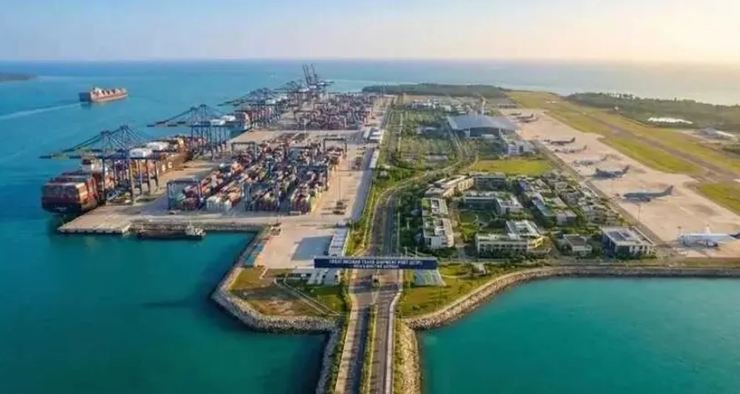
There is a curious phenomenon in India. Every time the nation attempts to undertake a project of genuine strategic significance, a familiar chorus emerges. Ports become ecological crimes. Airports become symbols of colonialism. Roads become instruments of cultural destruction. Development itself is placed on trial. The Great Nicobar Island Project is the latest battleground in this recurring national argument.
Yet beneath the noise lies a far more important question: Can India afford to leave one of the world’s most strategic maritime locations underdeveloped while the geopolitical landscape around it changes at breakneck speed?
The answer is no.
The Rs 90,000-crore Great Nicobar Island Project is not merely an infrastructure scheme. It is not just about a transshipment port, an airport, power generation facilities, or a modern township. It is about India’s place in the Indo-Pacific. It is about whether the country intends to shape the maritime century or merely watch others do so.
For decades, India has been blessed with a strategic geography that many nations would envy. Great Nicobar sits near the Six Degree Channel, one of the busiest maritime routes on the planet. A substantial portion of global trade passes through these waters, connecting the economies of East Asia with Europe, Africa, and the Middle East.
Geography handed India an extraordinary advantage. Successive governments largely ignored it.While New Delhi debated, delayed and drifted, China moved with purpose.
Over the last three decades, Beijing has steadily expanded its presence across the Indian Ocean through ports, logistics hubs and maritime infrastructure stretching from Pakistan’s Gwadar to Sri Lanka’s Hambantota, from Myanmar’s Kyaukpyu to its military base in Djibouti. Every project is officially described as commercial. Every facility is presented as an economic partnership. Yet nobody seriously involved in strategic affairs believes these investments are devoid of geopolitical implications.
History teaches a simple lesson: commerce and power have always travelled together. China understands this reality. India is only now beginning to act on it.
This is what makes Great Nicobar important.
A modern transshipment port at Galathea Bay would strengthen India’s role in regional trade. A strategically positioned airport would enhance connectivity and logistics. Expanded infrastructure would improve India’s ability to monitor critical sea lanes and support maritime operations in a region of growing geopolitical competition.
At present, a large share of India’s transshipment cargo is handled by foreign ports. This dependence is neither economically efficient nor strategically desirable. Nations aspiring to become major powers do not outsource critical maritime infrastructure indefinitely.
The strategic rationale behind Great Nicobar is therefore difficult to dispute. What is far more difficult—and far more important—is ensuring that strategic ambition does not come at the expense of constitutional principles.
This is where the debate becomes more complex than either side often admits. Supporters of the project sometimes treat every criticism as anti-national obstructionism. Opponents sometimes behave as though national security concerns are irrelevant. Both positions are intellectually lazy.
The Nicobarese people are not obstacles to development. Nor are they inconvenient footnotes in a national security document. They are citizens of India. Their rights exist not because governments choose to grant them but because the Constitution protects them.
The allegations raised by the Nicobar Tribal Council regarding pressure to surrender ancestral lands therefore deserve serious attention. The Council has repeatedly questioned whether rights under the Forest Rights Act have been properly identified, recognized and settled. It has alleged attempts to obtain consent through mechanisms that many tribal representatives consider coercive or inadequate.
Whether every allegation is ultimately upheld in court is a matter for judicial determination. However, dismissing such concerns outright would be a mistake.
India cannot claim to be defending sovereignty in the Indian Ocean while appearing indifferent to the rights of some of its most vulnerable indigenous communities.
The Forest Rights Act was enacted to correct historical injustices suffered by forest-dwelling communities. If individual and community rights remain unsettled, they must be settled transparently. If consultations have been inadequate, they must be conducted properly. If consent has not been obtained in a genuinely free, prior and informed manner, the process must be revisited.
Strategic necessity cannot become a license for administrative shortcuts. In fact, the greater the strategic importance of a project, the greater the responsibility of the state to ensure that every legal safeguard is respected.
India should resist the temptation to imitate the development model of authoritarian states. China’s approach often prioritizes strategic objectives first and addresses local concerns later, if at all. India should aspire to a higher standard—one where infrastructure, national security and constitutional rights reinforce rather than undermine one another.
This is not merely a legal obligation. It is a strategic one. Projects imposed through coercion generate resentment. Projects built through consultation generate legitimacy. The difference matters.
The future success of Great Nicobar will not depend solely on engineering expertise or financial investment. It will depend on whether the people most directly affected by the project believe they have been treated with dignity, fairness and respect.
The choice before India is therefore not between development and tribal rights.
That is a false choice. Nor is the choice between environmental protection and national security.
That too is a false choice.
A confident nation should be capable of protecting its indigenous communities while strengthening its strategic position. It should be capable of safeguarding biodiversity while building critical infrastructure. It should be capable of advancing national interests without abandoning constitutional principles.
The real danger facing India today is not development. It is strategic paralysis on one hand and developmental arrogance on the other.
The first leaves the nation vulnerable. The second undermines the very values the nation seeks to defend. Great Nicobar offers India an opportunity to avoid both mistakes.
As China expands its influence across the Indian Ocean, India is right to recognize the strategic value of Great Nicobar. The project should move forward. The geopolitical realities are too significant to ignore.
But it must proceed lawfully, transparently and with the informed participation of the Nicobarese people. India must not repeat the mistake of strategic inaction. Neither should it repeat the mistakes of dispossession disguised as progress.
The Great Nicobar project should be built. The question is not whether it should be built, but whether it will be built in a manner worthy of a constitutional democracy.
That is the real test before India.