


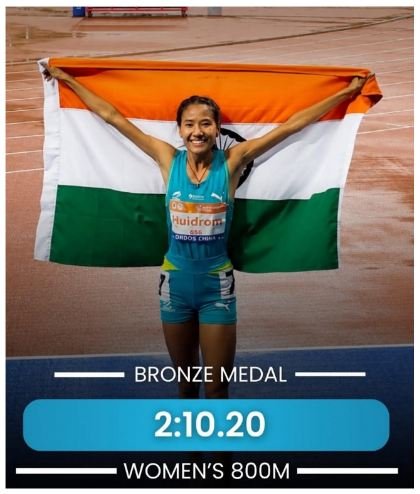
When Bhumeshwory Devi Huidrom stood with the Indian tricolour after winning bronze in the women’s 800m event at the Asian U23 Athletics Championships 2026 in Ordos, China, it was more than a personal triumph. It was a proud moment for Manipur and India. Her timing of 2:10.20 placed her on the continental podium and brought attention to a discipline that does not always receive the public celebration it deserves in the state.
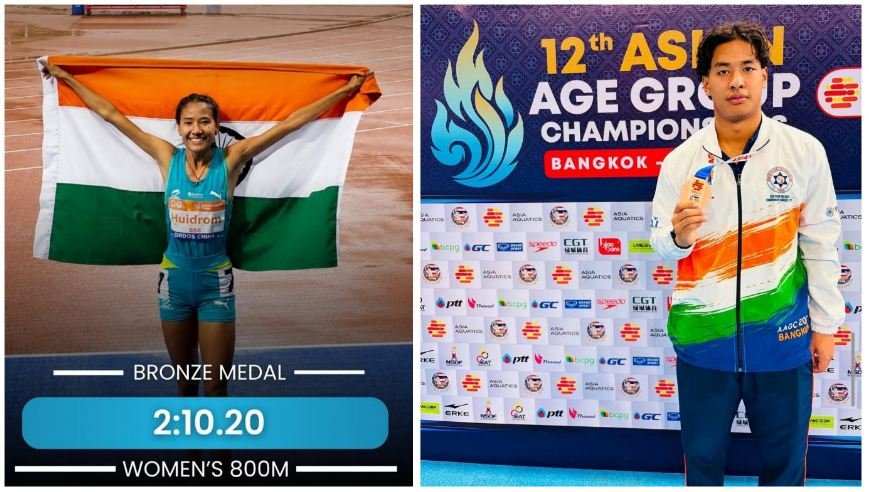
Soon after, another young Manipuri sportsperson, Laitonjam Lanchenba, added to this sense of pride by winning bronze in the 100m Butterfly event at the 12th Asian Age Group Aquatic Championships 2026 in Bangkok, Thailand. Competing in the 15 to 16 years category, he clocked 55.35 seconds and represented India with distinction.
These two achievements deserve to be seen together.
When Manipur speaks of sport, the conversation usually begins with football. It then moves naturally to weightlifting, boxing, judo, taekwondo, hockey, wushu, fencing and other disciplines that have repeatedly brought honour to the state and the country. This is understandable. These sports have produced icons, built public memory, and shaped Manipur’s reputation as one of India’s most remarkable sporting regions.
But the medals won by Bhumeshwory Devi and Lanchenba tell us something important. Manipur’s sporting promise is much wider than the disciplines that usually dominate public attention.

Bhumeshwory’s bronze in the 800m is significant because middle distance running demands a rare combination of speed, endurance, tactical intelligence and mental discipline. It is not a sport where success can be achieved through natural ability alone. It requires scientific training, proper recovery, nutrition, race exposure and long-term coaching support. For a Manipuri athlete to reach the Asian podium in such an event should be treated as a major moment for athletics in the state.
Lanchenba’s bronze in swimming is equally important. Swimming is not among the first disciplines that comes to mind when the public discusses Manipur’s sporting strength. Competitive swimming requires a different institutional base: standard pools, technical coaching, modern timing systems, regular exposure, nutrition support and structured talent development. His achievement proves that young Manipuri athletes can excel even in sports where the state has not historically built a strong public identity.
The larger question, therefore, is not whether Manipur should celebrate these medals. It must. The real question is whether Manipur will learn from them.
For decades, Manipur’s sporting success has been built on individual sacrifice, family commitment, community support and extraordinary discipline. Many athletes have risen not because the system was always ready for them, but because they endured despite its limitations. Families have carried the burden of travel, equipment, nutrition and coaching. Coaches have worked with inadequate infrastructure. Young athletes have trained with ambition greater than the facilities available to them.
That is why these two bronze medals must not be allowed to pass as brief social media moments. They should be treated as policy indicators.
They tell us that athletics needs deeper investment. Proper tracks, district level competitions, endurance programmes, sports science support, physiotherapy, transparent selection and regular exposure outside the state must become part of a serious plan. A runner cannot be produced only through occasional competitions. She must be supported through years of planned development.
They also tell us that swimming needs institutional attention. Manipur needs more competition standard pools, trained coaches, regular state championships, school level swimming programmes and clear pathways from district pools to national camps. A young swimmer like Lanchenba should not be an isolated success. He should become the beginning of a stronger swimming culture in the state.
Public celebration has value because recognition inspires the next generation. A medal won by Bhumeshwory Devi can encourage a young girl to take athletics seriously. A medal won by Lanchenba can encourage a young boy or girl to see swimming as more than recreation. Sporting culture becomes stronger when children are allowed to choose disciplines according to aptitude, body type, interest and opportunity.
A small state cannot afford a narrow sports policy. Manipur’s strength lies in its social respect for sport. In many parts of India, sport is still treated as an activity outside the main concerns of education and career. In Manipur, sport is part of public life. Local grounds, neighbourhood clubs, school competitions, family encouragement and community pride have created a strong sporting base. But this base now requires modernization.
The next stage of Manipur’s sporting development must move from admiration to planning.
The Khelo India initiative has already given Manipur an institutional framework on which a broader sporting future can be built. The Khuman Lampak Sports Complex in Imphal has been identified as a Khelo India State Centre of Excellence, with priority given to archery, hockey and weightlifting.
SAI facilities in Manipur have also supported disciplines such as athletics, boxing, football, taekwondo, cycling, fencing, kabaddi, sepaktakraw and wushu, while the Special Area Games Centre at Utlou has focused on boxing, football, taekwondo and weightlifting. These priorities have strengthened several disciplines in which Manipur already enjoys public recognition.
But the recent medals won by Bhumeshwory Devi in athletics and Lanchenba in swimming indicate that the next phase of sports planning must be wider. Track events, aquatic sports and other emerging disciplines should not remain dependent on individual determination alone. They must be brought into the centre of Manipur’s sports policy.
Besides, the Department of Youth Affairs and Sports, state associations, national federations, schools, colleges, private academies and local clubs must work with greater coordination. Associations must not exist only to send teams to competitions. They must build pathways.
A child from Imphal East, Bishnupur, Thoubal, Kakching, Churachandpur, Ukhrul, Senapati, Chandel, Noney, Tengnoupal or Jiribam should know where to train, whom to approach, what competitions to enter, and how to progress from district level to national level.
The achievements of Bhumeshwory Devi and Lanchenba also carry a larger public meaning. At a time when Manipur has been weighed down by conflict, uncertainty and social division, sport continues to offer a rare space of shared pride. A medal won by a Manipuri athlete abroad is not the possession of one locality, one community or one association. It belongs to the people of the state and to India.
This does not mean sport can solve political or social crises. That would be an exaggeration. But sport can remind a society of its productive energies. It can give young people discipline, ambition and confidence. It can show that Manipur is not only a place of difficulty, but also a place of excellence.
Bhumeshwory Devi Huidrom and Laitonjam Lanchenba have done more than win bronze medals. They have widened Manipur’s sporting imagination. They have shown that the state’s next champions may come from the track, the pool and other less discussed arenas.
Football, boxing, weightlifting, judo and taekwondo will remain central to Manipur’s sporting identity. But athletics, swimming and other disciplines must now receive their rightful attention.
The celebration should begin with pride. The planning must begin with seriousness.


Naorem Mohen is the Editor of Signpost News. Explore his views and opinion on X: @laimacha.