


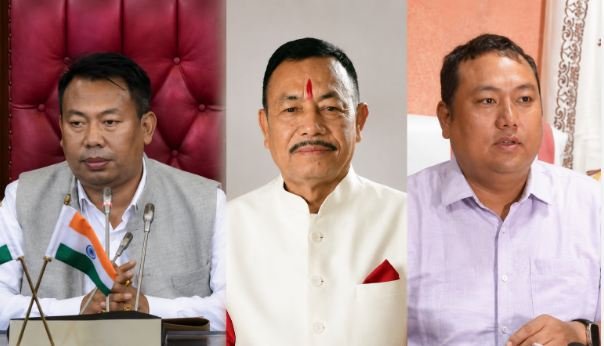
July 26, 2026 may come to be remembered as an important day in Manipur’s political calendar. On that day, at different public programmes held in different parts of the state, three senior leaders of the Bharatiya Janata Party spoke openly about the functioning of the government, the suffering of the people, and the continuing abnormality of life in Manipur.
The significance of these statements lies not only in what was said, but also in who said it. These were not voices from the Opposition. They came from within the ruling party itself.
Manipur Assembly Speaker Thokchom Satyabrata, former minister L. Susindro Singh (Yaima), and MLA Sapam Kunjakeswor Singh (Keba), spoke from separate platforms on the same day. Each of them, in different words, expressed concern over the condition of the state and the manner in which the government is responding to public hardship.
This cannot be dismissed as coincidence. When several senior leaders from the ruling party speak in almost the same moral and political register, it must be read as a signal. It is not merely personal opinion. It reflects a wider discomfort that has begun to surface inside the ruling establishment.
The political meaning is clear. The leaders who spoke are not marginal figures. They are experienced elected representatives associated with the BJP. If leaders from within the ruling party repeatedly speak of public suffering, administrative inadequacy, and the urgent need to restore normal life, their words inevitably raise questions about the leadership and functioning of the government headed by Chief Minister Yumnam Khemchand Singh.
This also suggests that the expected communication and coordination between the government and its elected representatives may have weakened. In a parliamentary democracy, governance does not rest only on official orders and administrative files. It also depends on trust within the ruling party, regular consultation with elected representatives, and the ability of the government to respond to the anxieties of the public.
The statements made on July 26 indicate that this chain of political communication may no longer be functioning as smoothly as it should. These are not warnings from outside the system. They are warnings from within.
Speaker Thokchom Satyabrata’s observation that the Meitei community is unable to move beyond Sekmai in the north and Kakching Lamkhai in the south is not an ordinary political remark. It is a public acknowledgement of a reality that ordinary people have been living with for the past three years. His comment that people may own expensive vehicles but still cannot travel freely captures the paralysis of normal life in a state where mobility has become restricted by fear, insecurity, and ethnic division.
Movement is one of the most basic signs of normalcy. When citizens cannot move freely within their own state, the issue goes beyond inconvenience. It becomes a question of constitutional authority, public confidence, and the credibility of governance. Roads, markets, workplaces, schools, hospitals, and public institutions lose their meaning when citizens are unable to access them safely.
Former minister L. Susindro Singh was even more direct. He stated that if a government does not work according to the wishes and aspirations of the people, there is no justification for remaining in party and power. MLA Sapam Kunjakeswor Singh expressed a similar sentiment when he said that power has no value if it is not used for the welfare of the people.
These statements carry a common message. The suffering of the people is no longer only an Opposition issue. It is now being acknowledged within the ruling party itself. That is what makes the development politically important.
For the past three years, the people of Manipur have waited for peace, free movement, security, and the restoration of ordinary life. The conflict has changed the social geography of the state. Communities have become separated. Travel has become uncertain. Administrative confidence has been strained. Public patience has been tested repeatedly.
In such a situation, the ruling party cannot assume that electoral strength alone will absorb public anger. Political legitimacy is not sustained by numbers alone. It is sustained by the ability to protect citizens, restore confidence, and provide a credible path out of prolonged uncertainty.
The timing of these statements is also important. The 2027 Assembly election is gradually approaching. As the election draws nearer, MLAs will have to return to their constituencies and face voters directly. They will be asked difficult questions. People will ask why normal life has not returned. They will ask why movement remains restricted. They will ask why promises of peace and stability have not produced visible results.
It is likely that many elected representatives are already feeling this pressure. Public statements of this nature often emerge when leaders sense that silence has become politically costly. In normal circumstances, ruling party legislators avoid open criticism of their own government. When they speak publicly, it usually means that discontent at the ground level has become too strong to ignore.
There is also another way to read these statements. In a democracy, the role of elected representatives is not merely to defend the government. Their first duty is to represent the people. If people are suffering, elected representatives are expected to carry that suffering into the political system. They are expected to speak when silence becomes irresponsible.
Seen in that sense, the statements made by these BJP leaders may also be viewed as an act of democratic responsibility. The real question is not whether they should have spoken. The real question is whether the government will listen.
The central issue now lies before both Imphal and Delhi. Manipur has a BJP government in the state, and the same party leads the government at the Centre. This creates both responsibility and opportunity. The Centre cannot treat these voices as routine local dissatisfaction. The state government cannot dismiss them as isolated remarks. Together, they reflect a warning that the political patience of the people is wearing thin.
The BJP’s central leadership must ask whether the present approach is sufficient. Has normal movement been restored? Has public confidence returned? Are deadline for safe resettlement of IDPs successfully achieved? Are citizens able to live without fear across the state? Do elected representatives feel adequately consulted? Are administrative decisions being communicated with political sensitivity? These questions cannot be postponed until the election campaign begins.
The restoration of normalcy in Manipur cannot be reduced to official statements. It has to be experienced by citizens in their daily lives. A person should be able to travel without fear. A patient should be able to reach a hospital. A student should be able to attend an institution. A trader should be able to move goods. A family should be able to visit relatives. Until these ordinary freedoms return, political claims of stability will remain incomplete.
History shows that the greatest threat to any ruling party is not always the Opposition. It is the erosion of public trust. Opposition parties can attack from outside, but trust collapses from within. Once people begin to believe that the government is unable or unwilling to respond to their suffering, recovery becomes difficult.
That is why the statements made by Speaker Thokchom Satyabrata, former Minister L. Susindro Singh, and MLA Sapam Kunjakeswor Singh deserve serious attention. They are not merely comments made at public functions. They are political indicators. They show that the unease felt by ordinary citizens has begun to travel upward into the ruling party’s own ranks.
The government still has time to respond. The next Assembly election is not tomorrow. But political time moves faster than administrative time. If corrective steps are delayed, public dissatisfaction may harden into electoral judgment. The warning signs are already visible.
What is required now is not denial, but course correction. The government must rebuild communication with its own representatives. It must take visible steps to restore secure movement. It must engage seriously with public grievances. It must show that power is being used not merely to remain in office, but to restore the dignity and security of citizens.
The events of July 26, 2026 should therefore be treated as a moment of political introspection. If the BJP leadership, both in the state and at the Centre, reads these voices carefully and acts with maturity, the day may later be remembered as a turning point. It could become the moment when the ruling party recognized the depth of public suffering and began to correct its course.
But if these voices are ignored, the consequences may extend beyond internal party discomfort. Public resentment may grow. Electoral pressure may intensify. The gap between government claims and people’s lived reality may become harder to bridge.
Manipur does not need more political management. It needs restoration of normal life. It needs safe movement, credible governance, and renewed public trust. The BJP’s own senior leaders have now publicly acknowledged that these expectations remain unfulfilled.
The question before the government is simple but serious: will it hear the warning from within, or will it wait until the people deliver their verdict in 2027?