China’s Ministry of Agriculture and Rural Affairs dropped a series of eye-opening figures at a high-profile press conference on Thursday, painting a picture of an agricultural sector transforming at breakneck speed.
Vice Minister Zhang Xingwang revealed that the contribution rate of agricultural scientific and technological progress exceeded 64 percent in 2025 — a clear signal that tech, not just traditional labor or land expansion, is now the dominant engine powering the world’s largest farming economy.
This isn’t incremental improvement. It’s a strategic power play. Facing climate volatility, shrinking rural workforces, and the imperative for food self-sufficiency, Beijing has doubled down on innovation across seeds, machinery, and digital systems.
The results? Record grain output (over 715 billion kilograms, up 1.2% year-on-year), near-total independence in key genetic resources, and widespread deployment of futuristic tools like drones and AI-driven farming.
Seed Security: Domestic Varieties Now Rule the Fields
At the heart of China’s agricultural independence push lies the revitalization of its seed industry. Domestically bred crop varieties now cover more than 95 percent of the nation’s planted area — a staggering achievement that sharply reduces vulnerability to foreign seed suppliers and supply-chain disruptions.
The numbers extend beyond staple grains: domestic seed sources command 80 percent of the livestock and poultry market, 86 percent for aquatic products, and 91 percent for vegetables. These figures, announced by Zhang, mark the successful culmination of years of focused policy to build a self-reliant seed ecosystem capable of delivering high-yield, resilient varieties tailored to China’s diverse climates and soils.
From Manual to Machine: Mechanization Hits 76.7%
The mechanization revolution is equally dramatic. The comprehensive mechanization rate for crop cultivation, planting, and harvesting climbed to 76.7 percent in 2025, bringing major crop production close to full automation. This leap addresses chronic rural labor shortages and boosts efficiency on a massive scale.
Particularly striking is the drone boom. China now operates more than 300,000 agricultural drones, with annual coverage exceeding 460 million mu (about 30.67 million hectares). These unmanned aerial systems handle precision pesticide application, crop monitoring, and data collection, slashing input costs and environmental impact while enabling rapid response across vast territories.
Breakthrough Science: Heat-Tolerant Rice and Beyond
Perhaps the most geopolitically and climatically significant advance is in basic and frontier research. Chinese scientists cloned the world’s first heat-tolerance gene in rice, a discovery hailed as a game-changer for maintaining stable, high-quality rice yields under extreme high-temperature conditions — precisely the kind of stress increasingly common due to global warming.
This breakthrough, spotlighted by Zhou Yunlong from the ministry’s science and technology department, joins other major feats: unraveling the mechanism of single somatic cell regeneration into complete plants (opening new paths for genetic improvement and rapid crop regeneration) and original innovations in agricultural bio-manufacturing.
The “AI + Agriculture” layout has accelerated dramatically. Large AI models for smart farming are being iteratively refined and deployed in real-world scenarios, optimizing planting decisions, resource use, and yield predictions.
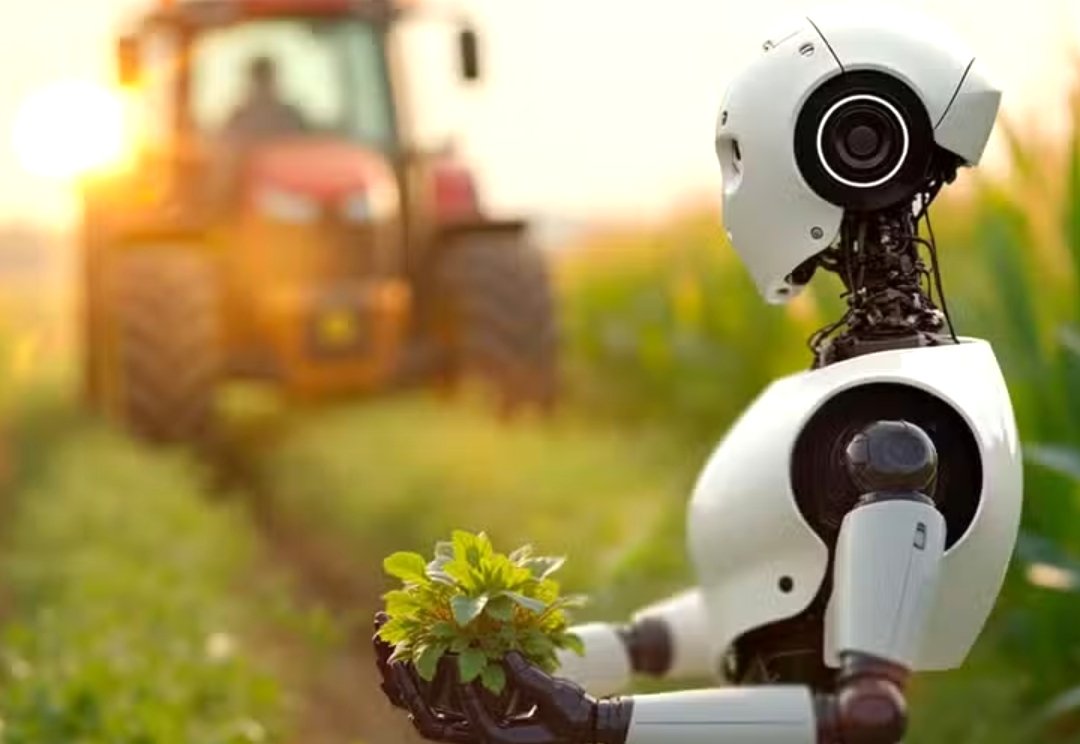
Meanwhile, new-energy machinery and agricultural robots are overcoming longstanding barriers in hilly and mountainous regions, where conventional equipment often fails.
Companies Investing in Agricultural Robots
Several prominent Chinese companies are leading the charge in deploying and manufacturing agricultural robots (including ground-based systems for weeding, harvesting, planting, spraying, and more), as well as complementary tech like drones that integrate into smart farming ecosystems.
Some key players actively using or developing farm robots in China includes XAG (also known as XAG Co., Ltd.). This is one of the largest and most influential in the sector, it develops and deploys intelligent agricultural machinery, including autonomous spraying systems, self-driving equipment, and robotic solutions for precision farming. Their tech is widely used across China’s vast farmlands to boost efficiency and reduce chemical use.
Jiangsu Lanjiang Intelligent Technology specializes in intelligent agricultural machinery, offering robotic systems for orchard plant protection, automated spraying, transportation, weeding, and targeted weed control to minimize pesticide overuse.
Suzhou Botian Agricultural Robot (SUZHOU BOTIAN) focuses on fruit and vegetable harvesting robots, field weeding robots, greenhouse agricultural robots, and plant protection robots. Backed by research from China Agricultural University and Suzhou University, they aim to pioneer scalable ag robotics in China.
Maifei Technology develops smart agricultural robotics and machinery, contributing to automated farming solutions for various crops and environments.
Shanghai Sweet AI Technology is known for deploying practical farm robots (e.g., weeding robots capable of covering large areas like 500 mu per day), controlled via mobile apps like WeChat. Their CEO has emphasized replacing backbreaking manual labor with accurate, tireless machines.
TopXGun and Rippton are two more companies which produces unmanned aerial vehicles (drones) heavily used in agriculture for spraying, seeding, and monitoring, often integrated with ground robot systems for full-field automation.
The Bigger Picture: Precision, Efficiency, Resilience
Vice Minister Zhang framed the trajectory clearly: “Modern technologies are being applied more widely in agriculture. We will continue to promote the application of artificial intelligence and other technologies in the agricultural sector, expanding the use of drones, the Internet of Things, robots, and other scenarios to make production more precise and efficient.”
These advances arrive against the backdrop of China’s 2025 grain harvest hitting yet another historic high, reinforcing the link between technological investment and tangible food security gains. As extreme weather events intensify worldwide, China’s combination of genetic resilience, robotic automation, and AI integration positions it not just as a major producer, but as a frontrunner in climate-adaptive agriculture.
In reality, 2025 wasn’t just another year of steady progress — it was the year China’s agricultural sector decisively pivoted to a high-tech, self-reliant future, with heat-proof rice, AI-managed fields, and farm robots leading the charge.