


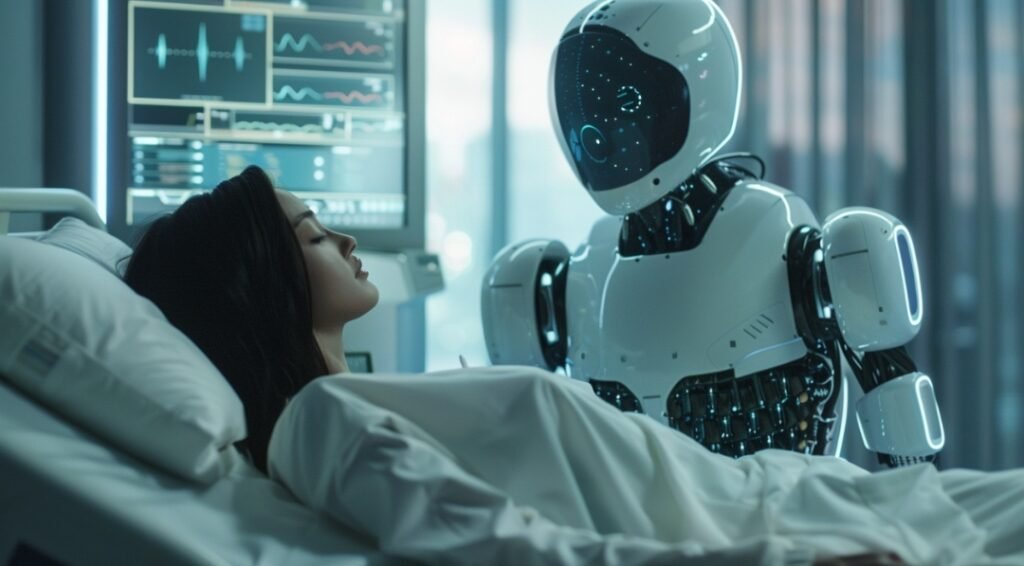
In a bid to fully exploit AI, China has unveiled the world’s first fully AI-operated hospital, a revolutionary milestone that could redefine the future of healthcare. This cutting-edge facility, powered by 14 AI doctors and 4 AI nurses, is designed to autonomously treat up to 3,000 patients daily, leveraging real-time data, advanced medical imaging, and comprehensive patient histories to deliver precise diagnoses and tailored treatment plans. By harnessing the capabilities of China’s leading medical AI platform, this hospital promises to transform healthcare delivery, offering faster, more cost-effective, and potentially more accurate care than traditional human-led systems. As the world watches this bold experiment unfold, questions arise about its implications for patients, healthcare professionals, and the global medical industry.
China is rapidly transforming the global healthcare landscape with its ambitious integration of artificial intelligence into medical systems. By deploying cutting-edge AI tools across hospitals nationwide, the country is setting a new standard for healthcare delivery. With a staggering projected investment of over US$1.4 trillion in AI development by 2030—a figure surpassing the GDP of many nations—China is not only advancing technology but also reimagining the future of medicine. At the forefront of this revolution is the world’s first fully AI-operated hospital, a pioneering effort that blends virtual AI agents, clinical expertise, and real-world applications into a seamless, transformative system. This initiative, alongside other AI-driven healthcare innovations, signals a bold leap toward faster, more accurate, and accessible medical care.
The Dawn of the AI Hospital
In 2024, Tsinghua University captured global attention with the launch of Agent Hospital, the world’s first fully AI-operated medical facility. This groundbreaking concept integrates 14 AI doctors, powered by the university’s self-evolving AI framework, MedAgent-Zero, developed by the Institute for AI Industry Research (AIR).
By November 2024, this vision expanded with the introduction of the “Zijing AI Doctor,” a sophisticated system created by Zijing Zhikang, a Tsinghua University spin-out. The Zijing AI Doctor now features 42 AI doctors across 21 clinical specialties, capable of diagnosing over 300 diseases with a remarkable 93% accuracy rate. These AI agents have been trained on more than ten common conditions per specialty and rigorously tested on a pool of 500,000 synthetic patient cases, enabling them to treat 10,000 virtual patients in days—a task that would take human doctors years.
Unlike traditional chatbots, these AI doctors operate within a closed-loop ecosystem, autonomously interacting with AI-generated patients to simulate real-world clinical scenarios. This closed-loop environment, tested extensively in November 2024, allowed for rapid refinement of the AI’s diagnostic and treatment capabilities. By simulating vast numbers of patient interactions and clinical workflows, the system honed its accuracy and adaptability, preparing it for public pilot testing. The results have been extraordinary, surpassing initial expectations and demonstrating the potential for AI to handle complex medical tasks with unprecedented efficiency.
The Agent Hospital model is a top-down, integrated approach to healthcare innovation. It combines advanced AI algorithms, real-time data analysis, and continuous learning to deliver precise diagnoses and personalized treatment plans. The system’s ability to process medical imaging, patient histories, and clinical data in real time enables early detection of diseases, from cancers to rare genetic disorders, often before symptoms become apparent. By treating thousands of patients daily with minimal latency, this AI-driven hospital drastically reduces wait times, a persistent challenge in traditional healthcare systems.
A Ground-Up Approach: DeepSeek AI’s Localized Impact
While Tsinghua’s Agent Hospital represents a centralized, high-tech vision, another major player, DeepSeek AI, is transforming healthcare from the ground up through localized deployment. This open-source medical large language model (LLM) is embedded in the intranets of over 260 hospitals across 93.5% of China’s provinces, ensuring that sensitive patient data remains secure within hospital firewalls. This approach addresses critical privacy and compliance concerns, making it a practical solution for widespread adoption.
DeepSeek AI is already making a tangible impact in cities like Shanghai, Shenzhen, and Chengdu, where it supports physicians with a range of advanced capabilities. At Ruijin Hospital in Shanghai, the system processes 3,000 pathological slides daily, enhancing diagnostic precision. At Chengdu First People’s Hospital, DeepSeek powers telemedicine platforms and chronic disease management, enabling remote care for patients with ongoing conditions. The Jinshan Branch of Shanghai Sixth Hospital has integrated real-time AI workstations that reduce misdiagnosis risks by providing instant clinical decision support.
DeepSeek’s applications are diverse and transformative. It automates pathology and slide analysis, screens for rare diseases, parses patient symptoms for intelligent triage, and generates medical documentation with minimal human input. These capabilities not only improve efficiency but also allow doctors to focus on complex cases requiring human judgment and empathy. By embedding AI directly into hospital workflows, DeepSeek ensures that technology enhances, rather than replaces, the human element of care.
The Promise and Potential of AI-Driven Healthcare
China’s dual approach—Tsinghua’s centralized AI hospital and DeepSeek’s localized deployments—offers a blueprint for addressing some of the most pressing challenges in global healthcare. Rising costs, aging populations, and shortages of medical professionals have strained systems worldwide. AI-driven solutions promise to alleviate these pressures by delivering faster, cheaper, and more accurate care.
The ability to treat thousands of patients daily with high accuracy is a game-changer. For example, the Zijing AI Doctor’s 93% diagnostic accuracy across 300 diseases rivals or surpasses human performance in many specialties. By leveraging real-time data and continuous learning, these systems can detect conditions earlier, improving patient outcomes and reducing the burden on healthcare infrastructure. Additionally, AI’s scalability makes it a viable solution for underserved regions, where access to skilled doctors is limited.
Cost reduction is another critical advantage. By automating routine tasks such as diagnostics, documentation, and triage, AI systems lower operational costs, making healthcare more affordable. In rural areas or developing nations, where building traditional hospitals is prohibitively expensive, AI-driven facilities could provide high-quality care at a fraction of the cost.
Challenges and Ethical Considerations
Despite its promise, AI-driven healthcare raises significant ethical and practical questions. One concern is the potential loss of the human touch in medicine. While AI excels at data-driven tasks, it lacks the emotional intelligence and cultural sensitivity that human doctors provide. Can AI systems adequately address patients’ psychological needs or navigate complex social dynamics? Ensuring that AI complements rather than replaces human caregivers will be crucial.
Accountability is another challenge. In cases of misdiagnosis or treatment errors, who is responsible—the AI developers, hospital administrators, or the system itself? Establishing clear legal frameworks will be essential to maintain patient trust. Additionally, data privacy remains a critical issue. While DeepSeek’s localized approach mitigates some concerns, the vast amounts of data required to train and operate AI systems must be protected against breaches or misuse.
Equity is also a concern. While AI has the potential to democratize healthcare, there is a risk that wealthier regions will adopt these technologies faster, widening global disparities. Policymakers must ensure that AI-driven healthcare is accessible to all, regardless of economic or geographic constraints.
The Global Implications
China’s AI healthcare revolution is poised to influence the global medical landscape. As other countries witness the success of Agent Hospital and DeepSeek’s deployments, they may accelerate their own investments in AI-driven healthcare. This could spark a global race to integrate AI into medical systems, transforming hospitals, clinics, and telemedicine platforms worldwide.
For developing nations, China’s model offers a scalable solution to improve healthcare access. International collaborations could facilitate the transfer of AI technologies, enabling resource-constrained systems to leapfrog traditional infrastructure challenges. However, cultural resistance to AI in human-centered healthcare systems, particularly in Western countries, may slow adoption. Building public trust through transparency and robust safeguards will be key.
A New Era for Medicine
China’s AI-powered healthcare initiatives—exemplified by Tsinghua’s Agent Hospital and DeepSeek’s localized deployments—represent a bold vision for the future of medicine. By combining autonomous AI systems, real-time data analysis, and continuous learning, these innovations promise to deliver faster, more accurate, and more accessible care. While challenges such as ethics, accountability, and equity remain, the potential to transform global healthcare is undeniable.
As China continues to invest heavily in AI, its healthcare revolution serves as both an inspiration and a challenge to the world. The question is not whether AI will reshape medicine, but how quickly and equitably it can do so. With projects like Agent Hospital and DeepSeek leading the way, the future of healthcare is already here—one algorithm at a time.


Naorem Mohen is the Editor of Signpost News. Explore his views and opinion on X: @laimacha.