


On 23 September 2025, I wrote in India Today NE that Pakistan based X users and foreign linked digital accounts were amplifying anti Meitei narratives and presenting the Manipur conflict through a deliberately altered frame. I had argued then that Manipur’s tragedy was not being discussed only as a local ethnic conflict, a governance failure, or a security challenge. It was being repackaged as an instrument in a wider information campaign against India, against the Meitei community, and against constitutional institutions.
The latest Digital Forensics, Research and Analytics Centre (DFRAC) report proves why that warning was necessary. Wars are no longer fought only on borders. In the modern era, mobile phones, computers, videos, screenshots, hashtags, and social media handles have become instruments of psychological and political warfare. There may be no visible line of soldiers in this battle, but there are posts, reposts, quote posts, edited clips, selective facts, emotional captions, and repeated narratives. Their purpose is not always to inform. Very often, their purpose is to create perception.
This is the new danger confronting Manipur.
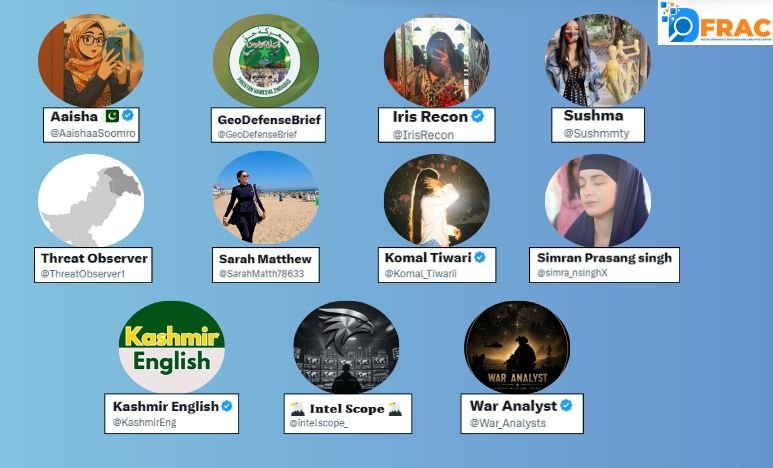
The DFRAC report examined the activities of 11 social media accounts that were active around sensitive issues involving Manipur, Kashmir, Punjab, and India’s internal security. These accounts included AaishaaSoomro, GeoDefenseBrief, IrisRecon, ThreatObserver1, Sushmmty, SarahMatth78633, Komal_Tiwarii, simra_nsinghX, KashmirEng, intelscope_, and War_Analysts. The report studied their posting trends, shared content, digital activity patterns, public profile details, narratives, and fake or misleading claims. The findings are serious.
According to the report, GeoDefenseBrief, AaishaaSoomro, ThreatObserver1, Intelscope, and War_Analysts showed public profile information indicating links to Pakistan. GeoDefenseBrief, AaishaaSoomro, and War_Analysts directly mentioned Pakistan or the Islamic Republic of Pakistan in their profile locations, while the account details of ThreatObserver1 and Intelscope displayed “Account based in Pakistan.” This matters because such accounts were not commenting on distant issues in a detached manner. They were actively posting on India’s internal tensions, including Manipur.
The report also found another category of accounts that presented different public identities but carried South Asia linked indicators. Iris Recon and Sushma listed India in their profile locations, while Komal Tiwari, Sarah Mathew, and Simran Prasang Singh mentioned Europe or India. The report, citing their About Sections, noted indicators such as “Account based in South Asia” or “Connected via South Asia Android App.” Kashmir English also displayed “Account based in South Asia.”
This method is familiar in information warfare. Accounts adopt identities that appear local, neutral, professional, or specialist. Some use the language of defence analysis. Some use the vocabulary of human rights. Some appear as ordinary users. Some claim to speak for oppressed communities. Some present themselves as geopolitical observers. The diversity of identities creates an illusion of spontaneous public opinion. But when terminology, timing, themes, and claims begin to resemble one another, a pattern emerges.
The DFRAC report further notes that the Government of India has already acted against some of these accounts. Geo Defense Brief, Iris Recon, Komal Tiwari, Kashmir English, and War Analyst were withheld in India in compliance with legal demands. Other accounts, including Aisha, Sarah Matthew, Intel Scope, Threat Observer, Simran Prasang Singh, and Sushma, were still active at the time of the report. This distinction is important. Withholding some accounts does not end the problem. The networked nature of propaganda allows similar narratives to continue through other handles, mirror accounts, diaspora amplifiers, ideological users, and local proxies.
For Manipur, the most important part of the DFRAC report is its analysis of narratives.

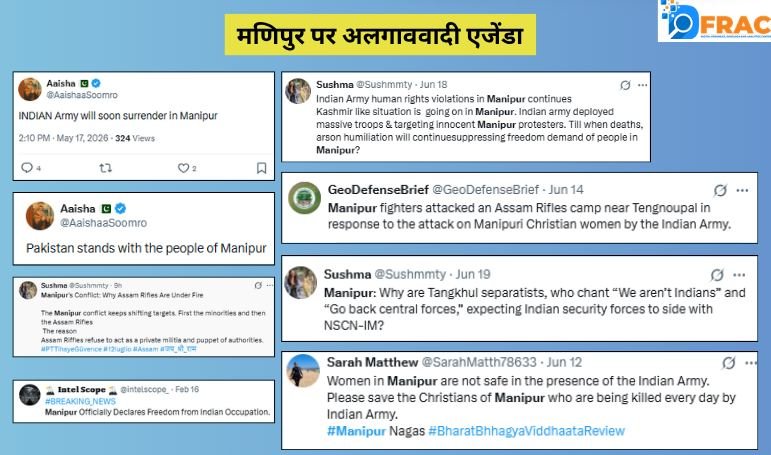
The report found that several accounts did not treat Manipur’s incidents as law and order issues or as a layered regional crisis. Instead, they consistently framed events under a specific narrative designed to create distrust in India’s constitutional and administrative systems. This is exactly what I had warned in September 2025, when I wrote that the Nambol ambush was seized by foreign and local amplifiers to portray Meiteis as terrorists and to use Manipur as a weapon against the Indian state.
The first narrative identified by DFRAC was the attempt to portray the Indian Army as acting against citizens. Several accounts circulated allegations that the Indian Army was taking action against ordinary people, particularly women and the Christian community. By presenting security forces in this light, the posts sought to associate them with human rights violations and create distrust toward the state’s security architecture.
This does not mean that security forces are beyond scrutiny. In a democracy, every institution must be accountable. Citizens have the right to question excess, delay, bias, or failure. But accountability requires verified facts. When old videos, unrelated incidents, exaggerated claims, and incomplete information are used to build hostility against security institutions, the outcome is not justice. It is manipulation.
The second narrative was more dangerous. Some posts described Manipur through the language of “Indian Occupation.” This is not ordinary criticism of governance. This language attempts to detach Manipur from India’s constitutional framework and present it as an occupied territory. It gives ideological support to separatist discourse and places Manipur alongside other sensitive regions in a way that serves external interests more than local truth.
The third narrative involved framing Manipur’s crisis as organised religious persecution. Many posts attempted to present the situation as an organised action against the Christian community rather than a complex regional conflict involving ethnicity, land, administration, security, illegal migration, armed groups, historical anxieties, and political demands. This framing is powerful because it travels easily in international networks. It invites global outrage without requiring a careful understanding of Manipur’s history.

This is where the real danger lies. Manipur’s conflict cannot be reduced to one religious explanation. It cannot be reduced to one community’s grievance. It cannot be reduced to a valley versus hills slogan. It cannot be reduced to one political party. It is a layered crisis rooted in history, geography, identity, security, administration, demographic anxiety, land rights, and competing visions of political future. Any attempt to flatten this complexity into a single global narrative is not analysis. It is propaganda.
The DFRAC report also links the Manipur narrative to Kashmir and Punjab. It notes that some accounts continuously propagated narratives questioning India’s sovereignty and constitutional status in Kashmir, including claims such as “Kashmir belongs to Pakistan.” The report further notes attempts to link Kashmir with Manipur, Punjab, Assam, and Nagaland in order to present India as a country facing simultaneous separatist movements. In several posts, India’s fragmentation was visualised through maps, graphics, and symbolic imagery. This is not accidental.
When Manipur is placed in the same narrative chain as Kashmir and Punjab, the intention is not to understand Manipur. The intention is to use Manipur. It becomes another exhibit in a manufactured argument that India is unstable, fragmented, oppressive, and internally collapsing. This is why local actors in Manipur must be careful. When they share unverified content from such accounts, they may think they are advancing their community’s cause. In reality, they may be serving a larger campaign that has little concern for Manipur’s future. The report’s content analysis provides further insight into how the accounts operate.
AaishaaSoomro was found sharing posts, reposts, and quote posts related to sensitive issues in India, particularly Manipur, Kashmir, and Punjab. GeoDefenseBrief shared India centric controversial content along with posts on geopolitics, defence, and national security, thereby attempting to lend credibility to specific narratives. IrisRecon regularly posted and reposted content related to defence, conflicts, and India related developments, adopting the style of military and security analysis. ThreatObserver1 posted on conflicts, military activities, and India’s internal issues, projecting the image of security and intelligence analysis.
Sushmmty regularly shared posts and quote posts related to Manipur, Kashmir, and other political issues, amplifying emotional and political narratives. SarahMatth78633 posted, reposted, and reacted to controversial issues concerning India, while also amplifying content from other similar accounts. Komal_Tiwarii contributed to narrative building through ideological framing. simra_nsinghX focused primarily on Punjab. KashmirEng attempted to build narratives around Kashmir through posts on human rights, security, and politics. intelscope_ shared defence and intelligence related content while presenting sensitive events through a specific frame. War_Analysts disseminated controversial narratives under the appearance of defence and security analysis.
This is how digital influence is manufactured. The ordinary user sees a military style account, a human rights handle, an intelligence sounding profile, a local name, a diaspora voice, and a political activist. They may appear unrelated. But when they circulate similar claims, frame the same events in the same way, and repeatedly insert Manipur into a wider anti India narrative, the effect is cumulative. It creates the appearance of a broad consensus when the foundation may be coordinated amplification.
The DFRAC fact checks are equally important.
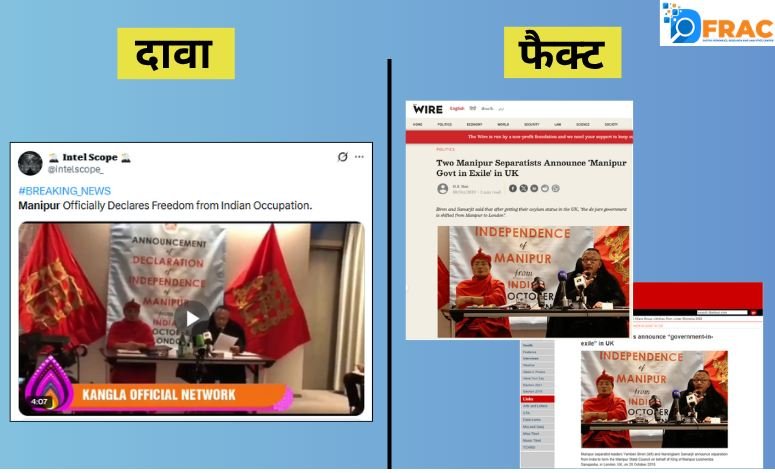
One claim stated that Manipuri leaders had officially declared independence from India following alleged human rights violations by the Indian Army. DFRAC found that the viral video was from 2019 and had no link to recent violence. This is a classic propaganda technique. An old video is taken from one context and inserted into another to create the impression of a current separatist development.

Another post claimed that Indian diplomats were questioned in Norway about human rights issues concerning Manipur, Punjab, and Kashmir. DFRAC found the claim misleading because the original video did not mention Manipur, Kashmir, or Punjab. Here again, the technique was not crude fabrication alone. It was the addition of a false meaning to a real video.
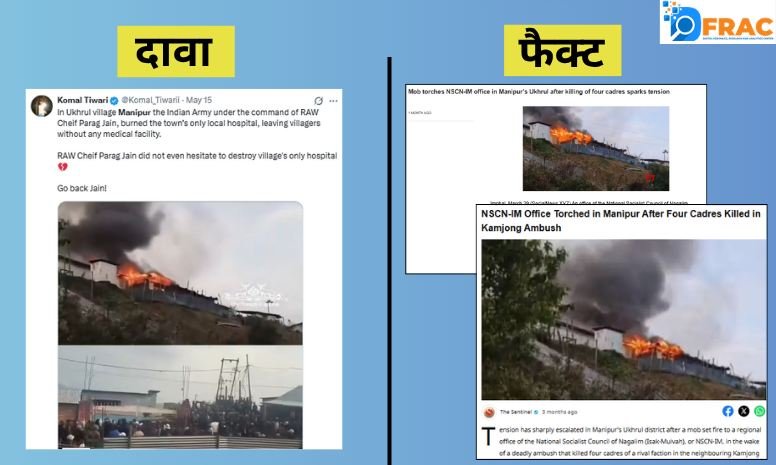
A third claim alleged that the Indian Army burnt down the only local hospital in Ukhrul and that army personnel were continuously burning houses. DFRAC found this misleading. The video being circulated was old and related to the NSCN IM office that was set on fire in March 2026. This kind of claim is deeply harmful in Manipur because Ukhrul is not merely a location. It is part of a sensitive ethnic and political geography. A false claim involving security forces, a hospital, and a hill district can rapidly damage public trust.
A fourth misleading item involved a statement attributed to former Jammu and Kashmir Chief Minister Mehbooba Mufti, claiming that she had said Kashmir, Punjab, and Manipur should be liberated. DFRAC found the claim false and the viral video digitally altered. A fifth claim involved a burning car video circulated with the allegation that a RAW officer had been targeted and killed in Delhi. DFRAC found that the video showed a car fire incident in Uttam Nagar, Delhi, with no casualties reported.
These examples show that information warfare rarely depends on a single lie. It works through repetition, partial truth, old material, fabricated captions, emotional interpretation, and borrowed credibility. It takes the speed of social media and combines it with the unresolved anxieties of conflict societies. This is why Manipur is especially vulnerable.
The state is already divided by memory, geography, and experience. The valley and the hills are consuming different versions of reality. Displaced families are living with trauma. Security forces are viewed differently by different communities. Civil society organisations issue competing claims. Political leaders speak to their own constituencies. The ordinary citizen receives information through WhatsApp, Facebook, X, YouTube, and community networks before any official clarification arrives.
In such an environment, propaganda does not need to persuade everyone. It only needs to harden those who are already angry.
The September 2025 India Today NE article on Pakistan based X users had shown this in the context of the Nambol ambush. On September 19, 2025, an Assam Rifles convoy travelling from Patsoi to Nambol base was ambushed near Nambol Sabal Leikai in Bishnupur district. Two jawans, Nb Sub Shyam Gurung and Rfn Ranjit Singh Kashyap, lost their lives, while five others were injured. Instead of allowing facts to emerge, a digital storm quickly turned the incident into a weapon of accusation.

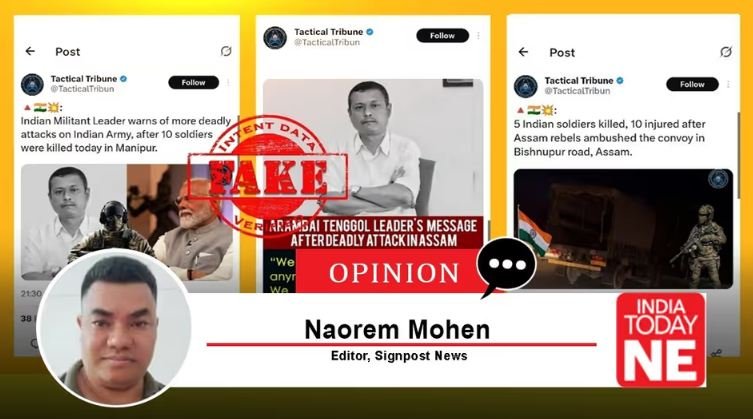
The article noted that Pakistan based accounts and foreign linked users circulated fabricated claims, including allegations that 10 Assam Rifles personnel had been killed and that Arambai Tenggol had threatened more attacks. These claims were baseless. Some posts used the image of Rajya Sabha MP Maharaja Sanajaoba Leishemba and falsely linked him to Arambai Tenggol, although he had made no such statement. Local and political amplifiers then circulated such claims, connecting ethnic vilification with anti BJP narratives. This was not responsible public discourse. It was narrative warfare.
The most painful part was that the ambush also revealed humanity on the ground. Meitei villagers helped wounded soldiers and rushed them to hospitals. Meira Paibi members and thousands of citizens condemned the attack. From Imphal to Churachandpur, people paid tribute to the fallen jawans. But this moment of shared grief was quickly overrun by online accounts that preferred accusation over evidence.
That pattern is now visible in the DFRAC report as well. Manipur’s tragedy is repeatedly taken out of its own context and inserted into external frames: Indian occupation, Christian persecution, human rights collapse, separatist liberation, and national fragmentation. This is not done to heal Manipur. It is done to use Manipur. This distinction must be understood clearly.
There are genuine victims in Manipur. There are genuine grievances. There have been failures of governance. There are legitimate questions about security, relief, rehabilitation, accountability, and justice. No serious opinion writer should deny this. But the presence of genuine suffering does not give legitimacy to fabricated claims. A real wound should not be dressed with a false narrative. Manipur needs truth as much as it needs peace.
The state government, central government, security agencies, media houses, civil society organisations, and citizens must recognise that the information space is now part of the conflict environment. Internet shutdowns alone cannot solve this. They may slow the spread of inflammatory material, but they also punish students, traders, journalists, patients, and ordinary families. A better response requires speed, credibility, transparency, and public trust.
The government must establish a rapid fact verification mechanism for conflict related claims. It must issue clarifications in English, Manipuri, and major tribal languages. It must respond not after a rumour has travelled for three days, but while it is still forming. Delayed truth often loses to immediate falsehood.
Media organisations must also strengthen verification discipline. Local journalism in Manipur works under immense pressure, but pressure cannot become an excuse for repeating unverified claims. Every video must be checked. Every casualty figure must be verified. Every claim of responsibility must be treated with caution. Every ethnic label must be used with restraint. In a conflict state, an inaccurate headline can have consequences far beyond the newsroom.
Civil society organisations must recover their moral responsibility. Their influence in Manipur is enormous. That influence must be used to calm society, not inflame it. If evidence exists, it should be placed before investigating agencies and the public. If evidence does not exist, speculation should not be converted into accusation.
Digital platforms must also be held accountable. X, Facebook, Instagram, and YouTube cannot treat Manipur as an ordinary debate space. In conflict conditions, algorithmic amplification can become a threat to public order. Platforms must respond faster to manipulated media, coordinated behaviour, hate speech, and foreign linked influence operations. Transparency on account location, coordinated amplification, and repeated misinformation is essential.
The central government must treat this as a national security concern, but it must do so carefully. Targeted action against foreign linked propaganda is necessary. Broad censorship will be counterproductive. It will strengthen the very claim that Manipur is being silenced. The response must be lawful, evidence based, and publicly defensible.
Manipur cannot allow anonymous handles, foreign linked accounts, old videos, edited clips, religious framing, separatist slogans, and political opportunism to decide its future.
The DFRAC report has placed evidence before the public. It shows that accounts linked to Pakistan and South Asia indicators have repeatedly engaged with sensitive Indian issues. It shows that some accounts were withheld in India while others remained active. It shows that Manipur was framed through narratives designed to weaken trust in security forces, present the state as occupied territory, and convert a regional conflict into religious persecution. It shows that Kashmir, Punjab, Manipur, Assam, and Nagaland were sometimes linked to suggest a wider picture of Indian instability. It also shows how false or misleading claims were circulated using old videos, digitally altered material, and fabricated captions.
This is precisely the distorted angle I had warned about in September 2025. The warning was not about defending one political party blindly. It was not about denying the pain of any community. It was about recognising that Manipur’s conflict was being used by actors who had no responsibility for Manipur’s future. They did not have to rebuild burnt homes. They did not have to reopen schools. They did not have to secure highways. They did not have to restore inter community trust. They only had to produce outrage.
That is why the defence of Manipur must include the defence of truth. Digital propaganda may not carry rifles, but it can prepare the mind for hostility. It may not burn villages, but it can make reconciliation impossible. It may not draw new borders on the ground, but it can divide citizens in imagination. Manipur has already paid too heavy a price for mistrust. It cannot afford another conflict manufactured through screens.
The future of Manipur must be decided by verified facts, constitutional processes, accountable governance, and the lived wisdom of its people, not by anonymous propaganda accounts operating from elsewhere.
Image credit – DFRAC and India Today NE


Naorem Mohen is the Editor of Signpost News. Explore his views and opinion on X: @laimacha.