


From 3rd May 2023 to Kanto Sabal, Manipur’s tragedy is not only ethnic conflict. It is the repeated failure of the State to protect citizens when danger is visible, predictable, and preventable.
On July 13, 2026, leaders of the Kuki-Zo Council held a press conference at the Press Club of India in New Delhi. The theme was “Appeal for Equal Justice, Humanitarian Intervention and an Expedited Political Solution.” The appeal was politically significant because it sought national attention at a time when Manipur remains trapped in prolonged ethnic separation, displacement, and insecurity. The Council also submitted a memorandum to the Ministry of Home Affairs and the Intelligence Bureau seeking urgent intervention and a political solution for Manipur.
The phrase “equal justice” deserves careful attention. It is a powerful phrase. It also raises an uncomfortable question that many in Manipur are now asking. Have Meiteis and Nagas received equal justice during these three years of violence, displacement, intimidation, arson, and selective insecurity? Can justice be invoked as a community demand while the suffering of other communities is pushed to the margins? Justice cannot be owned by one side. It must be measured by how the State protects every citizen, including those whose homes are burnt while security forces are present, by the families of those 6 innocent Nagas who were brutally killed.
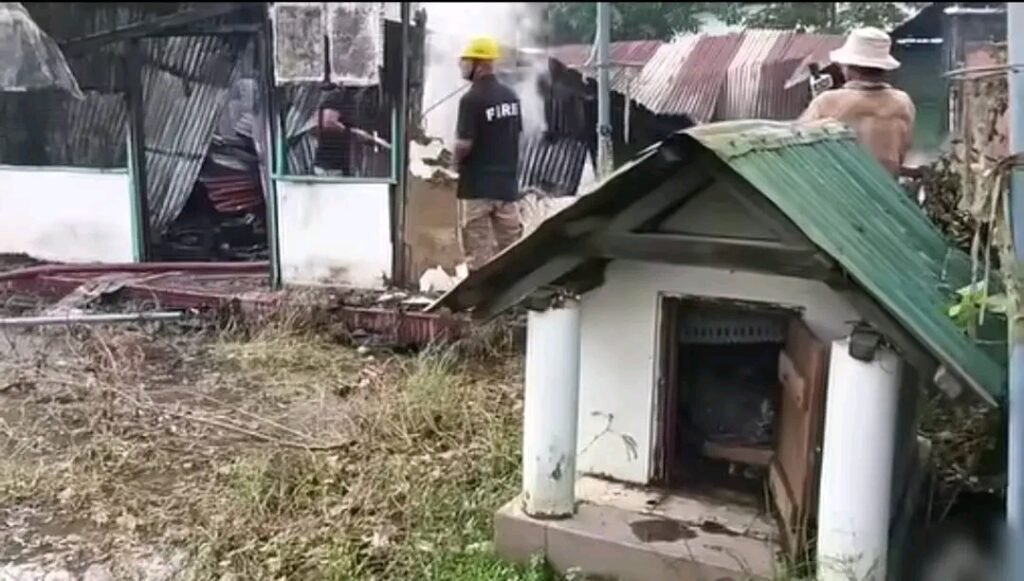
This question has become even more urgent after the incident at Kanto Sabal in Imphal West on July 11, 2026. According to reports, a mob of around 600 people attempted to move towards the Kanto Sabal area. Security forces were deployed and police described the intervention as an effort to prevent a possible communal clash. Abandoned Meitei houses, under the protection of the security forces were set ablaze.
These houses reportedly stood vacant because the owners had already been displaced by earlier violence. Their destruction therefore carries a meaning far deeper than property loss. It tells displaced families that even the remains of their former lives are unsafe.
This is why Kanto Sabal cannot be viewed in isolation. It must be placed beside May 3, 2023, the day that marked the beginning of Manipur’s present tragedy. On that day, a mass protest organised in the hill districts against the Meitei demand for Scheduled Tribe status turned into violence. Churachandpur, Torbung, Phougakchao Ikhai, Kangvai, and adjoining areas became sites of destruction, fear, and displacement.
For Meiteis, May 3 is remembered not as a routine protest that lost control, but as the moment when targeted violence broke open the fault lines of Manipur. Shops were reportedly destroyed. Houses were looted and burnt. Families fled. Localities became divided. Trust collapsed. The violence that began then has not truly ended. It has only changed form, location, and intensity.
The Kanto Sabal incident appears smaller in scale, but it belongs to the same pattern. In both cases, a protest or mass mobilisation took place in a deeply charged ethnic atmosphere. In both cases, Meitei homes and properties became vulnerable. In both cases, security forces were present or expected to be present. In both cases, the public allegation is that the State failed to act in time. In both cases, Meiteis experienced the State not as a protector, but as an institution that arrived without preventing loss.
This is the core of the issue. The debate is not only about who started which incident or how each side explains its grievance. The deeper question is whether the government and security forces have learned anything from May 3. A conflict that has lasted more than three years should have taught the administration that no mass mobilisation near sensitive villages can be treated casually. In Manipur, protest is no longer a simple democratic activity when it moves towards the settlement of another community in a conflict zone. It becomes a potential security crisis.
On May 3, 2023, the administration should have known that the atmosphere was combustible. The protest was publicly known. The issue was sensitive. The districts were tense. A responsible security plan should have included strict route control, separation of communities, fire response preparation, rapid deployment, and clear command instructions. Instead, violence spread with devastating consequences.
At Kanto Sabal, the warning should have been even clearer. This was not the first day of the conflict. It happened after three years of bitter experience, after countless reports of arson, displacement, security zones, armed village defence, and barricaded roads. The area was known to be sensitive. The houses were known to belong to displaced Meitei families. If a mob of around 600 people could still move close enough for houses to be burnt, then the failure was not simply tactical. It was institutional.
The allegation that security personnel did not intervene effectively is serious. Equally serious is the allegation that Meitei house owners and villagers were not allowed to protect their own homes. If victims are stopped from saving their property while those threatening it are not prevented in time, the State creates the appearance of one-sided enforcement. This perception is dangerous because it weakens faith in neutral institutions.
Neutrality does not mean asking victims to remain silent while their homes burn. Neutrality does not mean standing between communities only after one side has suffered loss. Neutrality means preventing the aggressor from advancing. It means protecting threatened property. It means arresting those responsible. It means allowing emergency response without delay. It means ensuring that the law does not become a barrier for the victim and a shield for the offender.
Security forces in Manipur operate under difficult conditions. They face armed groups, hostile terrain, ethnic suspicion, political pressure, and public anger from all sides. This reality must be acknowledged. But difficulty cannot explain repeated failure. A security force that can stop villagers from crossing a barricade must also be capable of stopping a mob from burning homes. A security arrangement that protects roads but not houses has failed its basic purpose.
This failure has three dimensions. The first is failure of anticipation. The State knew from 3rd May 2023 that ethnic mobilisation could become violence within minutes. It knew that abandoned houses in border localities are symbolic targets. It knew that displaced families are emotionally attached to such properties. It knew that one fresh incident could inflame wider tensions. Still, the preventive mechanism did not work adequately at Kanto Sabal.
The second is failure of command. In conflict zones, mere deployment is not enough. Personnel must know what they are authorised and required to do. Were they instructed to stop the mob before it approached the houses? Were they authorised to detain violent elements immediately? Were they told to prioritise crowd control over property protection? Who was responsible for the sector? Who monitored the movement? Who failed to order action at the decisive moment? These questions cannot be avoided.
The third is failure of accountability. After May 3, Manipur needed a clear public accounting of administrative collapse. Which warnings were ignored? Which officers failed to act? Which areas were inadequately protected? Which chains of command broke down? Without such accountability, the same administrative habits continue. Kanto Sabal appears to be another example of this unresolved weakness.
The issue of equal justice must therefore be examined honestly. If Kuki organisations demand justice, humanitarian intervention, and political solutions, they are exercising their political voice. But Meiteis and Nagas also have the right to ask whether their suffering is being recognised with equal seriousness. Meitei families who lost homes in Churachandpur, Torbung, Phougakchao Ikhai, Kangvai, and later in vulnerable border areas cannot be told that their grief is less important. Naga communities who have faced accusations, insecurity, and pressure in the wider conflict environment also cannot be reduced to bystanders in someone else’s narrative.
Justice in Manipur cannot become selective vocabulary. It must include every burnt house, every displaced family, every blocked road, every lost livelihood, every threatened village, and every community living under fear. If one community’s demand for justice is amplified nationally while another community’s suffering is dismissed locally, the idea of equal justice becomes hollow.
The tragedy of Kanto Sabal is that it should not have happened after May 3. The government had three years to understand the pattern of violence. It had three years to secure vulnerable settlements. It had three years to design a credible return policy for displaced families. It had three years to ensure that abandoned homes were not treated as ownerless structures. It had three years to rebuild confidence in law enforcement. The burning of those houses shows how much remains undone.
For displaced Meiteis, such incidents deepen the fear that displacement may become permanent. If their homes can be burnt while security forces are nearby, what confidence can they have in returning? If villagers are prevented from protecting their property, what meaning does citizenship hold in a conflict zone? If the State can restrain the victim but not stop the arsonist, what kind of peace is being enforced?
The government must respond to Kanto Sabal with more than routine investigation. It should publish a factual timeline of the incident. It should clarify the number of houses burnt. It should identify who led the mob and how it came close to the vulnerable area. It should explain the role of security forces on the ground. It should state whether homeowners were stopped from entering the area and why.
The Centre also needs to review the rules of engagement for security forces in sensitive Meitei border villages. Forces cannot function only as separators who freeze communities in place. They must function as protectors of citizens and property. A buffer zone that prevents return but fails to prevent arson is not a peace mechanism. It becomes an instrument of prolonged insecurity.
There is also a larger political lesson. Manipur’s conflict cannot be resolved by allowing competing narratives to travel to Delhi while ground realities remain unchanged. Press conferences, memoranda, and appeals have their place in democracy. But justice must begin where citizens live, where they flee, where their homes stand abandoned, and where those homes are either protected or burnt. The legitimacy of the State is not tested at press clubs. It is tested in places like Kanto Sabal.
May 3, 2023 was the beginning of a collapse. Kanto Sabal is a reminder that the collapse has not been repaired. The scale may be different, but the pattern is familiar: mobilisation, insecurity, delayed intervention, burnt Meitei homes, and public anger against security forces. If the government refuses to recognise the repetition, Manipur will remain trapped in cycles of accusation and retaliation.
Equal justice cannot be a slogan. It must be a standard. It must apply to Kuki-Zo, Meitei, Naga, and every citizen of Manipur. But it must also be honest enough to recognise when one community is repeatedly exposed to violence under the watch of the State. For Meiteis, May 3 and Kanto Sabal are connected by one painful thread: the failure of institutions to protect them when protection mattered most.
Until that failure is acknowledged and corrected, appeals for equal justice will remain incomplete. Manipur does not need another language of victimhood. It needs a State that can prevent mobs from burning homes, protect displaced families, hold officers accountable, and restore the confidence that citizenship is not suspended at the edge of a barricade.
Manipur did not burn on May 3, 2023 because society suddenly forgot coexistence in a single day. It burned because law and order collapsed at the very moment the State was required to stand firm. The violence that followed was not only the result of ethnic anger. It was also the consequence of administrative paralysis, weak command, selective protection, and the failure to act before mobs became masters of the ground.
Kanto Sabal now stands as the next warning. If the same pattern continues, if security forces remain passive when homes are attacked, if victims are restrained while aggressors advance, and if accountability is avoided once again, Manipur will not move towards peace. It will move towards another Kanto Sabal. Let us hope the State still has the wisdom, courage, and constitutional duty to ensure that there will not be another Kanto Sabal.


Naorem Mohen is the Editor of Signpost News. Explore his views and opinion on X: @laimacha.