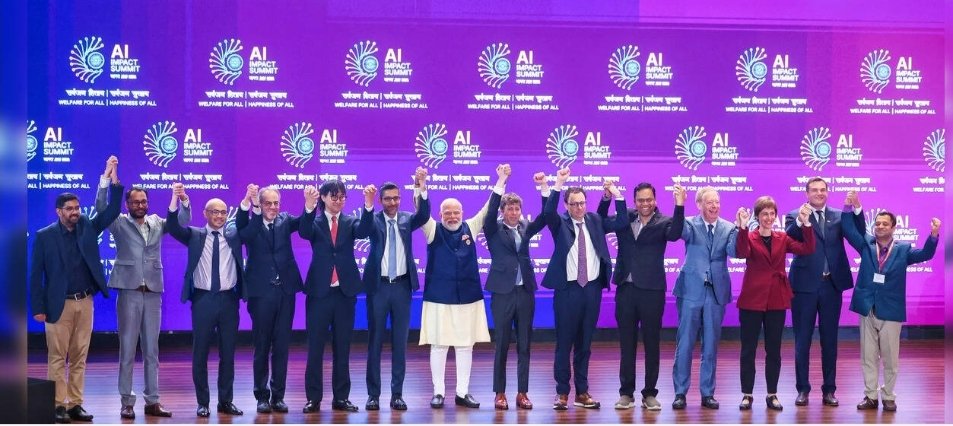
The India AI Impact Summit 2026 wasn’t just another tech conference, it was India’s resounding declaration to the world: “We’re not catching up; we’re leading.”
Held amid the vibrant chaos of New Delhi’s Bharat Mandapam from February 16-21, this event genuinely made the global community sit up and take notice. It marked a decisive significant in the AI narrative, shifting from the West’s endless hand-wringing over “doomerism” and existential risks to something far more refreshing and pragmatic: real-world impact, inclusion, and massive-scale deployment.
India didn’t host a summit, it hosted a movement.What struck me most was the sheer audacity of the scale. Over 5 lakh in-person attendees, live views in the millions, delegations from 100+ countries, 15+ heads of state, and a who’s-who of AI heavyweights—Sundar Pichai, Sam Altman, Dario Amodei, Demis Hassabis, Mukesh Ambani, and more.
This wasn’t elite posturing; it felt like a national festival of innovation. The energy was electric – young creators demoing multilingual AI tools, farmers exploring precision agriculture apps, students accessing free Adobe Firefly-powered creativity suites.
It screamed confidence. India, with its billion-plus population and proven digital public infrastructure (UPI handling 80% of food court payments effortlessly), showed the world how AI can actually reach the last mile, not just theorize about it.
The New Delhi Declaration on AI Impact, endorsed by 88-92 nations including unlikely bedfellows like the US, China, UK, France, Russia, and the EU, was a diplomatic masterstroke. Broader than any prior summit output, it championed democratized access, digital sovereignty, inclusive growth, verifiable systems, and barrier-free collaboration.
No more top-down safety obsession from the Global North; this was the Global South saying, “AI must serve humanity’s progress, not just the privileged few.” In my opinion, this declaration alone cements India’s role as a bridge-builder in fractured global tech governance.
Then came the money, and wow, did it flow. Commitments topping $200-270 billion in AI infrastructure, data centers, and deep tech. Reliance’s $110 billion pledge over seven years, Adani’s $100 billion by 2035, Google’s massive subsea cables and training for 20 million civil servants plus 11 million students, Microsoft’s expansions, Tata-OpenAI tie-ups, and more.
India added 20,000+ GPUs to its sovereign compute, joined the Pax Silica coalition, and launched Sarvam AI’s foundational models tailored for Indian languages and contexts. This isn’t hype; it’s hardware and capital signaling that India is building the backbone for an AI-first economy.
One of my favorite highlights was the fireside chat between Adobe CEO Shantanu Narayen and Bharti Enterprises Chairman Sunil Bharti Mittal. Narayen nailed it: India is “uniquely positioned” for open, trusted AI thanks to its scale, openness, innovation mindset, and emphasis on content authenticity and data trust.
He predicted India would experience the world’s biggest AI impact, and I couldn’t agree more. Mittal doubled down on “frugal innovation” or “jugaad,” showing how India turns constraints into scalable breakthroughs in healthcare (personalized medicine), education (adaptive learning), telecom, and beyond.
Their optimism felt authentic, not scripted.Adobe’s cultural showcase stole hearts too. Partnering with the Ministry of Information and Broadcasting, they premiered Kathāvātār—five stunning made-in-India AI short films using Firefly.
Reimagining folklore like “Language of Birds,” “Migoi,” “Uttarayan,” “The Barber’s Secret,” and “Yappasauras,” these blended ancient storytelling with cutting-edge generative tech. It proved AI amplifies creativity, preserves heritage, and excites crowds, a perfect counter to fears of job loss or cultural dilution.
PM Modi’s M.A.N.V. Vision (human-centric AI: empowering people, advancing growth, safeguarding the planet) and his call to “Design and develop in India, deliver to the world for the common good” captured the summit’s soul. Initiatives like free Adobe tools for thousands of schools/colleges, the AI responsibility campaign (Guinness record for most pledges in 24 hours), and global casebooks on AI in health, energy, gender, agriculture, education, and accessibility showed genuine commitment to inclusion.
Sure, there were hiccups, traffic nightmares, organizational glitches, even quirky controversies like a robo-dog mix-up, but these felt like growing pains of an ambitious, massive event, not fatal flaws.
The positives dwarfed them: India’s frugal genius shining through, youth-led innovations, sovereign AI push, and a bold rejection of billionaire dominance in favor of equitable progress.
In the end, the India AI Impact Summit 2026 didn’t just make the world take notice, it made the world believe. India isn’t waiting for permission to shape AI’s future; it’s already doing it, inclusively, impactfully, and unapologetically. This was India’s moment, and it’s only the beginning.