


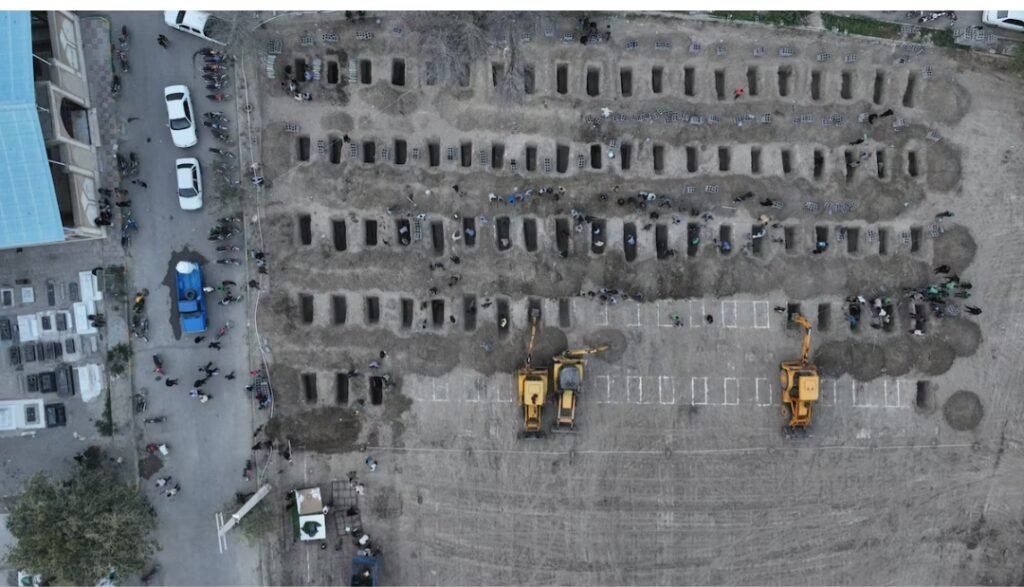
On March 9, 2026, during a news conference at Trump National Doral in Miami, Florida, President Donald Trump faced direct questions about a February 28 missile strike that devastated the Shajareh Tayyebeh girls’ elementary school in Minab, Hormozgan province, southern Iran.
The incident, which occurred on the opening day of intensified U.S. and Israeli military operations against Iran, resulted in significant civilian casualties, primarily young schoolgirls.
Iranian authorities reported that the strike killed between 165 and 180 people, most of them girls aged 7 to 12, with dozens more injured. The school, located adjacent to an Islamic Revolutionary Guard Corps (IRGC) naval base, was hit during morning classes, causing the building to collapse and trapping many victims under rubble.
UN experts condemned the attack, emphasizing that schools are protected civilian objects under international law and calling for an independent investigation. Human Rights Watch described it as an unlawful strike on civilians, noting the proximity to a military site but highlighting the failure to distinguish between combatants and non-combatants.
Multiple independent analyses, examined video footage, satellite imagery, and debris photos. A key piece of evidence is a geolocated video showing what appears to be a U.S. Tomahawk land-attack missile (BGM/UGM-109) striking the IRGC naval compound next to the school.
The footage, originally shared by Iranian media and verified by open-source investigators, depicts the missile’s trajectory and impact consistent with a Tomahawk launch. Debris images purportedly from the site bear markings like “Made in USA” and serial numbers matching U.S. munitions labeling standards.
Tomahawk missiles are a sophisticated, GPS-guided U.S.-developed weapon system, primarily operated by the United States. Limited numbers have been sold to close allies: the United Kingdom and Australia are confirmed operators, with Japan acquiring them for deployment and the Netherlands in the process of acquisition.
No credible evidence indicates that Iran possesses or has access to Tomahawks, as U.S. export controls and sanctions prohibit such transfers.
Preliminary U.S. assessments, cited anonymously by officials to outlets like CBS News and Reuters, indicated that American forces were likely responsible for the strike on the naval target, with possible collateral damage or error affecting the adjacent school.
Neither the U.S. nor Israel has claimed responsibility for hitting the school itself; an Israeli spokesperson stated they were not operating in the area.
The Pentagon has described the matter as under investigation, with Defense Secretary Pete Hegseth noting that assessments of civilian harm are ongoing but hampered by reduced staffing in relevant oversight offices.
In earlier comments aboard Air Force One around March 7–8, Trump stated without evidence that “in my opinion, based on what I’ve seen, that was done by Iran,” citing alleged inaccuracy of Iranian munitions.
During the March 9 press conference, reporters challenged him on emerging evidence, including the video of a Tomahawk strike.
One exchange included a reporter asking about footage showing a Tomahawk likely destroying the area and whether the U.S. would accept responsibility. Trump responded that he hadn’t seen it and suggested the Tomahawk is “sold and used by other countries,” adding that “whether it’s Iran, who also has some Tomahawks, I wish they had more, but whether it’s Iran or somebody else… a Tomahawk is very generic.”
A follow-up question pressed: “You just suggested that Iran somehow got its hands on a Tomahawk and bombed its own elementary school on the first day of the war. But you’re the only person in your government saying this. Even your Defense Secretary wouldn’t say that… Why are you the only person saying this?”
To this Trump replied: “Because I just don’t know enough about it. I think it’s something that I was told is under investigation, but Tomahawks are used by others, as you know. Numerous other nations have Tomahawks. They buy them from us… But that’s being investigated right now… Whatever the report shows, I’m willing to live with that report.”
This response marked a shift from his earlier definitive attribution to Iran toward claiming limited knowledge while implying possible involvement by others. Fact-checks from media and others labeled Trump’s assertion that Iran has Tomahawks as false, noting no evidence supports it and contradicting expert consensus on the missile’s limited proliferation.
The incident has intensified scrutiny of U.S. rules of engagement in the conflict, sparked global protests, and raised questions about accountability. Calls for probes by the International Criminal Court and congressional oversight continue, amid broader debates over civilian protections in military operations.
Trump’s March 9 remarks, captured on video and widely reported, reflect an attempt to navigate conflicting evidence while maintaining a stance of U.S. non-culpability for the school’s direct destruction.
As investigations proceed, the event highlights the challenges of verifying responsibility in fast-moving conflicts and the human cost of escalation.