


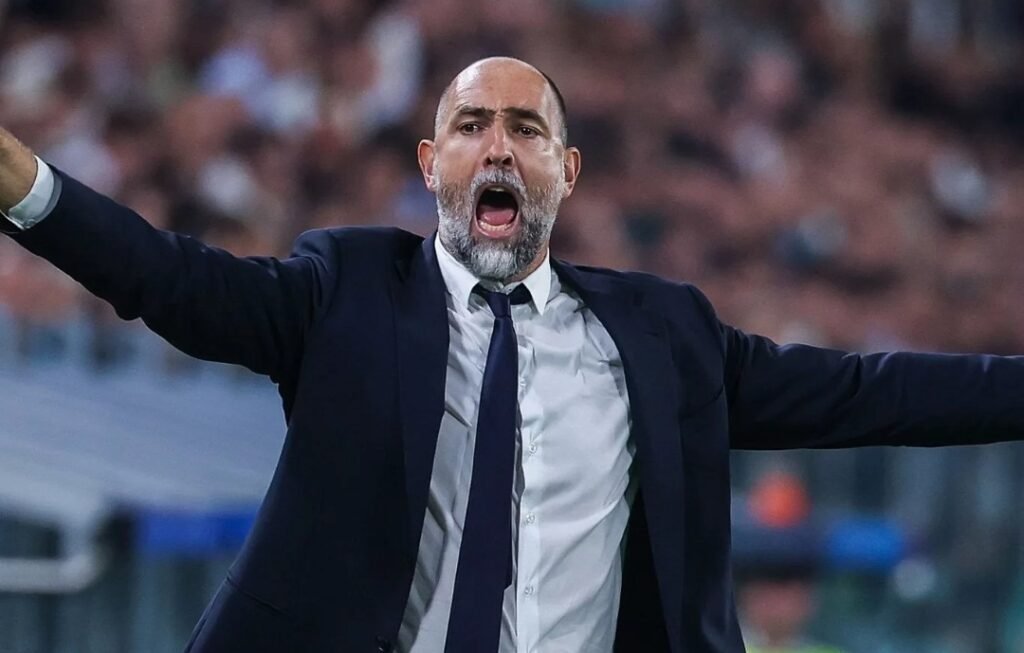
In a move that screams pragmatism over glamour, Tottenham Hotspur have turned to Igor Tudor as their interim head coach until the end of the 2025-26 season.
The announcement came on February 13, 2026, just days after the club sacked Thomas Frank following a dismal run that left Spurs teetering near the relegation zone in the Premier League.
At 47, the former Croatia international defender brings a nomadic but battle-hardened resume to north London—one built on short-term fixes, tactical discipline, and a no-nonsense approach that could be exactly what this fractured squad needs right now.
Tudor’s appointment isn’t about long-term vision; it’s about survival and stability. Spurs, under pressure after a chaotic spell, wanted an experienced operator who could impose structure quickly.
Tudor fits the bill: he’s the guy clubs call when the alarm bells are ringing loudest. His deal runs until June 2026 with no automatic permanent option, though a strong finish—perhaps steering the team clear of the drop and into Europe—could see him stay on.
For now, though, the focus is immediate: sort the defense, ignite some fight, and build momentum ahead of key fixtures like the north London derby.
Tudor’s journey from player to coach has been anything but straightforward. A rugged central defender who won two Serie A titles and two Italian Super Cups during his eight years at Juventus (1998-2007), he earned 55 caps for Croatia.
His managerial career kicked off in 2013 at boyhood club Hajduk Split, where he delivered one of his few tangible pieces of silverware: the 2012-13 Croatian Cup. That early success marked him as a promising talent in his homeland, but he soon ventured abroad, taking on a string of challenging roles across Europe.
His reputation as a “firefighter” really took shape in Italy. At Udinese, Tudor pulled off two notable escapes from relegation trouble. In April 2018, with just four games left, he took over a side averaging under a point per game and lifted their rate to 1.75, securing 14th place with crucial wins over Verona and Bologna.
He returned in March 2019 for another stint, engineering vital victories against Genoa, Empoli, Frosinone, SPAL, and Cagliari to drag them to mid-table safety. These short bursts showcased his ability to organize quickly, tighten defenses, and extract results under pressure.
Further proof came at Hellas Verona in 2021-22. Arriving after a winless start, Tudor transformed the team into a competitive outfit, finishing ninth in Serie A—a remarkable turnaround that highlighted his tactical nous with a back-three system and high pressing.
In France, Tudor took charge of Marseille in July 2022. Over one full season (2022-23), he guided them to third in Ligue 1 with an impressive 1.92 points per game, qualifying for the Champions League.
Though they exited early in Europe, his attacking, vertical style injected energy into the squad, earning praise for revitalizing a club known for volatility.Back in Italy, Tudor had a brief but effective spell at Lazio starting March 2024. In 11 matches, he won six, drew three, and lost two (1.91 points per game), steering them toward European qualification before resigning at season’s end.
Then came his second stint at Juventus in March 2025, replacing Thiago Motta. Over seven months, he steadied the ship enough to finish fourth in Serie A the previous campaign (qualifying for Champions League spots) and achieve a respectable win percentage before a poor run—eight games without a victory—led to his sacking on October 27, 2025.
Tudor’s recent achievements paint a picture of a coach who excels in rescue missions rather than building dynasties.
Key highlights include
Udinese survival acts (2018 and 2019): Twice prevented relegation in short tenures, turning around dire form with pragmatic tweaks.
Marseille’s Ligue 1 third place (2022-23): Secured Champions League football with high-scoring, intense football.
Lazio European push (2024): Strong points return in limited games to lift them into contention.
Juventus stabilization (2025): Led to fourth in Serie A and CL qualification before his exit.
Overall managerial win rate: Consistently above 37%, often 50%+, across nine clubs in 13 years.
Critics point to his high turnover—12 jobs since 2013—and occasional clashes with players or boards due to his demanding style. But in crisis mode, few match his track record for instant impact. He favors a 3-4-2-1 or 3-4-1-2, emphasizing high-intensity pressing, quick transitions, and vertical play over patient possession. It’s direct, aggressive, and sometimes scrappy—qualities Spurs desperately need after recent drift.
For Tottenham fans, this feels like a necessary reset. The club isn’t pretending Tudor is the long-term answer; they’re buying time, perhaps eyeing a Mauricio Pochettino return in the summer.
But if he can drill discipline into the backline, unleash the wing-backs, and foster real fight—especially in big games—this interim stint could spark a revival.It’s pragmatic football in a time of need. Not flashy, but potentially effective. Welcome to Spurs, Igor Tudor. The clock’s ticking—make it count.


Signpost News is an independent digital platform renowned for its bold geopolitics opinions, incisive editorials, and balanced ethical journalism, while delivering sharp, timely insights on AI, finance, education, tech, and automobiles.