


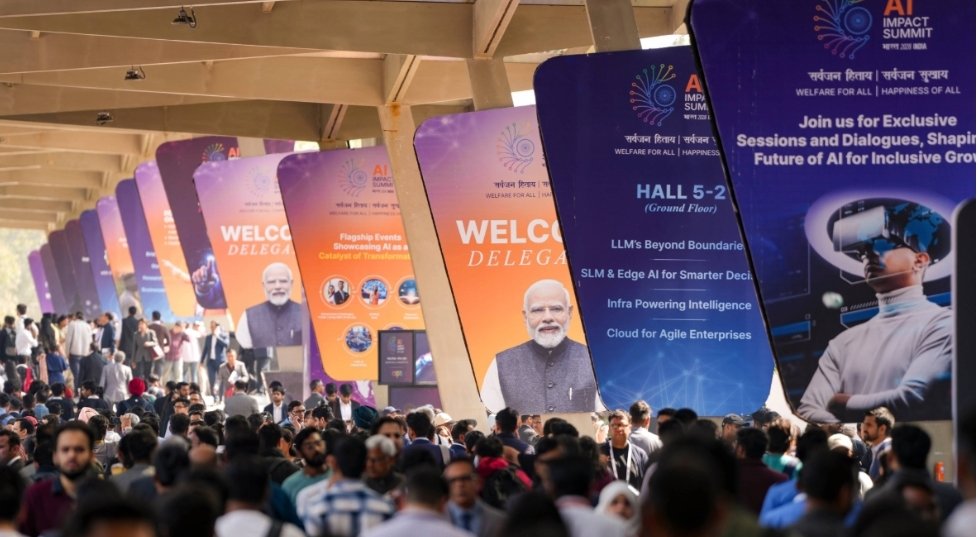
As an Indian who’s followed our country’s tech journey with pride and occasional frustration, the recent events at the India AI Impact Summit 2026 in New Delhi hit close to home. I wanted to believe this flagship event, at Bharat Mandapam from February 16-20, with PM Modi inaugurating it and global leaders like Sundar Pichai and Sam Altman in attendance would showcase genuine homegrown breakthroughs in AI.
Instead, one unfortunate incident turned the whole summit into what can only be described as the world’s biggest, unintended billboard for Chinese robotics dominance.
I’m talking about the Galgotias University episode. A professor from the university, in an interview with DD News, enthusiastically introduced a robotic dog named “Orion” as something developed by their Centre of Excellence. She described it as innovative, capable of tasks like surveillance and monitoring, and even called it “quite naughty.”
It sounded promising, until social media users, tech enthusiasts, and sharp observers quickly pointed out the truth: this was no indigenous creation. It was the Unitree Go2, a commercially available quadruped robot from China’s Unitree Robotics, readily purchasable for around $1,600–$2,800 (roughly Rs 1.3–2.3 lakh) and already a go-to choice for universities, researchers, and industries worldwide.
The backlash was immediate and brutal. Memes flooded X, international outlets like AP, BBC, Reuters, Al Jazeera, and others ran stories headlined with variations of “Indian university kicked out of AI summit for presenting Chinese robot as own.”
Government sources reportedly ordered Galgotias to vacate their stall, calling it a national embarrassment. The university issued apologies, clarifying that the robot was procured for academic demonstration and that the representative was “ill-informed” or overly enthusiastic on camera.
They also emphasized it was never meant to be claimed as built in-house, but the damage was done, and in a way, irreversible.
As someone who roots for India’s rise in AI, this stung. We pour resources into talent development, policy frameworks like IndiaAI, and massive computing power initiatives.
Yet here, at our own premier AI showcase, the hardware highlight relied on an off-the-shelf Chinese import. In trying to fill the stall with something impressive, the university inadvertently gave prime, controversy-fueled exposure to Unitree’s product.
Every viral clip, every mocking post, every global article that dissected the fiasco simultaneously spotlighted how advanced, affordable, and accessible Chinese AI robotics have become.
No paid ad campaign could match this level of visibility.This accidental billboard effect reveals a painful asymmetry I’ve observed for years. India excels in software talent, data annotation, and even foundational model contributions, but when it comes to embodied AI, robots that move, sense, and interact in the real world, we often end up importing the hardware.
The Unitree Go2 isn’t some unattainable prototype; it’s a mature, deployable system that’s democratized robotics. Its presence at our summit didn’t just embarrass one institution; it broadcast to the world that Chinese firms are setting the practical benchmarks for cost, reliability, and scalability in this space.
And China doesn’t stop at selling hardware, they’re masterfully weaving it into their cultural narrative, something we could learn from.
Take the 2026 CCTV Spring Festival Gala, watched by hundreds of millions. Humanoid robots from companies like Unitree, AgiBot, Galbot, Noetix, and MagicLab performed synchronized kung fu routines, swordplay, nunchuck sequences, and dances right alongside human performers and children.
They nailed complex moves, including drunken boxing with realistic falls and recoveries, blending ancient tradition with futuristic tech in a way that felt organic and inspiring.Then there are the viral videos of humanoid robots training at the Shaolin Temple itself, mimicking monks in precise stances, forms, and drills using advanced AI models like Genie Operator-1.
This isn’t cheap spectacle; it’s strategic. By having robots perform Shaolin-inspired routines on national stages, China positions AI as a continuation of its civilization, not a Western import.
It humanizes the technology, turns it into a source of national pride, and demonstrates real technical maturity: multi-robot coordination, dynamic balance, fault recovery, and adaptation in complex environments.These cultural integrations serve deeper goals.
They showcase capabilities critical for future uses, elderly care, disaster response, manufacturing, entertainment while normalizing humanoids in society. Robots that dance or execute kung fu today could tomorrow teach martial arts, preserve fading traditions, or aid physical therapy rooted in ancient practices.
With state backing, subsidies, talent attraction, high-profile events, Chinese companies iterate fast, drop costs, and scale production. This cultural fusion gives their tech a soft-power edge that’s hard to replicate.
In contrast, as an observer of global trends, I see the U.S. leading in AI models and software but lagging in consumer robotics deployment. Europe focuses on ethics and rules, which slows things down. India builds incredible talent pools but struggles with hardware ecosystems and supply chains.
The Galgotias incident laid that bare: to demonstrate capability at our own summit, we borrowed from China, and the world noticed.
One small misstep became a massive catalyst. It exposed gaps in originality and delivery while amplifying the very competitor we aim to surpass.
Every share of the “Orion” video, every headline about the eviction, reinforced China’s story: We build it affordably. We integrate it culturally. We deploy it at scale. The world watches, buys, and increasingly depends on it.
Looking ahead, I worry this trajectory points to Chinese AI robots dominating through sheer ubiquity and cultural resonance. Performances like those at the Spring Festival normalize humanoids, paving the way for everyday adoption.
Training on rich datasets from kung fu, emphasizing flow, balance, and adaptability, could produce more graceful, resilient machines than purely engineering-driven ones.
The India AI Impact Summit 2026 was meant to herald our leadership in responsible, impactful AI. Instead, through this one unintended billboard moment, it shone a brighter light on China’s robotics ascendancy: hardware excellence fused with cultural depth, now seen by millions worldwide.
As an Indian, it motivates me to push harder for real, indigenous innovation, not rebranding, but true creation, so next time, the spotlight stays on us.


Naorem Mohen is the Editor of Signpost News. Explore his views and opinion on X: @laimacha.