


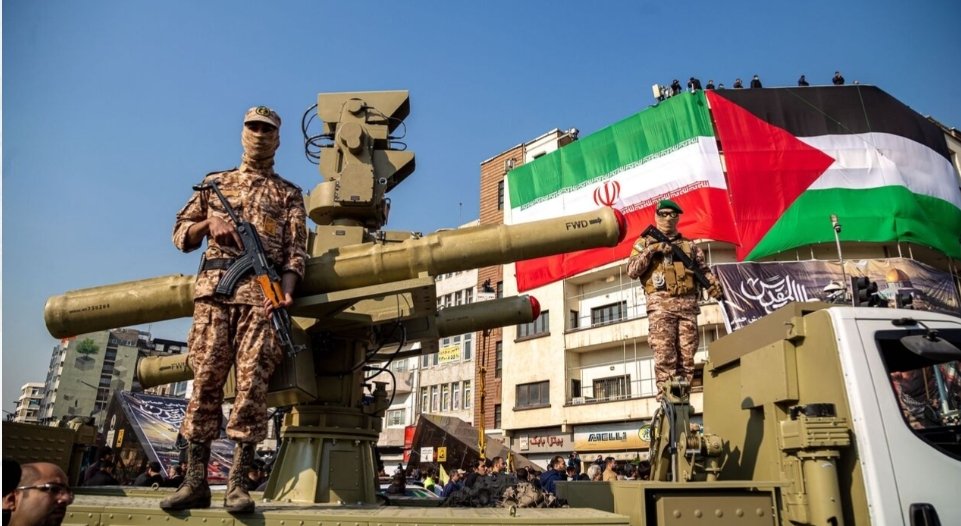
Iran’s Islamic Revolutionary Guard Corps (IRGC) issued its most severe warning to date on March 4, 2026, vowing readiness for the “complete destruction of the region’s military and economic infrastructure” if U.S. and Israeli attacks persist.
The statement, broadcast on Iranian state media and reported by the Associated Press from Dubai, explicitly linked any continued “mischief” by the U.S. and allies to potential strikes on bases, energy facilities, shipping routes in the Strait of Hormuz, and other vital assets across the Persian Gulf region.
The threat escalates the ongoing U.S.-Israeli campaign, now in its fifth day since launching on February 28, 2026. Initial strikes killed Supreme Leader Ayatollah Ali Khamenei and other top leaders, followed by widespread targeting of air defenses, ballistic missile sites, drone facilities, naval assets (including 17 ships sunk per U.S. Central Command), and nuclear-related sites like parts of Natanz.
Iran has countered with barrages of ballistic missiles and drones hitting U.S. bases in Iraq, Saudi Arabia, Bahrain, Qatar, Kuwait, and the UAE, as well as Israeli territory. Attacks have also struck energy infrastructure, ports, refineries, power stations, and civilian sites in Gulf states, disrupting oil and gas flows through the Strait of Hormuz, critical for one-fifth of global oil trade.
Oil prices have surged amid fears of broader disruptions.U.S. officials, including President Donald Trump and Joint Chiefs Chairman Gen. Dan Caine, have described the operation (dubbed “Epic Fury” in some reports) as aimed at eliminating Iran’s missile and nuclear capabilities, dismantling its navy, ending support for proxy groups, and potentially inducing regime change.
Trump has indicated the campaign could last several weeks, with a “big wave” of strikes still ahead, while noting that many initial leadership targets have already been eliminated.
As War continues, casualties are mounting. Iranian reports cite over 1,000 deaths from strikes, while the U.S. has confirmed service member fatalities.
Analysts view the IRGC’s threat as an attempt to impose severe economic pain on the region and global markets to force a de-escalation or ceasefire, even as Iran’s conventional forces face heavy degradation.
Diplomacy remains distant, with the risk of a wider regional war growing as energy infrastructure remains vulnerable and retaliatory cycles intensify.


Naorem Mohen is the Editor of Signpost News. Explore his views and opinion on X: @laimacha.