


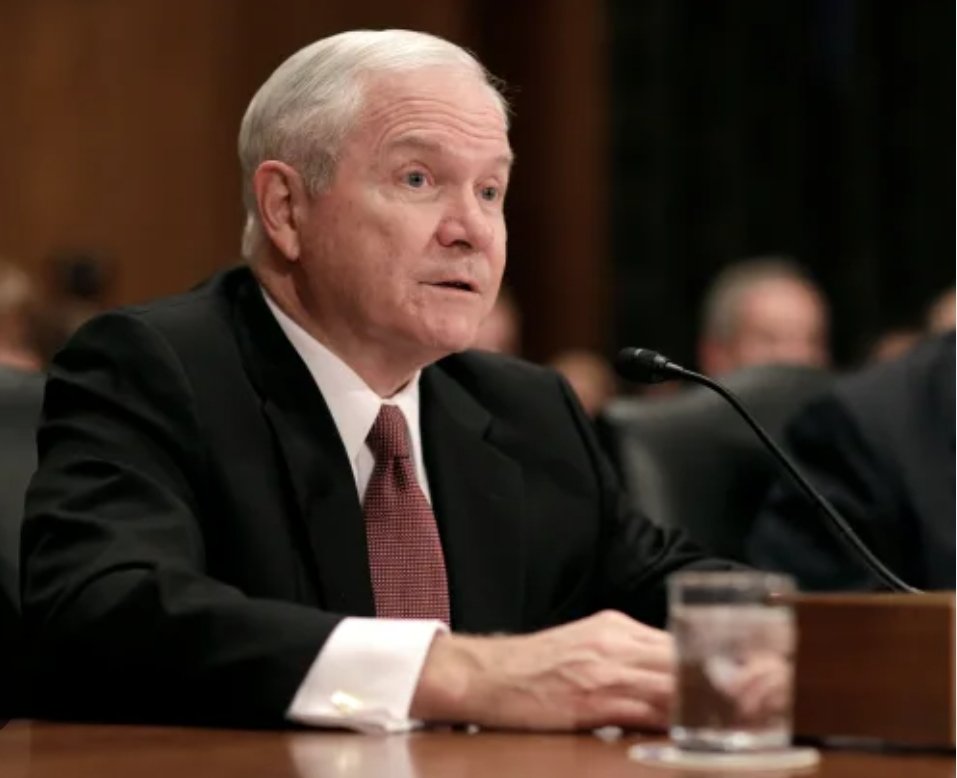
For years, Robert Gates has been one of Washington’s most clear-eyed realists — a man who served both Republican and Democratic presidents and rarely indulges in alarmism. That is why his latest warnings on Face the Nation deserve far more than a routine news cycle glance.
In a single interview, the former Defense Secretary painted a portrait of a United States facing its most complex and dangerous strategic moment since the Cold War — perhaps even more treacherous, because this time America confronts not one peer competitor, but two nuclear rivals working in uncomfortable alignment.
Gates’ central thesis is blunt. China and Russia together represent a deeper, more versatile challenge than the Soviet Union ever posed. Where Moscow once offered a singular military-ideological threat, today’s axis combines Beijing’s manufacturing dominance and technological ambition with Russia’s willingness to upend international norms.
The result is a world of simultaneous crises, Europe, the Indo-Pacific, and the Middle East stretching American resources and attention to the breaking point.
Gates correctly resists the hype that calls China a full peer. The United States still holds meaningful advantages in military quality, economic dynamism, and innovation ecosystems. Yet his description of Beijing as a “near peer” should unsettle policymakers.
The gap is narrowing in precisely the areas that matter for long-term competition: shipbuilding, drone swarms, hypersonics, and industrial resilience.
The recent Trump-Xi meeting, Gates suggests, was less about grand bargains than mutual exhaustion — both sides desperate to prevent the relationship from spiraling into open economic warfare. This pragmatism is understandable, but it also reveals a deeper truth: America is managing decline in relative power rather than reversing it.
On Taiwan, Gates’ defense of strategic ambiguity is prudent in the short term, yet one wonders how sustainable it remains as Chinese military capabilities mature. His warning that a full invasion is unlikely misses a larger point — Beijing doesn’t need to invade if it can successfully blockade, isolate, or politically subvert the island.
The fact that previous US arms packages remain undelivered due to empty stockpiles is not merely logistical; it is a damning indictment of decades of procurement complacency.
Robert Gates’ analysis of the Iran situation is perhaps his most realistic — and most politically inconvenient. Military strikes have bought time: facilities damaged, scientists eliminated, enriched uranium harder to access. But as he notes, only serious diplomacy that verifiably removes or neutralizes fissile material can close the pathway to a bomb.
The pattern is familiar, tactical successes that fail to deliver strategic resolution.His skepticism about regime change via external pressure is equally sharp. Netanyahu, Gates implies, may have overestimated the fragility of the Islamic Republic.
Decades of sanctions, isolation, and now direct strikes have not produced the popular uprising many hoped for. Internal controls remain robust; fear still trumps discontent. Real change, if it comes, will likely stem from elite fractures rather than street protests.
This raises uncomfortable questions. Have recent operations simply delayed the problem while hardening Iranian resolve and accelerating its covert programs?
Robert Gates’ domestic observations cut close to the bone. He supports shaking up the Pentagon’s sclerotic bureaucracy and injecting fresh industrial blood into weapons production — a long-overdue necessity.
Yet he issues a pointed warning: large-scale firings of senior officers without clear public justification erode trust. In an era of deep institutional skepticism, secrecy around personnel purges is not strength; it is a liability.
His defense of the College of William & Mary against “woke breeding ground” attacks feels like a necessary corrective. Elite universities are hardly perfect, but dismissing institutions with active ROTC programs and regular officer commissioning as hostile to the military is lazy rhetoric that solves nothing.
Gates’ closing remarks on Cuba highlight a blind spot in much of the foreign policy conversation. The real danger is not another Caribbean missile crisis but state collapse producing a refugee wave that could dwarf the 1980 Mariel boatlift.
Failed states on America’s doorstep have a way of exporting their misery northward. Most urgently, Gates hammers on the hollowing out of U.S. weapons inventories. Precision munitions, Patriot systems, THAAD, and Standard Missiles are running low after years of sustained operations.
This is not a minor supply issue, it is a strategic vulnerability that adversaries can exploit. His call for wartime urgency in production is correct, yet it exposes a deeper failure: America has been fighting 21st-century conflicts with a 20th-century industrial base mindset.
Robert Gates is not a defeatist. His message is one of urgent realism rather than despair. The United States retains formidable strengths, but it is operating in an environment where margin for error has shrunk dramatically.
The China-Russia tandem, an emboldened Iran, fragile supply chains, and depleted arsenals create a perfect storm.
The real question this interview forces upon Washington, and the American public, is whether the country still possesses the political will, industrial discipline, and strategic patience to compete effectively over the long haul.
Robert Gates has issued a warning. The danger now is that policymakers hear the words but fail to internalize the scale of adaptation required.
History rarely forgives great powers that confuse tactical wins with enduring advantage. In this new era of great-power convergence, America cannot afford to keep muddling through.


Naorem Mohen is the Editor of Signpost News. Explore his views and opinion on X: @laimacha.