


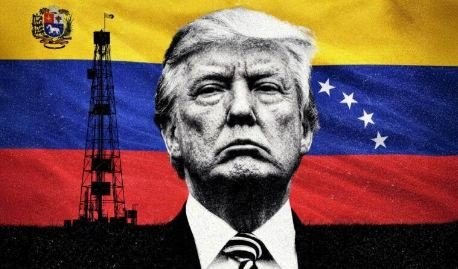
Donald Trump said that he was “seriously considering” making Venezuela the 51st US state. He even posted a provocative map on Truth Social with Venezuela draped in the American flag. The real motive was never hidden, the country’s estimated $40 trillion in oil reserves — the largest proven deposits on Earth, locked in the vast Orinoco Belt.
This was not statesmanship. It was raw imperial appetite wrapped in the rhetoric of opportunity. The contradiction is glaring and grotesque. While Trump’s administration accelerates mass deportations, branding Venezuelan migrants as dangerous “criminal aliens” tied to gangs like Tren de Aragua, and shipping hundreds to facilities in El Salvador under the Alien Enemies Act, the same voices now dream of absorbing their homeland.
One moment they are threats to be expelled; the next, their territory is a glittering prize to be annexed. This is the fractured soul of “America First” — a doctrine that sees the Global South only as danger or dominion, never as sovereign equals.
This sudden fixation on Venezuela did not arise from nowhere. It is a clear pivot born of frustration following Trump’s stalled ambitions in the Middle East.
At the International Court of Justice in The Hague, Venezuela’s acting president Delcy Rodríguez stood firm with the quiet dignity of a nation that has repeatedly refused to kneel. “Venezuela is not a colony, but a free country,” she declared on Monday.
Her words, spoken amid hearings on the oil-rich Essequibo dispute with Guyana, carried the weight of history — a history carved through anti-colonial resistance and an unyielding assertion of sovereignty. Delcy’s voice has rejected the idea that smaller nations exist merely as pawns or prizes for the powerful.
In early 2026, the administration, hand-in-glove with Israel, launched sweeping strikes aimed at destroying Iran’s nuclear programme, removing its leadership, and forcing regime change. Trump hailed tactical successes — hits on nuclear sites and military targets.
Yet the larger strategic goals collapsed. Iran’s capabilities were not eliminated. The regime hardened rather than crumbled. Tehran responded with asymmetric force: disrupting the Strait of Hormuz, driving up global energy prices, and inflicting economic pain felt across America and its allies.
What began with bold deadlines and boasts of “obliteration” slid into a messy stalemate. Cease-fires broke down. Negotiations achieved little. Iran’s resilience through proxies, energy leverage, and sheer endurance laid bare the limits of Washington’s military-first approach. Domestic costs mounted. Oil prices surged.
Another Middle Eastern quagmire loomed. The Iran policy, sold as a decisive break from past weakness, instead exposed the dangers of overreach without strategy or broad support. Political capital drained away.
With momentum lost in the Persian Gulf, eyes turned once more to Latin America’s resource-rich prize. Venezuela, long viewed as a thorn under Chavista rule, now looked vulnerable. Following U.S.-backed efforts that helped remove Nicolás Maduro earlier this year — paving the way for Delcy Rodríguez as acting president — Trump sensed an opening.
Over 300 billion barrels of proven reserves, far exceeding Saudi Arabia’s, sit mostly as heavy crude in the Orinoco region. Add Venezuela’s strategic Caribbean coastline, vital shipping lanes, and mineral wealth, and the temptation for those who see nations as extraction opportunities becomes irresistible.
But this is no innocent economic courtship. Trump’s annexation talk revives the oldest imperial reflex: the belief that power justifies redrawing maps and absorbing territories under the banners of stability, democracy, or mutual benefit.
History warns us repeatedly. From the Philippines and Hawaii to repeated interventions in Central America and the recent Middle East misadventures, such ventures begin with grand promises and end in resentment, instability, and strategic regret.
Venezuela has already suffered years of sanctions, economic warfare, political turbulence, and external meddling. Its people, hardened by hardship, have no desire to swap one set of burdens for the Stars and Stripes. Rodríguez’s statement in The Hague was not rhetoric — it was the clear voice of a nation claiming its right to self-determination.
Venezuela’s defiance echoes that same spirit. It reminds us why sovereignty and self-rule remain sacred, especially when resource wealth draws covetous eyes. The contradictions in Trump’s posture erode America’s moral authority.
Demonising Venezuelan migrants as invaders while treating their homeland as domestic real estate reveals a purely transactional worldview stripped of principle. Genuine leadership would seek diplomacy, fair trade, equitable energy partnerships, and respect for international norms. Instead, we see bluster that excites domestic crowds but alienates the Global South.
Nations across Latin America, Africa, and Asia recognise this familiar pattern. China and Russia have strengthened ties with Venezuela precisely by offering alternatives to such heavy-handedness. Trump’s fantasy only accelerates the shift toward a multipolar world that further dilutes U.S. influence.
Practically, the idea collapses under reality. Annexing a sovereign nation of more than 28 million people as a U.S. state would demand congressional approval, genuine Venezuelan consent (which is emphatically absent), and constitutional contortions that defy logic.
It ignores deep cultural, linguistic, and political differences. Forced unions breed instability, as seen from Soviet experiments to recent nation-building failures. Venezuela’s genuine challenges in governance, economy, and social cohesion cannot be solved by absorption. They require internal resolution supported by respectful external engagement.
This moment also reveals larger truths about our changing world. The unipolar era has ended. Rising powers and regional assertions have made old-style annexations relics of a dead age. Trump’s Iran setbacks showed the cost of confrontation without strategy; the Venezuelan daydream risks repeating the mistake in America’s traditional backyard.
Desperation for quick victories after strategic frustration often breeds miscalculation. Talk of $40 trillion in oil may thrill rally audiences, but empires built on extraction eventually collapse under resistance and overstretch.
Sovereignty is not bargaining currency. Free nations will defend it, as Venezuela has done with steel in The Hague. Its oil belongs to its people, not as bait for foreign ambition. Donald Trump’s territorial fantasy is not a bold vision but a symptom of frustration.
After the Iran stalemate, the gaze shifts south in search of easier prizes. Yet nations are not trophies to be claimed when other fronts falter. True strength lies in restraint, respect, and equal partnership. History’s verdict is clear: those who treat the world as their private estate plant the seeds of their own decline.
The international community is watching. Latin America, shaped by long memories of interventionism from the Monroe Doctrine onward, will not forget. Asia and Africa, still guarding their postcolonial dignity, see their own reflections in Venezuela’s stand.
Venezuela remains Venezuelan. That plain truth, spoken with dignity in The Hague, should sober the daydreamers in Washington. Resource wealth may tempt, but dignity endures. Partnership rooted in equality will always outlast the illusion of conquest. The world has long moved beyond colonial maps. It is time for policymakers to do the same.


Naorem Mohen is the Editor of Signpost News. Explore his views and opinion on X: @laimacha.