


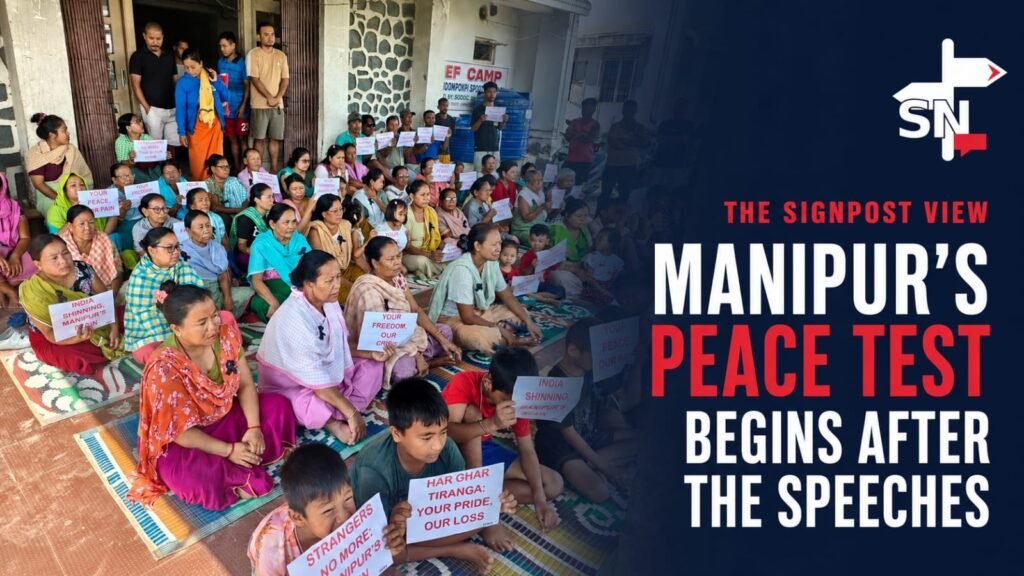
Mutual trust, justice and dignity are the right promises. Their meaning will now be measured by surrendered weapons, open highways, impartial investigations and the safe return of displaced families.
KEY POINTS
- Manipur’s peace must be measured through disarmament, open highways, impartial justice and the safe return of displaced families.
- The government’s 15-day weapons-surrender deadline will matter only if enforcement remains credible and impartial.
- Highway security and uninterrupted movement are essential to restore public confidence and economic normalcy.
- Independence Day black-flag protests by displaced families exposed the distance between official assurances and lived reality.
- Mutual trust, justice, dignity and participation must now be translated into measurable outcomes.
Independence Day speeches are expected to speak of unity, progress and hope. In Manipur, however, those words now carry an additional burden: they must convince a wounded society that the state can protect life, restore lawful movement and create the conditions for people to return home.
At the state-level celebration in Imphal on August 15, Chief Minister Yumnam Khemchand Singh called for lasting stability founded on mutual trust, justice, dignity and the participation of all communities. He also said that peace was indispensable to Manipur’s development and condemned the deadly attack at Langka Naga village in Kangpokpi district. India Today NE reported that the Chief Minister promised action against those responsible.
These are the right words. Manipur needs a language that recognises every community’s security, grief and dignity. Yet the real test began when the ceremonial march-past ended.
A peace appeal becomes policy only when citizens can see what follows it.
Disarmament must be impartial
The first test is the government’s 15-day window for the surrender of illegal, looted and unauthorised weapons. The appeal applies to both the hills and the valley, and those who fail to comply have been warned of legal action.
Between February 5 and August 11, security forces recovered 1,422 firearms, 7,010 cartridges and 1,137 explosives, according to figures presented at a government programme on restoring normalcy. The PTI report carried by Rediff also said the weapons could be surrendered through local MLAs or Superintendents of Police.
The scale of these recoveries reveals both progress and the depth of the danger. Peace cannot be secured while armed power continues to exist beyond accountable institutions.
The deadline must therefore be followed by transparent enforcement. The government should publish district-wise figures showing weapons surrendered, recovered and still unaccounted for. After the amnesty period ends, possession of illegal arms must invite the same legal consequences irrespective of geography, organisation or community affiliation.
Selective enforcement would deepen mistrust. Equal enforcement would begin rebuilding it.
Highways cannot remain bargaining grounds
The second test is freedom of movement.
On August 14, the Supreme Court called for a comprehensive solution to highway blockades in Manipur. It rejected a piecemeal approach in which one route is opened while another remains obstructed. The Court described highways as the “lifeline of the common person” because they carry food, medicines, fuel and other essentials. The Statesman reported that the Court sought concrete proposals to restore and keep all highways functional.
This is not merely a transport issue. It is a test of equal citizenship.
No community should have to negotiate its right to travel, receive medicine or obtain essential commodities. No organisation should be permitted to convert a public highway into an instrument of collective punishment. Extortion, intimidation and selective movement along these routes must be treated as threats to the entire state—not as isolated local disputes.
The government needs a permanent highway-security protocol, not temporary reopening announcements. It should include secure movement for passenger and commercial vehicles, rapid response to obstruction, action against extortion, emergency medical support and a public channel for reporting disruptions.
Peace must be visible on the road.
Justice must be faster than retaliation
The third test is the response to fresh violence.
Two Naga village guards were killed and two others injured in the Langka Naga village attack in Kangpokpi district. The United Naga Council subsequently called a 24-hour shutdown across Naga-inhabited areas. India Today NE reported that the UNC demanded an impartial investigation and action against those responsible.
When justice appears uncertain, communities retreat into collective mobilisation. Shutdowns then inflict fresh hardship on people who had no role in the original crime. This cycle—violence, accusation, shutdown and counter-allegation—cannot be allowed to become Manipur’s normal political language.
The state must establish facts quickly, protect witnesses, arrest those responsible and communicate verifiable progress. Impartial justice is not simply punishment after violence; it is also a means of preventing retaliation.
Displaced families must be at the centre
Perhaps the most painful contrast on Independence Day came from relief camps.
Internally displaced people at Sajiwa, Sawombung and Akampat reportedly raised black flags to draw attention to their prolonged displacement and uncertain future. Their message was devastatingly simple: a campaign invoking a flag at every home rings differently for families who no longer have a home. They demanded a safe return, rehabilitation and restored livelihoods. “We have no meaning for ‘Har Ghar Tiranga’ as we have no ‘ghar’ now to celebrate,” the protesters said.
Financial assistance and welfare support are necessary, but relief cannot become a permanent substitute for restoration.
The government should publish a time-bound rehabilitation framework stating where return is presently possible, what security conditions are required, how damaged homes will be assessed, what compensation will be provided and what alternatives will be available where immediate return remains unsafe.
Dignity cannot remain only a word in a speech. For displaced families, it means a secure home, a livelihood, education for their children and the freedom to live without fear.
Turn the speech into a public commitment
Manipur does not need another declaration that peace is returning. It needs evidence that peace is being built.
The government can provide that evidence through a public peace-and-rehabilitation dashboard updated regularly with figures on surrendered weapons, reopened roads, extortion cases, investigations into major incidents, displaced families rehabilitated and inter-community dialogue initiatives.
Such disclosure would not solve the conflict by itself. It would, however, replace vague assurances with measurable responsibility.
The Chief Minister’s emphasis on mutual trust, justice, dignity and participation offers a sound framework. But trust will grow only through equal protection. Justice will matter only when it is impartial and timely. Dignity will be restored only when displaced citizens can rebuild their lives. Participation will be genuine only when affected communities are heard beyond ceremonial events.
The most unsettling image of Independence Day in Manipur did not come from an official parade ground. It came from relief camps at Sajiwa, Sawombung and Akampat, where internally displaced people hoisted black flags to protest their prolonged displacement and the absence of a permanent solution.
The black flags were not a rejection of freedom. They were an indictment of a peace that has still not restored homes, livelihoods, security or normal family life to thousands uprooted by the violence that began in May 2023. More than three years later, many displaced families remain uncertain about when—or whether—they can safely return.
This is why the safe and dignified return of displaced families must be treated as a central measure of peace, not as a secondary welfare issue. Numbers of recovered weapons, search operations and official meetings may indicate administrative activity, but they cannot alone establish normalcy. Until displaced families can return without fear, rebuild their livelihoods and recover a sense of dignity, Manipur cannot credibly declare that peace has arrived.
The ceremonial flag has been lowered. The speeches have ended. Manipur’s peace test has now begun.