


India has entered a troubling phase in parliamentary politics. What was once described as individual defection has now acquired a more organised and legally protected form. The new phrase is no longer “party hopping”. It is mass defection.
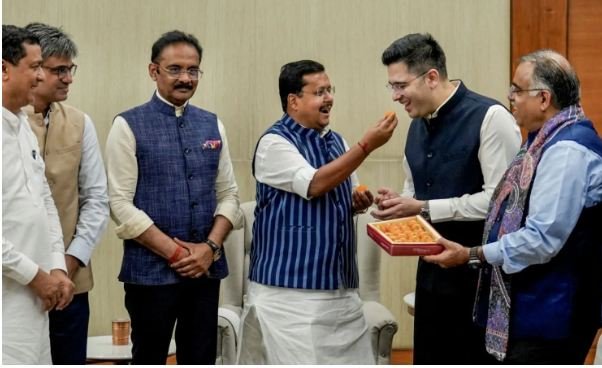
The recent movement of seven Aam Aadmi Party Rajya Sabha MPs, led by Raghav Chadha, to the Bharatiya Janata Party has brought this contradiction into sharp public focus. Reports noted that the switch was made possible because the defecting MPs met the two-thirds threshold required under the existing anti-defection framework. In AAP’s case, seven of its ten Rajya Sabha MPs reportedly crossed that number exactly.
This was followed by a deeper crisis in the Trinamool Congress. The party has approached Lok Sabha Speaker Om Birla seeking disqualification of 20 dissident MPs after they sought recognition as a separate bloc and reportedly moved towards a merger with the Nationalist Citizens Party of India. TMC leader Abhishek Banerjee has argued that MPs elected on the party symbol cannot retain their seats after joining another political formation.
In Tamil Nadu, the AIADMK has also faced a visible erosion of its legislative ranks, with India Today reporting that a fourth AIADMK MLA resigned from the Assembly and joined Chief Minister C Joseph Vijay’s TVK, after three other rebel legislators had already done so. The AIADMK has alleged political poaching and raised questions over the acceptance of resignations while anti-defection pleas were pending.
Taken together, these developments point to a larger institutional problem. The anti-defection law, created to prevent instability, has begun to reward mass defection when it is executed on a sufficiently large scale.
The Tenth Schedule was introduced during the Rajiv Gandhi government through the 52nd Constitutional Amendment in 1985. Its purpose was clear. It sought to end the culture of legislators changing sides after securing a mandate from voters under one party symbol. The law treated voluntary giving up of party membership or voting against the party whip as grounds for disqualification.
But the original law carried a major weakness. It protected splits if one-third of a legislative party broke away. That provision soon became a political instrument. Legislators were no longer merely defecting. They were calculating numbers. The law did not end defection. It changed its arithmetic.
The 91st Constitutional Amendment of 2003 removed the one-third split protection. What remained was the merger exception. Under the current law, legislators may avoid disqualification if at least two-thirds of the members of the legislative party support a merger with another party. PRS Legislative Research explains that in such a situation, neither those who agree to merge nor those who remain with the original party face disqualification.
This is the paradox at the heart of the present crisis. The law punishes small defections but protects large ones, mass defection. It discourages individual betrayal but legitimises collective migration. In practice, it tells political actors that if they wish to defect, they must do so in sufficient numbers.
That is why the present moment is not merely a crisis of morality. It is a crisis of constitutional design.
Opposition parties now describe these mass defection as a murder of democracy and theft of mandate. Their anger is understandable. A voter who elects a candidate on one party symbol does not necessarily consent to that representative joining another party midway through the term. The mandate belongs not only to the individual candidate but also to the political platform, party programme, leadership, and ideological appeal presented before the electorate.
Still, the affected parties cannot escape scrutiny. Mass defections rarely occur in healthy political organisations. They usually take place where internal consultation has weakened, leadership has become centralised, and legislators feel either ignored, insecure, or politically stranded. Many smaller parties in India are controlled by one family, one personality, or one command centre. Such structures may work during periods of electoral success. They become fragile during pressure.
The BJP undoubtedly benefits from this political churn. Its parliamentary numbers, its organisational reach, and its proximity to power make it the natural destination for many defectors. But defections cannot be explained only through the ambition of the receiving party. They also expose the weakness of the parties being emptied from within.
The INDIA bloc has often argued that it prevented the ruling alliance from reaching the psychological and constitutional strength of “400 paar”. But politics is not decided only on counting day. Numbers can change after elections when parties are unable to retain loyalty. If MPs and MLAs move in groups, the balance inside Parliament and Assemblies can change without a fresh mandate from the people.
This has serious consequences. A government that lacks a two-thirds majority after elections may gradually approach that figure through mass defection. Once that threshold is crossed, constitutional amendments become easier. The moral difference between winning a mandate and assembling one after the election becomes blurred.
The issue is not whether one party alone is guilty. India’s political history shows that nearly every major party has used defections when convenient and condemned them when damaged by them. The real issue is whether the constitutional system should allow elected representatives to carry a mandate from one party to another without returning to the people.
The present law is inadequate because it treats legislative numbers as the test of legitimacy. Democracy cannot be reduced to arithmetic alone. A two-thirds group may be numerically large, but it does not automatically possess moral authority to transfer the voters’ mandate.
A stronger reform is now necessary. Any legislator who wishes to join another party should first resign from the House and seek re-election. This principle must apply regardless of whether the defection involves one member, ten members, or two-thirds of the legislative party. The voter must remain the final authority.
A cooling off period may also be considered. Legislators who resign from one party and join another should not immediately receive ministerial office or other political reward. Without such restraint, defection becomes an investment. The public begins to suspect that ideology is merely the language used after power has already been negotiated.
There is also a need to take the power of deciding defection cases away from purely political timelines. Speakers and Chairpersons occupy constitutional offices, but they are often drawn from political parties. Delay in deciding disqualification petitions has repeatedly weakened the purpose of the law. A fixed time limit, subject to judicial review, would give the Tenth Schedule greater credibility.
The deeper lesson is for political parties themselves. Parties cannot demand loyalty only at the time of crisis. They must build internal democracy, consult legislators, respect regional voices, and create transparent mechanisms for grievance redressal. A party that treats elected representatives as ornamental numbers cannot complain when those numbers are courted elsewhere.
India’s democracy does not merely need stable governments. It needs stable mandates. The anti-defection law was meant to protect that mandate. Instead, its merger clause has created a lawful passage for mass defection, a political migration.
The country is now witnessing the consequences. The cure has not removed the disease. It has changed its form.
If Parliament is serious about protecting electoral morality, the law must be rewritten with one clear principle: no representative should be allowed to transfer the people’s mandate without returning to the people. Until that happens, mass defections will continue to wear the clothing of legality while weakening the spirit of democracy.