


The demand for separate administration in Manipur has often been discussed as if it is only an internal ethnic question. That is a limited reading of a much larger problem. The conflict that began in May 2023 has produced deep wounds, displacement, mistrust and political hardening among communities. These realities cannot be dismissed. But the politics built around separate administration has never been confined to Manipur alone. It has always drawn strength from geography, border instability, ethnic linkages across India and Myanmar, and the belief that control over strategic routes could be converted into political leverage.
This is why the latest developments in Myanmar’s Chin State matter to Manipur.
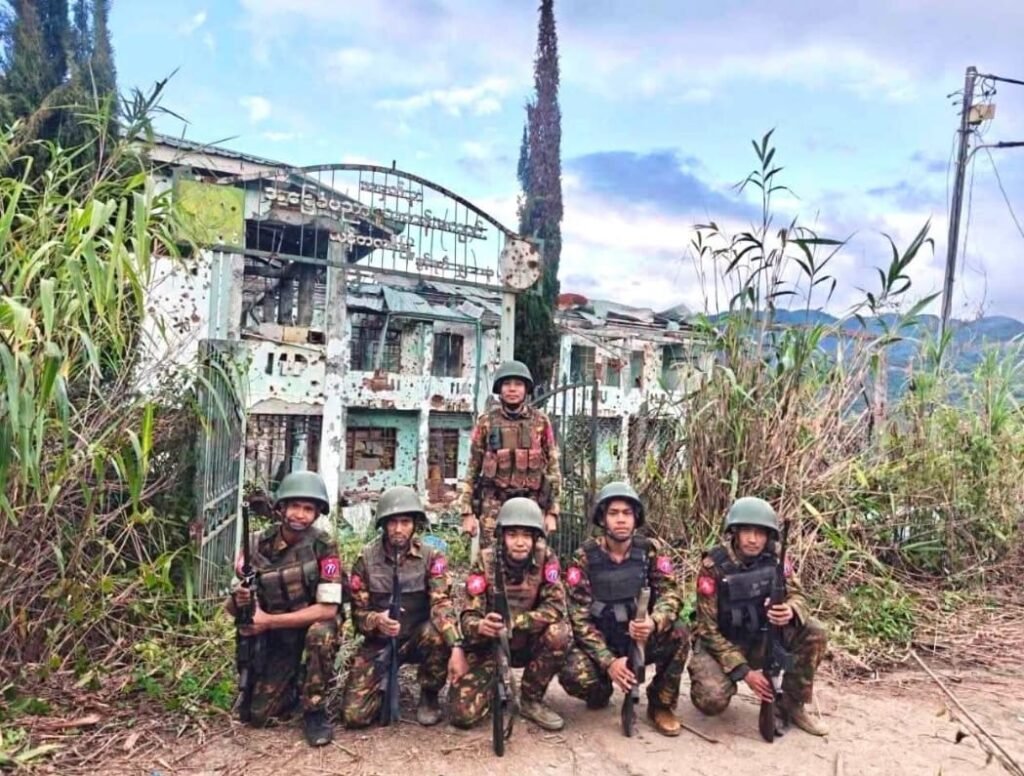
Myanmar’s military has claimed that it has regained full control over Thantlang in Chin State after successive operations against Chin armed groups. Regime media reported that the Tatmadaw regained control of the town on July 16, 2026, after operations involving the seizure of positions, weapons and military equipment. As with most claims from active conflict zones in Myanmar, this must be read with caution because independent verification is difficult. Still, even as a battlefield claim, it carries significance because Thantlang has been one of the important symbols of Chin resistance since the post-coup conflict intensified in 2021.
Thantlang is not an ordinary town in this context. Located near Hakha, the capital of Chin State, it became one of the most contested theatres between the Myanmar military and Chin resistance forces. Earlier reporting had described Thantlang township as a key resistance stronghold where Chin defence groups developed parallel public services and continued armed resistance after the 2021 coup.
Tonzang is particularly relevant to Manipur. It lies close to the India-Myanmar border and is connected geographically to northern Chin areas adjoining Manipur’s southern border belt. In May 2026, the Associated Press reported that Myanmar’s military-backed government had recaptured Tonzang after a 10-day operation, describing it as a town about 25 km east of the Indian border. Tonzang had been under the control of Chin ethnic militias and local resistance forces since May 2024.
The immediate conclusion should not be that Chin resistance has collapsed. That would be premature. Chin State remains fragmented, contested and militarised. The Arakan Army had earlier expanded its control into Paletwa Township in Chin State while making major advances in neighbouring Rakhine State, showing that Myanmar’s western front remains complex and far from settled.
But politics is not shaped only by final victory or final defeat. It is also shaped by momentum, perception and the availability of strategic depth. If the Myanmar military has regained key positions around Thantlang and the Hakha-Thantlang axis, the cross-border confidence of armed and political networks linked to the wider Chin-Kuki world is affected. This is the point Manipur and New Delhi must understand clearly.
The demand for separate administration in Manipur did not gain force only from local grievances. It also gained force from the belief that the Kuki political position could be strengthened through a wider zone of influence stretching from the hill districts of Manipur to Mizoram and further into Chin State. That imagination depended on disorder, weak borders, armed corridors, sympathetic ethnic linkages and the disruption of normal state authority. That imagination is now under pressure.
The idea that control over Kangpokpi, Churachandpur, Moreh, parts of the national highways and cross-border links could alter India’s strategic calculus was always risky. It assumed that the state would remain paralysed, that Myanmar’s western borderlands would remain favourable to anti-junta and ethnic armed formations, and that India would eventually accept political concessions in Manipur for the sake of restoring temporary calm. The shifting battlefield in Myanmar weakens that assumption.
Moreh is central to this argument. It is not merely a border town or a local commercial point. India’s official Act East Policy gives strategic importance to connectivity with Myanmar and Southeast Asia. The India-Myanmar-Thailand Trilateral Highway is described by the Government of India as a flagship project intended to connect Moreh in Manipur with Mae Sot in Thailand through Myanmar.
The Land Ports Authority of India also describes Moreh as India’s gateway to the East through the Moreh-Tamu border point and notes that it lies along the proposed 1,360 km India-Myanmar-Thailand Trilateral Highway.
This gives Manipur’s conflict a dimension beyond ethnic politics. Control over access routes to Moreh, disruption of National Highway 2 and National Highway 37, and the creation of areas where state authority is contested are not merely local law and order problems. They affect India’s eastern connectivity, border management and strategic posture.
For this reason, separatist politics in Manipur was never simply about administrative rearrangement. It was also about bargaining power. The more the conflict disrupted highways, trade routes and security movement, the more pressure was placed on Imphal and New Delhi. The calculation appeared to be that prolonged instability would force the Indian state to treat separate administration as a price for peace. That calculation must now be resisted.
The developments in Chin State indicate that the wider regional environment may no longer be as favourable to such bargaining. If armed groups across the border lose mobility, territory or confidence, their ability to provide strategic depth to related political demands in Manipur weakens. If the Myanmar military regains roads and towns, even partially or temporarily, cross-border movement becomes riskier. Supply lines become more uncertain. Rear areas become less secure. The symbolic claim of a larger ethnic political zone becomes harder to maintain. This is bad news for Kuki separatist politics in Manipur.
It is not bad news because ordinary Kuki citizens should suffer. They must not. It is not bad news because reconciliation should be rejected. It must not be. It is bad news for separatist politics because the strategic environment that gave confidence to maximalist demands is changing. When the external pillar of a political project weakens, its internal bargaining power also declines.
This is the moment for the Government of Manipur and the Union Government to act with discipline. They must not mistake the weakening of separatist leverage for the automatic arrival of peace. Nor should they allow this moment to pass through indecision. A state that fails to use a strategic opening may later find itself forced to negotiate under worse conditions.
The principle must be clear. There should be no bargaining chip for ending violence. Peace cannot be purchased by rewarding armed pressure. If separate administration is conceded because violence created ungovernable spaces, the message to every future armed movement will be dangerous. It will say that territorial disruption, blockade politics and armed mobilisation can produce constitutional reward.
The present moment also exposes the limits of performative peace initiatives. Reports of church leaders from Manipur, Nagaland and Mizoram attempting to facilitate talks may have value if they help reduce hatred, restore communication and persuade communities to stop violence. Religious and civil society leaders can contribute to reconciliation at the social level. But they cannot decide constitutional questions. They cannot negotiate territorial restructuring. They cannot replace the authority of the state.
Any peace initiative that creates the appearance of dialogue while protecting the substance of separatist bargaining will only prolong the crisis. Manipur does not need theatrical mediation. It needs verifiable commitments: surrender of illegal arms, reopening of highways, safe movement of civilians, cooperation with investigation agencies, return of displaced persons where possible, and restoration of lawful administration in all districts.
The Centre must also read the Naga factor carefully. Manipur’s conflict cannot be reduced to a Meitei-Kuki binary. Naga communities have their own historical anxieties, territorial concerns and political positions. Any administrative arrangement that redraws authority in the hills without addressing Naga concerns will create another zone of resentment. The current conflict has already shown how fragile inter-community trust has become. A rushed political concession to one side may unsettle others.
This is why separate administration is not a legitimate solution. It may appear attractive to those who believe that physical separation can reduce violence. But administrative separation imposed after ethnic violence would harden the logic of segregation. It would convert conflict lines into political lines. It would reward the creation of no-go zones. It would weaken the idea of Manipur as a shared constitutional space. A responsible state cannot accept such an outcome.
The correct way forward lies in restoring normalcy through law, security and institutional reform. The highways must be reopened fully and permanently. No community or armed formation should be allowed to determine who travels on a National Highway. Relief and rehabilitation must be transparent. Serious crimes must be investigated professionally. Illegal weapons must be recovered. Security forces must act without ethnic bias. Border management must be strengthened without ignoring humanitarian realities.
At the same time, political dialogue should continue, but only within the Constitution. Dialogue should address local governance, development deficits, representation, land, policing, district administration, displaced populations and inter-community confidence building. It should not begin with the assumption that violence has already earned territorial concession.
The developments in Myanmar offer India a chance to correct the strategic imbalance created by the Manipur crisis. For too long, the state appeared reactive. It responded to incidents rather than shaping outcomes. It allowed blockades, armed positions, propaganda and displacement to create political facts. That must end.
New Delhi must also coordinate its Manipur policy with its Myanmar policy. The Act East Policy cannot succeed if Manipur remains internally fractured. The Moreh-Tamu route cannot become a reliable gateway if armed politics controls access on the Indian side. The India-Myanmar-Thailand Trilateral Highway cannot be treated as only an infrastructure project. It is a test of state capacity, border stability and internal cohesion.
There is also a deeper lesson. Armed politics often appears powerful when states are weak, borders are porous and public fear is high. But such power is unstable. It depends on circumstances beyond its control. A shift in Myanmar, a military counteroffensive, a change in regional alliances, pressure on supply lines or fatigue among ordinary people can alter the balance quickly. That is what may be happening now.
The separate administration demand may not disappear immediately. It may continue as a slogan, a community position and a negotiation tactic. But its strategic confidence has been shaken if the cross-border environment that sustained it becomes uncertain. This is the meaning of the Myanmar developments for Manipur.
For Imphal and New Delhi, the lesson is clear. Do not negotiate from fear. Do not reward coercion. Do not confuse reconciliation with surrender. Restore authority, secure justice and rebuild coexistence.
Manipur requires peace, but not peace at any constitutional cost. It requires dialogue, but not dialogue conducted under the shadow of armed pressure. It requires healing, but not political fragmentation imposed by violence.
Myanmar’s shifting battlefield is bad news for Kuki separatist politics in Manipur because it weakens the larger strategic imagination behind the demand. The Indian state must now use this opening wisely. The purpose should be the restoration of lawful authority, the protection of all citizens and the prevention of separatist bargaining from acquiring another life through delay and confusion.


Naorem Mohen is the Editor of Signpost News. Explore his views and opinion on X: @laimacha.