


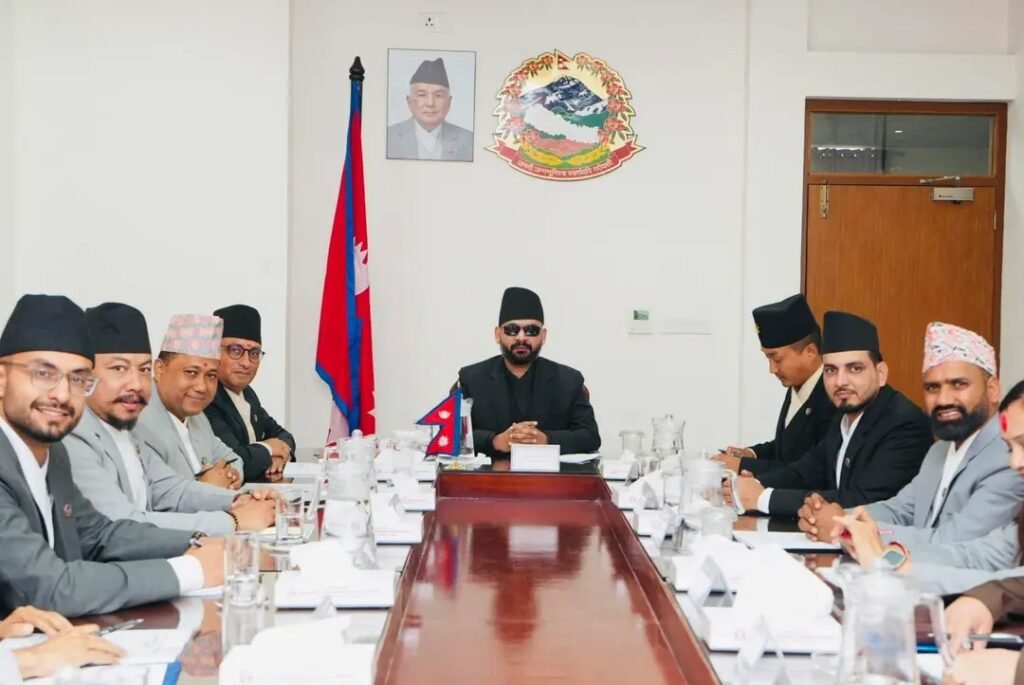
Nepal is sending a powerful signal to the entire South Asian region. Public office must serve the people, not private families. In a swift and decisive move on April 9, 2026, Prime Minister Balendra Shah—popularly known as Balen Shah—removed Labour, Employment and Social Security Minister Deepak Kumar Sah from his post, barely two weeks after his appointment.
The reason was clear and unambiguous. Deepak Kumar Sah allegedly misused his official position to facilitate the continued role of his wife, Junu Shrestha, as a member of the Health Insurance Board, an institution that had remained largely inactive for a long time.
This was no knee-jerk reaction. The decision came on the formal recommendation of the Rastriya Swatantra Party (RSP), the ruling party led by Rabi Lamichhane. Lamichhane wrote directly to the Prime Minister, citing the findings of the party’s central disciplinary committee.
The committee concluded that Deepak Sah had violated standards of official conduct and party principles by abusing his authority for personal benefit. Invoking the party’s “right to recall” provision, the RSP urged immediate action.
Prime Minister Balen Shah acted promptly, relieving Deepak Sah of his duties and also directing a caution to Health and Population Minister Nisha Mehta for not handling the matter with sufficient seriousness.
This episode is remarkable not just for its speed but for its substance. In much of South Asia, nepotism in politics is often tolerated as “normal” family politics. Ministers appoint relatives to boards, commissions, or advisory roles with little consequence.
Nepal under Balen Shah is challenging that norm head-on. The message is loud and clear. In Nepal, public office is not a family business. It is a position of public trust that demands integrity, transparency, and accountability.
To understand why this matters, we must look at Nepal’s recent political journey. The country dramatically overthrew its centuries-old monarchy in 2006 through the second People’s Movement (Jana Andolan II). Widespread protests against King Gyanendra’s direct rule forced the restoration of parliament, leading to peace with the Maoists, constituent assembly elections, and the abolition of the monarchy in 2008.
That revolution ended absolute royal rule but failed to eliminate deep-rooted problems: chronic corruption, political instability, patronage networks, and elite capture by traditional parties.
Frustration boiled over again in 2025 when youth-led protests erupted against governmental mismanagement and violence. These protests, driven largely by Gen Z and young professionals, toppled the previous establishment and paved the way for fresh elections.
The Rastriya Swatantra Party, a relatively new force, rode this wave of discontent to a strong mandate. Balen Shah, a 35-year-old former rapper, structural engineer, and successful mayor of Kathmandu, emerged as Nepal’s youngest Prime Minister. His cabinet is strikingly youthful, with many ministers in their thirties or early forties, bringing new energy and perspectives unburdened by decades of old-style politics.
One of the most visible early reforms is the crackdown on VIP culture. Home Minister Sudan Gurung has issued clear directives: no more special treatment for politicians or high officials on the roads. Traffic police have been empowered to stop any vehicle, including ministerial convoys, if rules are violated.
Viral videos show Gurung’s own convoy yielding to regular traffic, with the minister publicly stating that officials are citizens first. This symbolic yet practical step dismantles the psychology of privilege that has long separated rulers from the ruled in the region.
The sacking of Deepak Kumar Sah complements this cultural shift with institutional accountability. Allegations against Deepak Sah went beyond the family appointment. Reports highlighted his prior associations with labor consultancies involved in sending Nepali workers abroad and claims of continued “backdoor meetings” even after assuming office.
The RSP’s disciplinary process was thorough: investigation, committee findings, formal recommendations, and swift execution by Prime Minister Balen Shah. This internal self-correction is rare in coalition politics, where parties often shield their own to protect numbers and alliances.
By acting so decisively, Balen Shah and the RSP are setting a precedent. Public office cannot be treated as an extension of the family enterprise. When a minister uses influence to place a spouse on a government board—especially one that had been inactive—it erodes public trust and undermines the very purpose of governance.
The fact that Janu Shrestha had reportedly been removed earlier for repeated absences only intensified the perception of abuse of power.
Nepal’s developments carry important lessons for neighboring countries facing similar challenges. Dynastic politics, nepotism, and VIP privileges remain persistent issues across the region. In many places, family members of leaders routinely occupy influential positions in boards, corporations, or advisory roles, often sparking accusations of conflict of interest.
Road blockades for VIP movements continue to inconvenience ordinary citizens daily. Nepal is demonstrating that change is possible when common citizens demand better through sustained pressure and electoral choice.
The 2006 revolution showed that mass mobilization can overthrow entrenched regimes. The 2025–2026 transition under Balen Shah adds another layer that once in power, youthful leadership can institutionalize accountability and challenge old cultures of entitlement.
Of course, Nepal’s journey is far from complete. The economy remains vulnerable, heavily dependent on remittances from migrant workers—a sector ironically linked to the Labour Ministry. Youth unemployment and outward migration persist.
The ambitious 100-point reform agenda announced by the government, which includes asset declarations for past leaders, digital transparency platforms, mandating public schooling for officials’ children, and removing personal photos from government offices, will require consistent implementation.
Some may argue that such rapid actions risk instability or reflect inexperience. However, the early signals are encouraging. Ministries functioning without crowds of sycophants, focus on service delivery, and a clear emphasis on equality and merit. The inclusion of young, educated leaders brings fresh ideas to critical areas such as employment generation, health insurance reform, and labor rights.
Sustainability will depend on whether these moves remain consistent and non-selective. Selective accountability can quickly lose credibility. If the government applies the same standards across the board—regardless of party affiliation or personal connections—it can build lasting public trust.
By enforcing accountability within its own ranks just weeks into the new government, the RSP and Prime Minister Balen Shah are proving that ethical governance is not idealism—it is pragmatic, effective politics that can restore faith in democracy.
South Asia would do well to watch and learn. When public office stops being treated as a family business and starts being treated as a sacred trust, ordinary citizens benefit the most. Nepal’s young leadership is showing the way.


Naorem Mohen is the Editor of Signpost News. Explore his views and opinion on X: @laimacha.