


A recent opinion published in The Hills Journal under the name Sushma Sharma, with no clear credential or public accountability, carried the title “Accountability in Action: Human Right Bodies Questions BJP’s Failure for Manipur’s Christians’ Crisis”. The article presents the Manipur conflict as a case of BJP enabled persecution of Kuki Christians.
The problem is not that it questions the government. The government must be questioned. The problem is that it hides behind selective human rights language while reducing Manipur’s complex ethnic, territorial and political conflict into a simplistic Hindu versus Christian story.
That is not accountability. That is propaganda.
This needs to be rebutted clearly.
The problem is that the article uses the language of human rights to promote a narrow propaganda frame. It presents Kukis only as Christian victims, Meiteis as Hindu aggressors and the BJP as the enabling force behind a religious crisis. This is not serious analysis. It is political simplification.
Manipur’s tragedy did not begin as a religious war. It emerged from a deep and unresolved conflict shaped by land, identity, poppy cultivation, the state government’s action against Kuki militants under the Suspension of Operation agreement, eviction drives of encroachers from reserved and protected forests, concerns over illegal migration, the presence of armed groups, demographic anxieties, territorial claims and the collapse of trust between communities. The Meitei demand for inclusion in the Scheduled Tribes list also became a trigger, creating the occasion for the rally organised on May 3, 2023. Religion may shape identity and attract external sympathy, but it is not the root cause of the violence.
To call it simply a “Christians’ crisis” is to erase the suffering of many others.
Since 3 May 2023, Kukis have suffered. Meiteis have suffered. Nagas have suffered. Homes have been burned. Villages have been destroyed. Families have been displaced. Churches, temples, Sanamahi sacred places, public buildings and private properties have come under attack. Lives have been lost across communities. No honest account of Manipur can recognise one grief and ignore another.
That is precisely what the article does.
It cites Amnesty International, Human Rights Watch, United Nations experts and the United States Department of State to argue that Manipur’s violence reflects a failure to protect Kuki Christians. These references may raise important questions about state failure, security lapses and human rights violations. But they do not automatically prove that the conflict is religious persecution.
There is a major difference between saying that the government failed to protect citizens and saying that the government enabled a war against Christians. The first is a legitimate criticism. The second requires clear evidence. The article does not provide that evidence. It relies on implication, repetition and selective presentation.
This is where propaganda begins.
The article claims that Meiteis sought to expand their power and capture Kuki ancestral land. Such a serious allegation cannot be thrown into public discourse without serious proof. The immediate background of the conflict included the Meitei demand for Scheduled Tribe status, the Tribal Solidarity March of 3 May 2023, land insecurity, forest eviction drives, concerns over illegal migration, armed mobilisation, village defence groups, competing territorial claims and deep historical mistrust between hills and valley.
To reduce all this to Meitei greed against Christian Kukis is dishonest.
The Scheduled Tribe issue is also distorted. The article suggests that Meiteis demanded ST status only to gain access to tribal land in the hills. This is a misleading argument. ST status by itself does not automatically give any community unrestricted right to occupy hill areas. Land ownership and settlement in Manipur are governed by constitutional provisions, state laws, administrative boundaries, local regulations and special protections.
The ST demand is open to debate. Hill communities have genuine concerns. Meitei organisations have their own arguments about constitutional protection, identity and demographic vulnerability. But disagreement over ST status cannot be reduced to a land grabbing conspiracy. That may serve propaganda, but it does not serve truth.
History further weakens the religious persecution narrative.
Manipur witnessed the Kuki Naga conflict of the 1990s, which killed hundreds and displaced many. Both communities had a strong Christian presence. That conflict was not described as Christian persecution. It was understood as an ethnic and territorial conflict.
The Kuki Paite conflict of 1997 and 1998 devastated villages and displaced thousands. Both sides were largely Christian. It was not called a religious war. It was linked to identity, local dominance, armed mobilisation and political representation.
Moreh has witnessed violence involving Kukis, Tamils and Meiteis. Assam has seen Karbi Kuki clashes. Tensions have also occurred within the broader Kuki Zo family, including among Hmar, Zomi and other groups. These conflicts were not explained through religion. They were shaped by ethnicity, territory, authority and power.
Why, then, is the Meitei Kuki conflict alone being sold internationally as a Hindu Christian war?
The answer is political convenience.
Because the BJP was in power in Manipur and at the Centre, outside commentators found it easy to impose a familiar global template: Hindu government, Christian minority, religious persecution. This framing is attractive for international advocacy. It is simple, emotional and politically useful. But Manipur cannot be understood through imported templates.
The Meitei community is not a single Hindu block. Many Meiteis follow Sanamahi faith. Many are Hindus. Some are Christians. Kukis are not only a religious category. Nagas are largely Christians too, but their suffering is often ignored when it does not fit the selected narrative.
This selective sympathy is dangerous.
When Kuki Christians suffer, international voices speak loudly. Their suffering must be recognised, their displacement must be addressed, and their insecurity must never be ignored. But accountability cannot be selective. When Meitei civilians are displaced from hill areas, when Thadou Christians and Naga Christians are killed, when temples are burned, when Sanamahi sacred sites are damaged, when valley villages come under attack, and when public institutions are destroyed, the same human rights vocabulary suddenly becomes quieter.
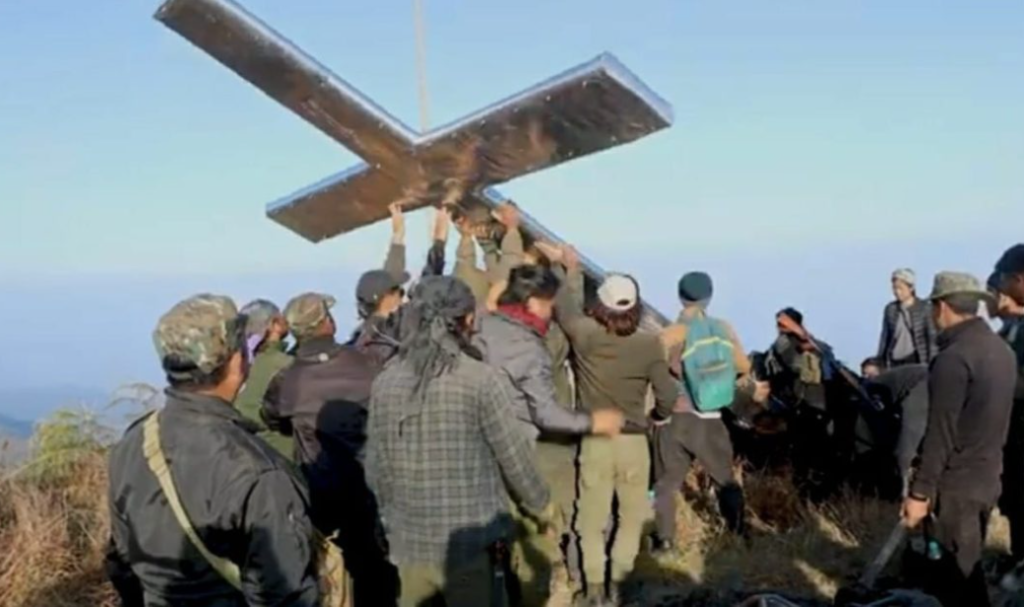
One painful example is the reported installation of a cross sign at Thangjing peak, a sacred site deeply revered by the Meitei as the abode of Ibudhou Thangjing. For the Meitei people, Thangjing is not merely a hill or a geographical location. It is a living sacred space tied to faith, memory, ancestral worship and the cultural soul of Manipur. Similarly, the alleged defacement of Koubru Laiphamlen, another sacred place associated with Meitei faith and civilisational memory, has caused deep pain among the people. Koubru is not just a mountain. It occupies a sacred place in Meitei belief, history and identity.
To damage, deface or overwrite such sacred spaces with another religious symbol is not an ordinary act. It becomes a statement of cultural domination over another community’s spiritual heritage. If the burning or occupation of a church is rightly condemned as religious desecration, then the damage to Thangjing, Koubru Laiphamlen or any Sanamahi sacred place must also be condemned with the same moral force.
That is not human rights. That is selective politics.
A genuine human rights position must speak for every victim. It cannot recognise suffering only when it serves a political argument. It cannot present one community as the permanent victim and another as the permanent aggressor. It cannot highlight churches while ignoring temples, Sanamahi sacred sites, homes, schools and public institutions. It cannot speak of displacement only when the displaced belong to one side.
Who can forget the pain of Jiribam, where even an eight month old child was not spared, and where six innocent Meitei women and children were killed? Who can speak of human rights and remain silent when Naga civilians, including pastors, were brutally killed? Which church leader, human rights advocate or international observer can close their eyes to the horror of those six Naga civilians whose bodies bore the marks of unspeakable violence?
If the language of justice is to have any moral value, it must be applied equally. The suffering of Kuki Christians must be acknowledged, but so too must the suffering of Meiteis, Nagas, Thadous and every other community caught in Manipur’s tragedy. Selective compassion is not human rights. It is politics wearing the mask of morality.
Such writing does not bring justice closer. It deepens division.
The article also avoids one of the most uncomfortable questions in Manipur: the role of armed groups. Any serious discussion of the crisis must examine Suspension of Operations groups, illegal weapons, village defence networks, extortion, territorial control, cross border movement and the erosion of public trust in security institutions. These are central to understanding the conflict.
The article avoids these questions because they disturb the clean story it wants to sell.
A conflict involving land, armed actors, border anxieties, territorial demands and institutional collapse cannot be honestly described as a simple attack on Christians. That framing may help advocacy abroad, but it weakens public understanding at home.
The demand for separate administration is another example. The article presents it as if it is the natural moral answer to the crisis. It is not. It is a political demand supported by some groups and opposed by others. For Kuki groups, it may appear as protection. For Meiteis, it appears as a threat to Manipur’s territorial integrity. For Nagas, any territorial restructuring carries its own historical and political implications.
Therefore, separate administration cannot be treated as a human rights verdict. Any lasting solution must protect all communities, ensure the safe return of displaced persons, address land disputes, restore rule of law and punish all perpetrators without community preference.
Manipur does not need faceless propaganda. It needs truth.
If Meitei individuals or groups committed crimes, they must be punished. If Kuki individuals or groups committed crimes, they must also be punished. If state actors failed, they must answer. If armed groups violated civilian rights, they must not be protected by silence. If security agencies failed to act impartially, that failure must be investigated.
Justice cannot have a community preference.
The BJP government’s failure in Manipur deserves criticism. The inability to restore normalcy, secure free movement, protect displaced citizens and rebuild trust reflects a serious institutional failure. But criticism of the government must not become a license to misrepresent the conflict.
Calling Manipur a Christian crisis may help international lobbying, but it is historically weak and morally selective. It ignores earlier conflicts among Christian communities. It erases Meitei and Naga suffering. It hides the territorial and political roots of the violence. It turns government failure into religious conspiracy without proving the link.
This is not accountability. It is propaganda wearing the language of accountability.
Manipur’s people have endured enough. They do not need nameless or faceless writers using their suffering to serve external narratives. They need careful truth, impartial justice and institutional accountability. They need a public discourse that recognises all victims and names all failures.
The world must speak for all victims, not only those useful to a narrative.


Naorem Mohen is the Editor of Signpost News. Explore his views and opinion on X: @laimacha.