


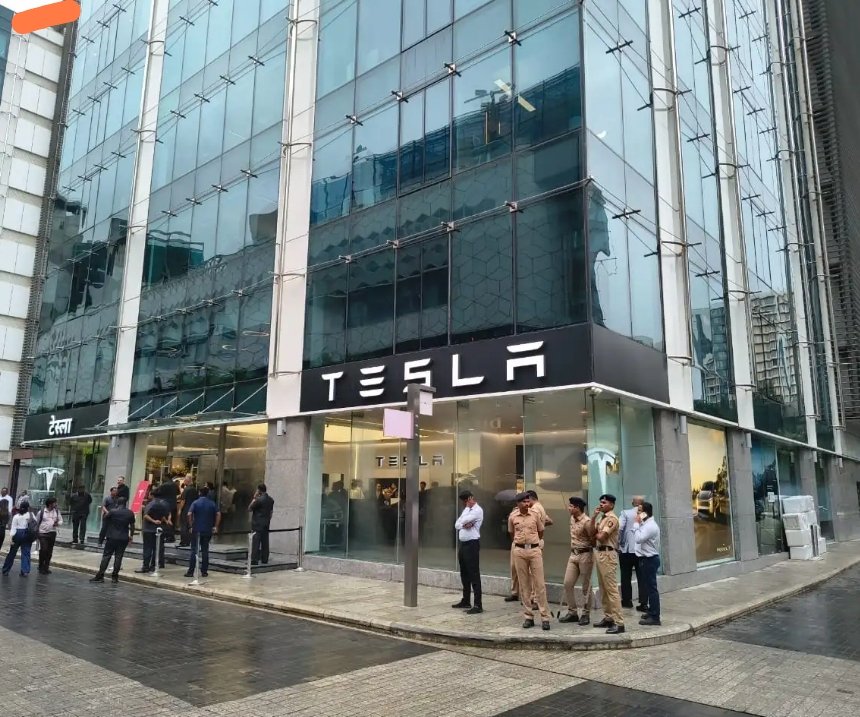
Maharashtra Chief Minister Devendra Fadnavis welcomed Tesla’s grand entry into India with the launch of its inaugural Experience Centre in Mumbai’s bustling Bandra Kurla Complex today. He urged the electric vehicle (EV) giant to deepen its roots in India by establishing research, development, and manufacturing hubs in the state, positioning Maharashtra as a key ally in Tesla’s global journey.
Speaking at the opening ceremony, Fadnavis described Tesla’s arrival as a powerful endorsement of Mumbai’s and Maharashtra’s economic dynamism. “This is more than a showroom—it’s a testament to Tesla choosing the right city and state for its Indian debut,” he said. He highlighted Mumbai’s role as India’s financial, commercial, and innovation powerhouse, calling it a hub for entrepreneurship and sustainability.
Fadnavis emphasized Tesla’s unique identity, stating, “Tesla isn’t just about cars; it’s a symbol of cutting-edge design, innovation, and eco-conscious mobility.” Reflecting on a personal anecdote, he recalled his first Tesla ride in the U.S. in 2015, expressing delight that a decade later, the brand has finally arrived in India. “India is ready for Tesla, and I’m confident this will become one of your biggest markets,” he told the company.
The Maharashtra CM also highlighted Maharashtra’s readiness to support the EV revolution, pointing to the state’s robust policies on charging infrastructure, vehicle promotion, and manufacturing incentives. “We’re not just a market; we’re a manufacturing powerhouse with policies designed to drive growth in electric mobility,” he said, signaling the potential for Tesla to reshape India’s automotive segment.
Industry sources reveal that Tesla has already shipped an initial batch of Model Y rear-wheel drive SUVs from its China facility to India. The company recently leased a 24,565-square-foot warehouse in Mumbai’s Lodha Logistics Park for five years, signaling plans to scale up operations. However, Union Heavy Industries Minister H D Kumaraswamy noted in June that while Tesla is keen on establishing showrooms in India, it has shown no interest in local manufacturing.
The Indian government has rolled out a new EV policy to attract global players like Tesla, easing import duties for manufacturers investing at least ₹4,150 crore in local facilities. Under the scheme, companies can import up to 8,000 fully assembled EVs annually, valued at $35,000 or more, at a reduced 15% customs duty for five years. This is a sharp drop from the standard 60-100% duties on completely built units (CBUs), depending on the vehicle’s cost. The policy targets global firms with annual revenues of ₹10,000 crore and fixed assets worth at least ₹3,000 crore.
This move aligns with India’s ambition to become a global EV manufacturing hub, with the automotive sector—currently valued at ₹12.5 lakh crore—projected to double to ₹24.9 lakh crore by 2030. The sector contributes 7.1% to India’s GDP and ranks as the world’s third-largest and fastest-growing automotive market.
Tesla’s push into India follows its 2021 appeal to lower import duties on fully assembled vehicles to 15-40%, a demand largely met by the new policy. Yet, despite the favorable terms, Tesla continues to rely on its massive China-based assembly operations, showing no immediate plans to manufacture in India.
The Mumbai Experience Centre marks a pivotal moment for Tesla’s Indian journey, offering a glimpse of its futuristic vehicles to a market eager for sustainable mobility. As Fadnavis noted, “This is just the beginning, and it has the power to transform how India drives.”