


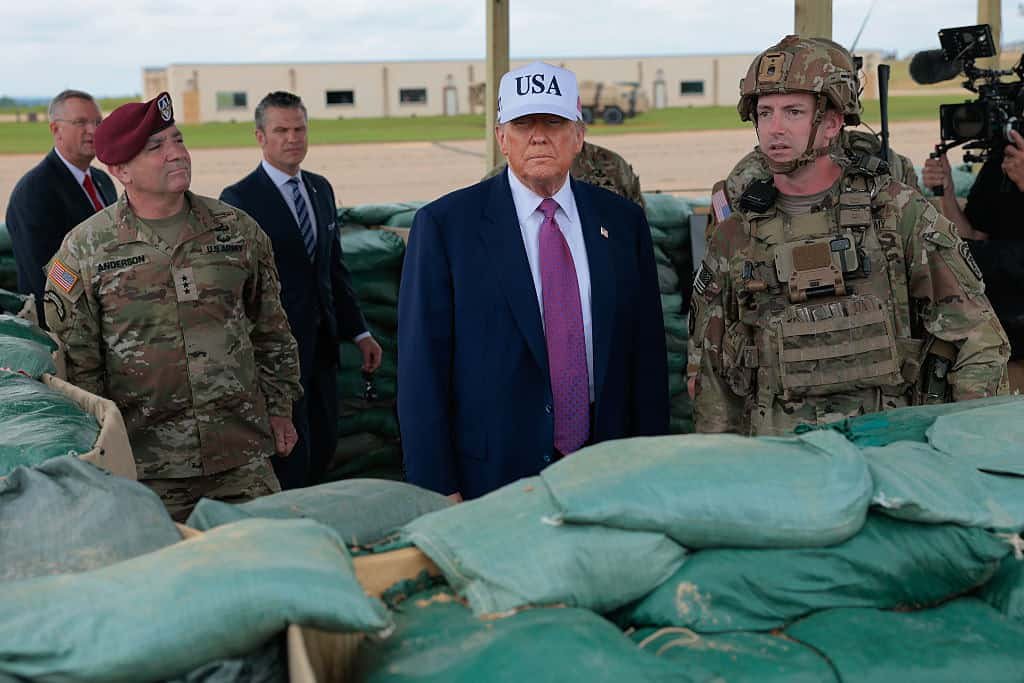
In a bold escalation of his administration’s “war on narco-terrorists,” President Donald Trump today voiced strong support for intensified U.S. military operations targeting drug cartels across the Americas, spotlighting recent airstrikes in Colombia that claimed the lives of 19 suspected FARC splinter fighters.
Speaking to reporters aboard Air Force One en route to a campaign-style rally in Florida, Trump described the strikes as a “decisive blow” against the narcotics trade fueling violence and addiction in the United States. “These cartels are terrorists, plain and simple – they’re poisoning our kids and destabilizing our neighbors. We’re not asking permission anymore; we’re taking them out,” Trump declared, referencing his executive order earlier this year designating groups like Mexico’s Sinaloa Cartel and Venezuela’s Tren de Aragua as foreign terrorist organizations.
The controversial airstrikes, conducted last week in Colombia’s rugged eastern plains, targeted a suspected camp operated by a dissident faction of the Revolutionary Armed Forces of Colombia (FARC), a Marxist guerrilla group notorious for financing its operations through cocaine production and trafficking.
Colombian military sources, coordinating with U.S. drone operators, confirmed the raid destroyed a makeshift laboratory and weapons cache, with no U.S. casualties reported. The operation marks the latest in a series of over 20 U.S.-led strikes since September, primarily on maritime smuggling routes in the Caribbean and eastern Pacific, where unmanned drones have sunk or disabled at least a dozen vessels laden with narcotics.
Trump’s endorsement comes amid mounting diplomatic friction with Latin American allies. Colombian President Gustavo Petro, a leftist critic of aggressive anti-drug tactics, condemned the strikes as “extrajudicial vigilantism” that risks inflaming regional tensions. Petro’s office claimed the dead included low-level farmers coerced into the drug trade, echoing earlier accusations from Venezuela’s government under Nicolás Maduro, which labeled the U.S. actions “imperialist murder.”
Human rights advocates, including Amnesty International, have decried the operations as violations of international law, arguing they bypass congressional oversight and the War Powers Resolution. “Blowing up boats and camps without due process isn’t justice – it’s murder,” Amnesty’s Latin America director stated in a recent report.
Defending the strategy, U.S. Defense Secretary Pete Hegseth and Secretary of State Marco Rubio emphasized that the strikes operate under a Justice Department memo classifying the cartels as combatants in a non-international armed conflict (NIAC).
The memo, leaked to media outlets this week, asserts that drone-only missions pose no risk to American personnel and thus evade traditional “hostilities” thresholds. It also invokes collective self-defense, citing cartel violence against Colombian and Mexican security forces.
The Senate, however, has rebuffed two attempts to curb Trump’s authority, with a November 6 vote failing along party lines.Critics, including Democratic lawmakers and foreign policy experts, warn that the aerial campaign – the most extensive U.S. military action in Latin America since the 1989 Panama invasion – could fragment cartels into more elusive networks, exacerbate humanitarian crises, and strain alliances.
“Airstrikes make for good headlines, but they don’t touch the root: U.S. demand and underfunded treatment programs at home,” said Sen. Elizabeth Warren (D-MA) in a floor speech yesterday.As the operations expand – with Trump floating the idea of targeting Colombian “cocaine factories” directly – the White House faces growing calls for transparency.
No evidence linking the slain fighters to specific U.S.-bound shipments has been publicly released, and at least one prior strike drew backlash after Colombian officials identified a victim as an innocent fisherman.The president’s remarks today signal no slowdown, even as allies like the Dominican Republic assist in drug recoveries from strike debris.
With midterm elections looming and border security a top voter issue, Trump’s hardline stance on cartels appears aimed at rallying his base, though it risks isolating the U.S. in hemispheric diplomacy. For now, the skies over the Americas remain a contested frontier in the endless war on drugs.