The ongoing crisis in the Strait of Hormuz, triggered by the escalation of the US-Israeli conflict with Iran, has plunged the global energy system into one of its most severe disruptions in decades.
The maritime traffic through this narrow chokepoint has effectively ground to a halt, not through a full military blockade, but via a combination of Iranian threats, selective attacks on vessels, skyrocketing insurance premiums, and shippers’ voluntary avoidance.
Iran has declared the strait closed to most traffic, with explicit warnings that unauthorized ships will be targeted. Reports indicate that Tehran is granting exceptions primarily to Chinese-flagged or signaled vessels, framing this as gratitude for Beijing’s diplomatic and economic support during the war.
Some sources suggest Russia may also benefit indirectly through aligned interests, though direct passage exceptions appear more limited.
This selective policy is a classic piece of wartime realpolitik: Iran rewards its key ally while punishing perceived adversaries. Yet it exposes deeper truths about global energy vulnerabilities.
The strait carries roughly 20% of the world’s seaborne crude oil, around 20-21 million barrels per day in normal times and a substantial portion of liquefied natural gas (LNG), particularly from Qatar. With flows now paralyzed, oil prices have surged toward triple-digit levels (and potentially higher if the crisis drags on), while LNG freight rates have exploded due to competition for alternative supplies.
Who stands to lose the most in a prolonged closure?
The answer is unequivocal: Asia, and particularly its major importers. Western economies, while affected by higher prices, have greater diversification, domestic production (especially the US), and strategic reserves. Gulf exporters like Saudi Arabia, the UAE, Iraq, and Kuwait suffer revenue hits from stranded exports, but they can pivot to limited pipeline alternatives (e.g., Saudi’s East-West pipeline to the Red Sea) and have sovereign wealth buffers.
Iran itself is self-inflictedly wounded, its own oil exports are choked, further strangling its economy under sanctions and war damage.
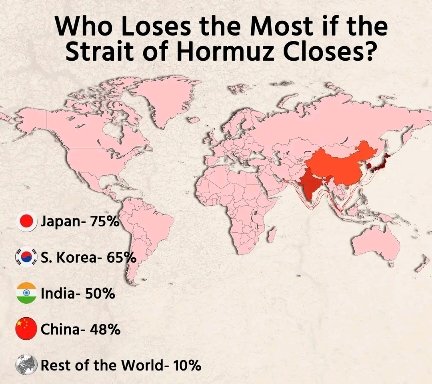
Asia, however, absorbs the lion’s share of Hormuz flows: China, India, Japan, and South Korea together historically account for about 75% of the crude and over half of the LNG transiting the strait. A sustained disruption would deliver physical shortages, inflationary spirals, currency depreciation, industrial slowdowns, and potential recessions.
Among these, Japan and South Korea emerge as perhaps the most structurally vulnerable major economies due to their extreme dependence on imported fossil fuels and limited domestic alternatives.
Japan stands out as one of the hardest hit: It imports nearly 95% of its crude from the Middle East, with around 70-75% of that routing through Hormuz, equating to roughly 1.6-2 million barrels per day at risk. Japan’s LNG exposure is somewhat less acute thanks to diversification toward Australia and the US, plus robust stockpiles covering several months, but the dual oil-gas hit would still strain its hyper-import-dependent economy.
Trade deficits would balloon, the yen would weaken further, and energy costs could feed into stagflation despite Tokyo’s emergency reserves and contingency planning.
South Korea faces similarly acute vulnerability, often ranking just behind Japan in exposure analyses. The country relies on imports for nearly all its fossil fuel needs, with approximately 65-70% of its crude oil sourced from the Middle East (primarily Saudi Arabia, UAE, Iraq, and Kuwait), and over 95% of those volumes transiting the Strait of Hormuz—amounting to about 1.7 million barrels per day of exposure.
South Korea is frequently described as the most crude oil-dependent economy among OECD members, with net oil imports representing around 2.7% of GDP.
A prolonged closure would quickly impact refineries, transportation sectors (including shipping, airlines, and logistics), manufacturing, and construction, where petroleum derivatives like asphalt, lubricants, and plastics are essential inputs.
On the LNG side, South Korea sources about 14-20% from Qatar and the UAE via the strait, though this is lower than oil exposure and buffered by strong stockpiles (well above the mandatory nine days, with overall reserves covering considerable periods even if Qatari supplies halt entirely).
Government assessments indicate sufficient combined public and private oil reserves for around 200-208 days, allowing short-term stability, but prolonged disruption could shave growth by 0.3 percentage points or more, inflate consumer prices by over 1%, and widen the current account deficit significantly (potentially by $26 billion in a high-price scenario).
Seoul is already exploring ramps in imports from the US and Australia as alternatives, but these shifts take time and face global competition.
India too faces acute pain as well. Around 50-55% of its crude imports (primarily from Iraq, Saudi Arabia, UAE, and others) pass through Hormuz, amounting to about 2.6 million barrels per day of exposure.
On the gas side, Qatar supplies a hefty chunk of India’s LNG needs, now at risk of stranding. This would translate to immediate refinery disruptions, soaring domestic fuel prices, higher inflation, and pressure on the rupee. India’s recent heavy reliance on discounted Russian crude (which once reached 30-40% of imports) offers partial insulation, but it cannot fully offset the Gulf shortfall—especially with global competition for those barrels intensifying.
China, despite being the world’s largest oil importer, occupies a somewhat privileged yet contradictory position. Roughly 45 – 48% of its oil inflows transit Hormuz, and it buys the vast majority of Iran’s sanctioned exports.
Beijing has been actively pressing Tehran in back-channel talks to allow safe passage for crude and, crucially, Qatari LNG cargoes destined for China. Reports of Chinese vessels (or those re-signaling as Chinese-owned) successfully transiting underscore this favoritism.
China’s stockpiles, domestic production, rapid electrification reducing oil intensity, and alternative suppliers provide a buffer that Japan, South Korea, or India lack to the same degree.
Still, prolonged paralysis would hurt—potentially causing “real problems” within months if Iranian supplies dry up entirely. Beijing’s push for exceptions isn’t altruism; it’s self-preservation in a system where it holds leverage over Iran economically.
Analyses often rank China fourth in vulnerability behind Japan, South Korea, and India, as its lower oil intensity and diversification mitigate impacts relative to its Northeast Asian neighbors.
Russia’s support for Iran remains largely rhetorical and strategic rather than operational in reopening the strait. Joint naval exercises with Iran and China (including in the Hormuz area earlier in 2026) signal alignment against Western dominance, but Moscow has offered no direct military aid to challenge the closure broadly.
Russia’s own oil exports route via other paths (Black Sea, Baltic, Arctic, Pacific), leaving them largely unscathed—and even benefiting from elevated global prices. This hands-off stance highlights the limits of the “Axis of Upheaval”.
Russia and China provide diplomatic cover but avoid entanglement that could draw US retaliation or divert resources from Ukraine or Taiwan contingencies.
The US’s 30-day waiver (issued in early March 2026, expiring around April 4) for Indian purchases of Russian crude is a pragmatic, narrowly tailored intervention. It authorizes delivery of Russian oil and products loaded before March 5, often from stranded vessels, to Indian refiners—bypassing prior sanctions pressures (including recent tariffs).
This stopgap eases immediate strain on India’s supply chains amid Hormuz chaos, prevents sharper global price spikes by keeping some barrels moving, and acknowledges that rigid sanctions enforcement would exacerbate the crisis.
It’s not a blank check, limited to pre-loaded cargoes and time-bound, but it demonstrates energy realism overriding geopolitics. Competition from Chinese buyers for the same Russian volumes will cap India’s gains, yet the waiver buys critical breathing room.
Similar relief mechanisms could indirectly benefit South Korea or others scrambling for non-Middle East supplies.In my opinion, this crisis lays bare the absurdity of global energy dependence on a single 21-mile-wide strait controlled (or threatened) by one actor.
Iran’s selective “China-only” policy is shrewd in the short term, rewarding loyalty while starving foes, but self-destructive long-term. By alienating broader markets and risking further isolation, Tehran accelerates its economic strangulation.
The favoritism alienates India, Japan, and South Korea, who must now scramble for alternatives, and even pressures China to broker wider access lest its own supplies falter.
Asia’s disproportionate suffering exposes decades of underinvestment in diversification. Japan and South Korea, despite repeated warnings, remain tethered to Middle Eastern hydrocarbons with painfully limited hedging—South Korea’s high oil intensity and near-total import reliance making it especially prone to rapid economic scarring.
India’s Russian pivot helps but remains insufficient against a full Gulf cutoff. China, ironically the most buffered among the big four, still faces risks that could undermine its growth narrative, though its buffers provide relative resilience.
The US waiver is smart diplomacy, limited relief that stabilizes flows without rewarding adversaries excessively. Yet it underscores a broader failure: the world still lacks robust alternatives to Hormuz. Pipelines, new LNG routes, renewables acceleration, and strategic stockpiling could mitigate future shocks, but political will has lagged.
Ultimately, no one wins from prolonged closure. Iran bleeds revenue and legitimacy; Gulf states lose export markets; Asia endures economic scarring, with Japan and South Korea bearing some of the heaviest relative burdens due to their structural dependencies; global inflation rises.
De-escalation—via diplomacy, perhaps Chinese-mediated—is the only viable path. Until then, this selective strait saga serves as a stark reminder: in energy geopolitics, chokepoints remain weapons, and dependency is the ultimate vulnerability.
The pain is asymmetric, falling hardest on those farthest from alternatives, Japan and South Korea foremost among them, followed closely by India while rewarding those with leverage or buffers like China.