


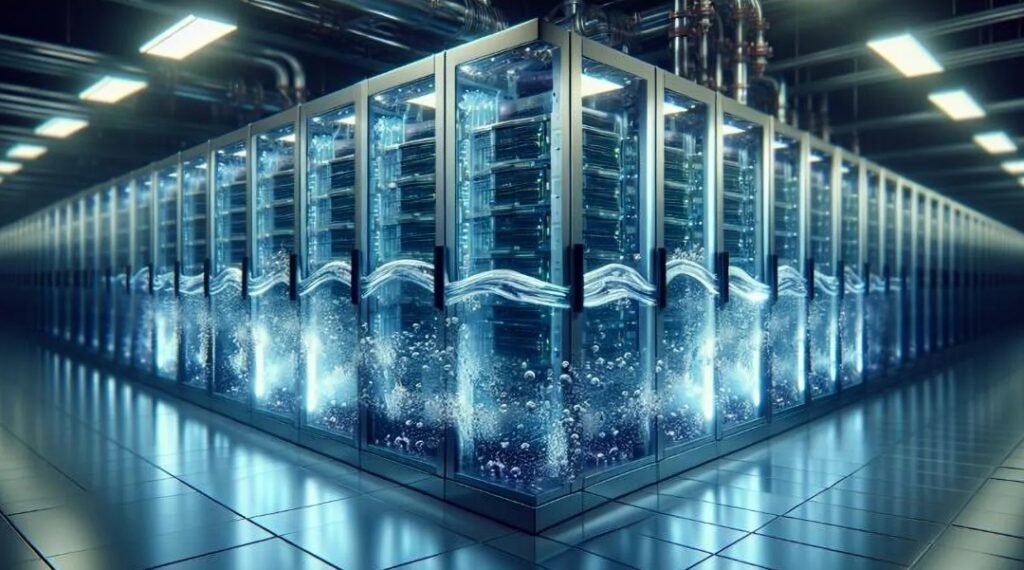
In the gleaming server halls of our digital future, something profoundly ironic is unfolding. Artificial Intelligence—the technology poised to redefine human progress—depends not just on electricity and algorithms, but on something far more elemental: water. Vast quantities of it.
And India, already one of the most water-stressed nations on Earth, is pouring this precious resource into data centres at a scale that should alarm every policymaker, technologist, and citizen.
A single 100-megawatt data centre can consume roughly two million litres of water per day for cooling its servers. India’s data centres collectively used about 150 billion litres in 2025. By 2030, that figure is projected to exceed 358 billion litres.
These facilities are not sprouting in arid wastelands or water-abundant regions. They are rising in Mumbai, Bengaluru, Chennai, Hyderabad, and Delhi-NCR—cities already gasping under acute water shortages and inequitable distribution.
Bengaluru’s data centres alone consume over 26 million litres each year, even as the city suffered what was called its worst water crisis in nearly five centuries. Hyderabad stares at a projected daily water deficit of 870 million litres by 2027, yet expansions by major players like Amazon continue unabated.
Chennai, still scarred by its 2019 “Day Zero” when reservoirs ran bone-dry, remains a prime destination for server farms. The pattern is unmistakable: we are building the infrastructure of tomorrow in the drought zones of today.
This is not mere coincidence or oversight. It is a symptom of a deeper disconnect—the belief that technological advancement can somehow transcend ecological limits.
We speak of AI as if it exists in a cloud, ethereal and weightless. In reality, it is anchored to the ground, sucking rivers, lakes, and groundwater to prevent overheating silicon chips. Without adequate cooling, servers fail. Without water, there is no AI.
Nature is not optional infrastructure.The environmental cost extends beyond water. Data centres demand reliable power, often drawn from strained grids or coal-heavy sources. They generate heat islands in already warming cities.
And when located in water-stressed zones, they compete directly with agriculture, households, and ecosystems for every drop. Farmers in surrounding areas, urban slums, and future generations pay the hidden price of our ChatGPT queries and recommendation algorithms.
India stands at a critical juncture. We want to become a global AI powerhouse. We have the talent, the ambition, and a young demographic hungry for opportunity. Yet sustainable development cannot mean “develop first, sustain later.”
The climate crisis and water emergencies are not distant threats—they are here, manifesting in parched lakes, falling groundwater tables, and summer migrations in search of water. AI will not deliver prosperity if its foundations crumble under environmental neglect.
Closed-Loop Cooling: A Urgent and Practical Shift
Traditional evaporative cooling towers, which rely on water loss through evaporation and blowdown, dominate many existing facilities and drive much of the crisis. In India’s hot, humid conditions, these systems are especially thirsty. The solution lies in scaling closed-loop cooling technologies that recirculate fluid in sealed circuits, dramatically slashing ongoing freshwater demand.
In closed-loop systems, a water-glycol mix or dielectric liquid flows through direct-to-chip cold plates mounted on CPUs and GPUs, rear-door heat exchangers, or full immersion baths. The fluid absorbs heat at the source and carries it to external dry coolers or chillers, where it rejects heat to the air without evaporation. The same coolant circulates indefinitely.
Initial fills require roughly 3,000–10,000 litres per MW, with annual top-ups for minor leaks and maintenance as low as 100–1,000 litres per MW—representing 70–90% reductions compared to conventional towers.
Hyperscalers are already demonstrating the potential. Microsoft’s closed-loop pilots target zero evaporative water use, saving around 125 million litres per site annually. Oracle operates “fill-once, recirculate-forever” designs with near-zero ongoing community draw.
Vantage Data Centers report campus consumption dropping to roughly 22,000 gallons per day for non-cooling needs versus millions in evaporative setups.
In India, new AI-driven builds increasingly adopt these systems for high-density racks exceeding 50–100 kW, where liquid cooling handles heat far more efficiently than air—up to 3,000 times better thermally.
The advantages are compelling for water-stressed India. No daily competition with households or farms. Superior energy efficiency through lower Power Usage Effectiveness (PUE). Stronger alignment with environmental clearances and global ESG expectations.
Hybrids integrating wastewater recycling for initial fills or secondary loops, plus industrial-scale rainwater harvesting, can push facilities toward genuinely water-positive status—replenishing more than they consume through aquifer recharge and lake revival projects.
Yet challenges remain. Upfront capital costs are higher for piping, coolant distribution units, and server modifications. Retrofitting older facilities is complex. Fluid management demands corrosion inhibitors and biocides.
In tropical heat, external heat rejection requires careful engineering, often supplemented by free cooling during milder periods. These hurdles are surmountable.
India’s growing domestic manufacturing ecosystem for components, combined with technician training programmes, can turn them into opportunities for local innovation and jobs.
For even deeper alignment with nature, geothermal cooling harnesses the Earth’s stable subsurface temperatures—typically 10–20°C at moderate depths—as a reliable heat sink.
Closed-loop ground source heat exchangers circulate fluid through deep boreholes (100–550 feet or more), transferring server heat into the ground before returning cooler fluid.
Variants such as Aquifer Thermal Energy Storage (ATES) or Cold Underground Thermal Energy Storage (UTES) store cold energy off-peak for peak demand, easing grid pressure.
Real-world deployments prove the concept. Iron Mountain’s underground mine facility in Pennsylvania uses natural aquifers for consistent, low-PUE cooling with minimal water use.
Microsoft’s Redmond campus employs hundreds of boreholes for major energy reductions. Equinix and other operators report 40–50% savings in cooling energy when integrated with liquid systems.
In India, while large-scale geothermal remains nascent, studies on earth-air and shallow systems in composite climates show up to 90% electricity savings versus conventional air conditioning—and 100% water savings relative to evaporative methods. Potential resources in the Himalayas, Cambay basin, and other regions, alongside enhanced geothermal techniques, could expand feasibility.
Geothermal cooling offers profound benefits in India’s context: near-zero ongoing water consumption after setup, year-round reliability in hot climates where ambient air cooling struggles, and synergy with closed-loop liquid cooling for ultra-dense AI workloads.
It reduces peak power demand, supports renewable integration, and delivers long-term operating cost savings that offset higher initial drilling investments—typically with payback in 5–10 years under supportive policies.
Limitations exist. Site-specific geology matters; not every location suits deep boreholes without risk of thermal saturation. Land footprints for hyperscale deployments can be substantial. Capital intensity deters smaller players.
Yet these are engineering and policy problems, not fundamental barriers. Strategic siting in suitable zones outside the most stressed urban cores, combined with hybrid designs, can overcome them.
We must demand better. Hyperscale operators and cloud giants should be mandated to adopt water-positive practices: closed-loop cooling systems, wastewater recycling, and rainwater harvesting at industrial scale.
Locational policies need urgent revision—new data centres should prioritise regions with surplus water or access to seawater desalination where feasible. Innovation in chip design and liquid immersion cooling must be accelerated to slash water footprints. Geothermal pilots, supported by targeted R&D, should form part of every major new cluster.
Transparency is non-negotiable: public disclosure of water and energy consumption by every major facility. Governments, both central and state, have a duty here.
Environmental clearances for data centres must factor in cumulative water stress, not treat each project in isolation. Incentives should reward sustainability leaders—not just those who bring the biggest investment cheques.
Updated national and state data centre policies must embed green mandates, skills development for advanced cooling technologies, and support for local manufacturing. Civil society, including the tech community itself, must push back against the “growth at all costs” mindset.
The message is simple yet profound: Without nature, AI will deliver nothing. No intelligence—artificial or otherwise—can flourish in a dehydrated landscape. The servers may hum today, but if we ignore the rivers running dry around them, tomorrow’s innovations will be built on borrowed time and stolen water.
India’s AI dream must be a green one. Not as an afterthought or marketing slogan, but as a foundational principle. Technology that outpaces the planet’s carrying capacity is not progress; it is pyrrhic.
The choice before us is clear: align AI with ecology, or watch both falter. The water we save today will cool the servers of a truly sustainable tomorrow.
By embracing closed-loop and geothermal solutions alongside smarter siting, renewables, waste heat recovery, and transparent governance, India can lead the world in responsible AI infrastructure. The talent, ambition, and policy tools exist. What remains is the collective will to act—before the thirst of silicon becomes an unquenchable crisis.


Naorem Mohen is the Editor of Signpost News. Explore his views and opinion on X: @laimacha.