


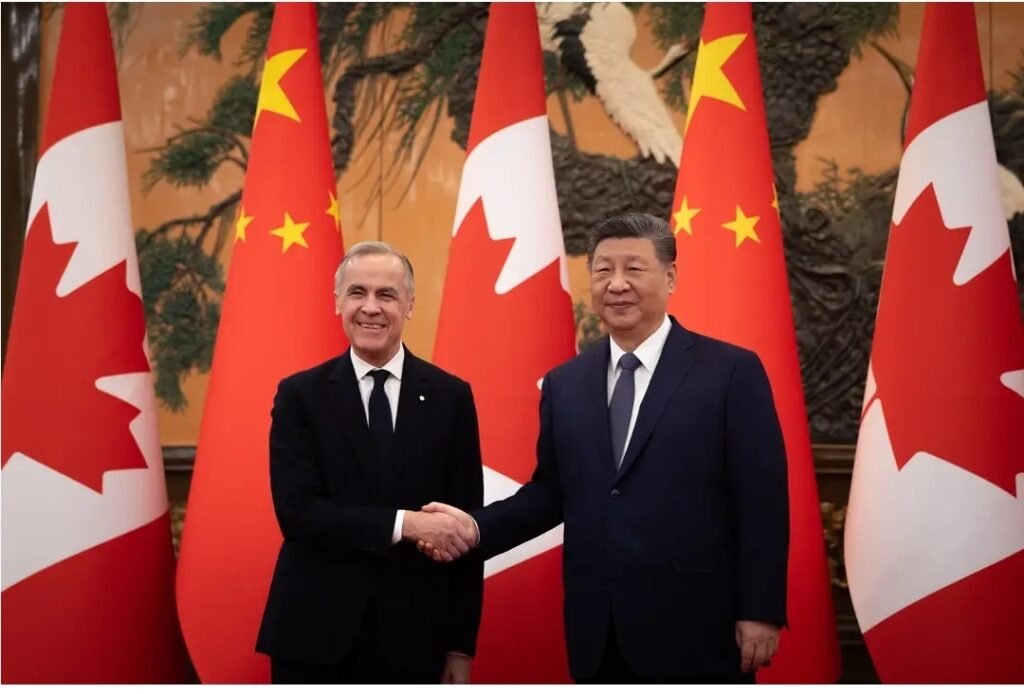
The recent meeting between Canadian Prime Minister Mark Carney and Chinese President Xi Jinping on January 16, 2026, wasn’t just a diplomatic handshake—it was a seismic moment that could redefine power dynamics across North America and beyond.
This newly minted Canada-China Strategic Partnership isn’t merely a bilateral reset. It’s a direct rebuke to U.S. unilateralism under President Donald Trump, and it carries profound implications for the United States and the global stage.
Let me break it down as I see it.First, consider the immediate blow to the U.S. For decades, Canada has been America’s steadfast neighbor and economic appendage, bound by geography, NAFTA’s remnants, and shared security interests.
But Trump’s aggressive geo politics, from launching an invasion of Venezuela earlier this month, capturing President Nicolás Maduro, and brazenly threatening to seize Greenland has alienated allies like never before.
I’ve argued before that such moves smack of imperial overreach, and now we’re seeing the fallout. Carney’s trip to Beijing, the first by a Canadian leader in eight years, signals Ottawa’s desperation to diversify away from a volatile Washington.
With agreements to slash tariffs on Chinese electric vehicles and boost Canadian canola exports, Canada is essentially hedging its bets. In my view, this erodes U.S. leverage. If Canada, the closest partner of the U.S., turns to China for stability, what’s stopping Mexico or even European NATO allies from doing the same?
Economically, it could mean lost markets for American goods—think U.S. farmers undercut by Canadian deals or tech firms facing stiffer competition from Sino-Canadian clean energy collaborations. Politically, it isolates Trump further, making his “America First” mantra look like “America Alone.”
Zooming out to the world at large, this partnership accelerates the march toward a multipolar order, one where China’s influence fills the voids left by U.S. blunders. It has been long believed that actions like the Venezuela incursion, framed as securing oil but widely condemned as a sovereignty violation, only hasten this transition.
By emphasizing “stability, security, and prosperity” in their joint statement, Carney and Xi are positioning their tie-up as a counterweight to chaos.
Imagine the ripple effects now. Other middle powers, from Australia to Brazil, might follow Canada’s lead, forging deeper ties with Beijing to buffer against U.S. tariffs and threats.
This could reshape global supply chains, with more trade flowing through Asia-Pacific routes that bypass American dominance. On security, it might embolden challenges to institutions like NATO.
If Denmark’s Greenland spat escalates, and Canada stays neutral or even sympathetic to China’s Arctic interests, the alliance could fracture. In a best-case scenario, this fosters genuine multilateralism, cooperation on climate tech or pandemic response that Trump’s isolationism has sidelined.
But pessimistically, as I fear, it risks escalating tensions into a new Cold War divide, with proxy conflicts in Latin America or the Arctic heating up.
Don’t get me wrong; I’m not cheering for a diminished America. Trump’s warnings about Greenland, “anything less is unacceptable” and his Venezuela gambit scream of a leader prioritizing short-term gains over long-term alliances.
If Washington doesn’t course-correct, perhaps by rebuilding trust through diplomacy rather than force, the Canada-China bond could inspire a cascade of realignments.
Europe might deepen its own China outreach, Africa could accelerate Belt and Road integrations, and even Indo-Pacific nations might question U.S. reliability.
In the end, I believe this moment marks a tipping point. The Canada-China Strategic Partnership isn’t just about two countries finding common ground. Rather, it’s a harbinger of a world where U.S. exceptionalism no longer dictates the rules.
For America, it’s time to wake up and rebuild bridges before more allies cross over to the other side. For the globe, it could mean a more balanced, if unpredictable, future, one where cooperation trumps confrontation, but only if we understand these shifts wisely.