


As India prepares to celebrate Independence Day, Manipur must confront a difficult question: can citizens be considered truly free when their movement, safety and everyday lives continue to depend on armed escorts?
The question assumes particular importance after the Manipur government presented an extensive account of its efforts to restore normalcy in the state.
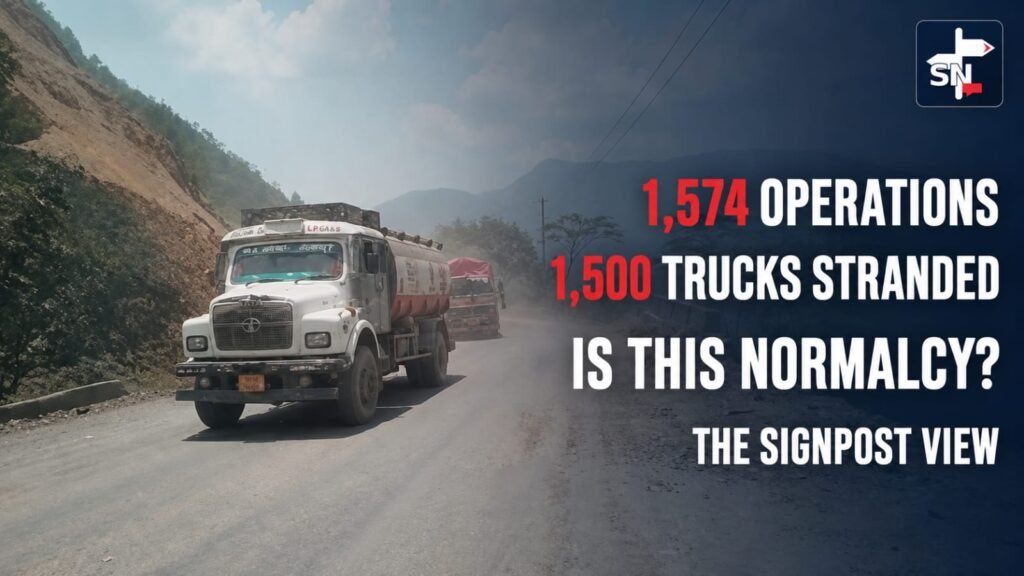
According to Director General of Police Mukesh Singh, security forces and law-enforcement agencies conducted 1,574 combing and search operations across vulnerable and conflict-affected areas between February and August 2026.
These search operations reportedly led to the recovery of 1,422 firearms, 7,010 rounds of ammunition and 1,137 explosives. The authorities also arrested 491 alleged extremists, destroyed 962 acres of illicit poppy cultivation and arrested 233 people in 158 drug-related cases.
These are substantial figures. They reflect both the scale of the challenge and the sustained work undertaken by the Manipur Police, Central Armed Police Forces, Army, Assam Rifles and other agencies.
However, the number of operations conducted or weapons recovered cannot, by itself, become the final measure of peace.
Security operations and arms recoveries are necessary, but normalcy must ultimately be measured by whether displaced families return home, citizens travel freely and everyday life no longer depends on armed protection.
Security statistics tell us what the state has done. Civilian life tells us whether those actions have succeeded.
What does normalcy mean?
For a shopkeeper, normalcy means receiving goods without paying higher prices caused by blockades, extortion or prolonged security arrangements.
For a student, it means travelling to school, university or an examination centre without fear of crossing an informal ethnic boundary.
For a farmer, it means reaching fields and markets without wondering whether a road will suddenly be closed.
For an internally displaced family, normalcy does not mean receiving relief indefinitely. It means obtaining secure housing, recovering a livelihood and rebuilding a life with dignity.
For every citizen, normalcy should mean that protection comes from the law—not from possessing a gun or depending upon an armed group.
The DGP said approximately 60,500 goods-laden trucks had been transported under security escort to maintain the supply of essential commodities. This demonstrates a serious administrative effort to prevent shortages.
At the same time, it reveals how far Manipur still has to travel. When tens of thousands of trucks require security escorts to move essential goods within a state, the supply system may be functioning, but ordinary freedom has not been fully restored.
From protected movement to free movement
The government’s announcement reopening National Highways 2 and 37 to people from all communities and resuming inter-state bus services is significant.
These highways are more than transport routes. They are Manipur’s economic lifelines and essential connections between communities.
But the events of August 13 demonstrate why reopening a highway through an announcement is not the same as restoring normal movement.
Truckers announced a 24-hour halt in the movement of goods vehicles to Manipur after a driver was found dead inside his vehicle near Labankhal in Jiribam district. The deceased was identified as Nageena Kumar Mahto, a resident of Bihar.
Fellow drivers said he had been stranded amid the prolonged congestion along the Lakhipur–Jiribam stretch. He was taken to the Jiribam Primary Health Centre, where he was declared dead. His body was subsequently sent to Silchar Medical College and Hospital for post-mortem examination.
The exact cause of his death must be determined medically. It would be irresponsible to reach a conclusion before the post-mortem report becomes available.
However, his death has exposed the conditions under which truck drivers have been waiting along the highway.
Reports indicate that more than 1,500 vehicles were stranded near the Assam–Manipur border, with some drivers having spent more than two weeks waiting for security convoys. Truckers complained of inadequate access to food, clean drinking water, medicines and sanitation.
The Silchar Drivers’ Union and other transport bodies demanded compensation for Mahto’s family and halted the movement of heavy vehicles between Assam and Manipur. They warned that the protest could continue unless the authorities addressed the humanitarian and logistical problems confronting the drivers.
The Transporters’ and Drivers’ Council also issued an ultimatum. Its representatives reportedly warned that if the government failed to provide additional security convoys and clear the congestion by Sunday, trucks would begin moving in organised batches of 500 vehicles from Monday—with or without security escorts.
Such a move would carry obvious security and road-safety risks. Yet the ultimatum also reflects the desperation created by a system in which drivers, vehicles and essential commodities can remain trapped for weeks while waiting for protected passage.
The contrast is difficult to ignore.
On August 12, the government highlighted that 60,500 goods-laden trucks had been transported under security escort as evidence of progress towards normalcy. A day later, truckers halted movement on NH-37 following the death of a stranded driver and the accumulation of approximately 1,500 vehicles near the interstate border.
The first figure demonstrates the scale of state intervention. The second demonstrates the fragility of the system that intervention is attempting to sustain.
The movement of oil and LPG tankers reportedly became another source of friction when transporters objected to prioritising petroleum vehicles while other trucks carrying general goods remained stranded. From the drivers’ perspective, every person waiting on the highway faces the same need for security, food, medical care and movement.
The immediate economic consequences cannot be dismissed. NH-37 carries food, medicines, fuel and other essential commodities into Manipur. Any prolonged disruption risks creating shortages, increasing transport costs and raising market prices—burdens that ultimately fall upon ordinary households.
The government must therefore treat the present crisis as more than a dispute between transport unions and security agencies.
It must immediately ensure medical assistance, food, drinking water and sanitation for stranded drivers; increase the frequency and capacity of security convoys; publish a transparent vehicle-clearance schedule; and establish coordination among the Assam government, Manipur government, CRPF, district administrations and transport unions.
Most importantly, it must investigate why such a large backlog was allowed to develop despite repeated warnings from drivers.
A highway is genuinely open only when an ordinary passenger, driver or trader can use it safely and predictably without waiting for weeks, depending on exceptional convoys or checking identity and destination against an unwritten map of fear.
Protected movement may be necessary during a transition. But when protected movement itself breaks down, it cannot be presented as normalcy.
Free, safe and predictable movement must remain the final objective.
The gun must lose its social legitimacy
Chief Minister Yumnam Khemchand Singh has given those possessing looted, illegal or unauthorised weapons 15 days to surrender them through their respective MLAs or district police authorities. He has warned that anyone retaining such weapons after the deadline will face legal action.
Providing one final opportunity for voluntary surrender is reasonable. During the worst phase of the conflict, fear and the collapse of trust may have led some people to believe that possessing a weapon was necessary for survival.
But an emergency cannot become a permanent justification for illegal arms.
The government must enforce the deadline impartially across the hills and valley. No organisation, armed faction, influential individual or community should enjoy informal immunity.
Selective recovery would deepen suspicion. Equal enforcement would begin rebuilding public trust in the state.
The task should not end when a weapon is deposited. The authorities must maintain transparent inventories, conduct forensic examinations where necessary and investigate firearms suspected of having been used in crimes.
Surrendering a weapon cannot automatically erase responsibility for violence committed with it. Arms recovery and criminal accountability are connected, but they are not the same process.
The larger objective is to end the social legitimacy of the gun. As long as weapons shape public movement, political negotiation and community relations, democratic institutions cannot exercise their full authority.
Put displaced people at the centre
The most meaningful indicator of peace will be the condition of internally displaced persons.
Officials said in January that approximately 16,500 displaced people belonging to more than 3,700 families had been resettled. The government had also set a target of rehabilitating more than 40,000 people by March 31.
Yet a report published in April said that approximately 58,821 people had been displaced by the conflict up to March 30. The difference between the scale of displacement and the reported progress in resettlement shows why an updated public assessment is necessary.
How many families have returned to their original villages? How many have been relocated elsewhere? How many reconstructed homes are ready for occupation? How many families possess secure land documents, employment and access to schools and healthcare? How many remain unable to return because of unresolved security concerns?
Publishing these answers would allow citizens to distinguish measurable recovery from administrative optimism.
Resettlement must not become an exercise in merely emptying relief camps. Families should not be pressured to leave before security, housing and livelihoods are in place.
A camp closure is not rehabilitation if displaced people are transferred from visible hardship to invisible insecurity.
Build a civilian normalcy dashboard
The Manipur government should publish a regular civilian normalcy dashboard.
Along with operations, arrests and weapons recoveries, it should report:
- illegal weapons recovered and properly accounted for;
- roads reopened and safely used by all communities;
- verified incidents of blockades and extortion;
- displaced families rehabilitated with housing and livelihood support;
- schools, markets and public transport services functioning normally;
- progress in investigating major conflict-related crimes; and
- inter-community meetings that produce concrete agreements.
Such disclosure would strengthen public trust and allow the government to demonstrate progress through outcomes citizens can experience.
Manipur unquestionably needs effective security operations. It needs arms recovery, action against militant networks, protection of highways and firm enforcement against those attempting to prolong disorder.
But peace is not the indefinite management of conflict. Nor is normalcy merely the absence of a major violent incident for a few weeks.
Peace begins when people no longer organise their lives around fear. It becomes visible when buses cross districts without controversy, traders move without extortion, children attend school without disruption and displaced families rebuild their lives with dignity.
The 1,574 security operations may represent an important beginning. Their success, however, will ultimately be measured not by weapons displayed at an official programme, but by freedoms restored outside it.
This Independence Day, Manipur must move from counting operations to restoring ordinary life. That is where normalcy becomes peace—and where security finally becomes freedom.