


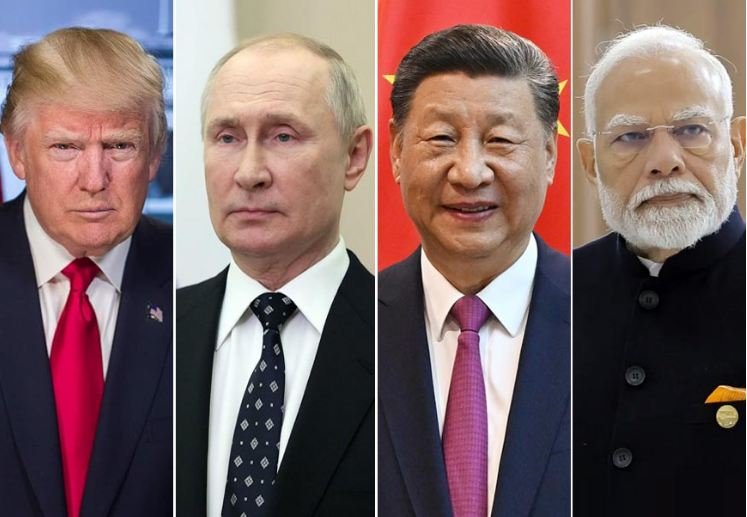
The world watched with keen interest as Beijing hosted back-to-back visits from the leaders of the United States and Russia. Chinese President Xi Jinping rolled out the red carpet, complete with gun salutes, grand photo opportunities, and high-level talks, for Donald Trump and Vladimir Putin in quick succession.
Trump’s visit, his first to Beijing since 2017, came amid strained relations and America’s shifting foreign policy priorities. Putin, on his 25th official trip to China, sought to deepen the “no limits” partnership with his “good old friend” Xi while securing economic and diplomatic support for Russia’s ongoing challenges in Ukraine.
These visits, though Moscow insists had “no connection,” paint a vivid picture of a deeper structural shift in global politics. Beijing is no longer playing second fiddle. It is signaling confidence, autonomy, and a willingness to place itself at the center of great-power diplomacy. Xi’s invocation of the “Thucydides Trap” during talks with Trump was particularly pointed, a subtle warning that America’s containment strategies could lead to dangerous confrontation between a rising power and an established one.
This development demands a clear-eyed realism from New Delhi. The question arises naturally: When the US and Russia repeatedly turn to China, why isn’t India, China’s immediate neighbor sharing a long and contested border, more alarmed? Why not simply “make friends” with Beijing? Where does India stand as China appears to claim leadership in a new triad of giants?
The answer is rooted in geography, history, lived experience, and strategic necessity. India is not panicked because panic solves nothing. Instead, New Delhi is pursuing a path of multi-alignment, deterrence, and long-term capacity building. Friendship with China cannot be forced through wishful thinking when unresolved border tensions, power asymmetries, and differing visions of Asia persist.
India and China share one of the world’s longest disputed land borders, over 3,488 kilometers. This is not a distant maritime issue like those between China and the United States or even some Southeast Asian nations. It is a high-altitude reality involving the Himalayas, where troops stand eye-to-eye in freezing conditions.
The 2020 Galwan Valley incident, where Indian and Chinese soldiers clashed in brutal hand-to-hand combat, remains etched in national memory. Subsequent disengagement processes have been slow, incomplete, and marked by continued infrastructure races on both sides.
These border frictions are not abstract. Arunachal Pradesh, which China claims as “South Tibet,” is an integral part of India’s cultural and strategic fabric. Beijing’s periodic issuance of maps showing Indian territory as its own, coupled with infrastructure buildup along the Line of Actual Control (LAC), creates a perpetual trust deficit.
Unlike Russia, which enjoys vast territorial buffers, or the US, separated by oceans, India must live with this reality daily.“Making friends” sounds appealing in diplomatic salons, but on the ground, it has often translated into demands for unilateral concessions.
China’s approach with smaller neighbors, economic engagement followed by political pressure, serves as a cautionary tale. India has seen this pattern: from Australia’s barley and coal disputes to Lithuania’s Taiwan office row. New Delhi chooses engagement without illusions.
Trade continues to exceed $100 billion annually, yet it remains heavily imbalanced, with India importing far more manufactured goods, electronics components, APIs, and solar equipment. Delhi’s response, Atmanirbhar initiatives, production-linked incentives (PLI), and “China-plus-one” strategies, reflects pragmatic economic nationalism, not hostility.
In the Northeast, where border states like Arunachal, Sikkim, and parts of Ladakh feel the direct heat, this caution resonates deeply. Development projects here, from roads to railways, are as much about connectivity as they are about strategic signaling. India is investing in its frontiers not out of fear, but to assert presence and improve lives.
This opinion highlights Xi’s “distant handshake” and dominant body language with Trump, the modest outcomes of the summit (no major deal, no joint communiqué, no breakthroughs on Iran or Taiwan), and the contrast with Putin’s haul of 20 agreements. This asymmetry is telling. China now views the US as one important player among others, not the indispensable nation.
By hosting both leaders and subtly reminding Trump of Putin’s privileged access to Zhongnanhai, Xi positioned Beijing as the pivot.This is classic power signaling. China is leveraging its economic heft and Russia’s dependence amid Western sanctions. The “Power of Siberia-2” pipeline discussions, even if not fully sealed, expose Beijing’s energy leverage, especially with Middle East supplies disrupted.
For India, this raises legitimate concerns. A Russia overly tilted toward China could alter arms supply dynamics, energy markets, and the broader Asian balance. India has benefited from discounted Russian oil since the Ukraine conflict, helping stabilize its economy. A full Moscow-Beijing axis risks reducing Russia’s maneuverability and India’s options.
Yet, India has not severed ties. It continues defense cooperation with Russia while diversifying toward the US, France, and Israel. This multi-alignment is not fence-sitting; it is sophisticated diplomacy suited to a multipolar world.
Historically, the US sat atop the “great power triangle,” balancing China and the Soviet Union/Russia. Today, the geometry has inverted. Both Trump and Putin came to Beijing seeking stabilization and signaling. China is not actively pitting them against each other in classic triangular diplomacy but positioning itself as the central node through which major diplomacy flows.
This is impressive but not unchallenged. China’s strengths, manufacturing dominance, technological leaps in EVs and renewables, massive infrastructure via Belt and Road, are real. However, challenges abound: demographic decline, property sector woes, Western decoupling in critical tech, and regional pushback.
The “Thucydides Trap” Xi mentioned cuts both ways. A rising China risks overreach, alienating neighbors and accelerating containment coalitions.
India stands as a distinct pole in this emerging order. With 1.4 billion people, the world’s largest democracy, a fast-growing economy, and a youthful demographic dividend, India is no junior partner. Its influence in the Indian Ocean Region (IOR), leadership in the Global South (evident during its G20 presidency and “Voice of Global South” summits), and role in supply chain resilience make it indispensable.
In BRICS and SCO, India engages China constructively on climate, trade, and multilateral reform. Yet it rejects any notion of a subordinate “Asian century” dictated from Beijing. The Quad (with US, Japan, Australia) and initiatives like iCET (tech cooperation with US) reflect shared concerns over Indo-Pacific stability without formal alliances that compromise autonomy.From Manipur’s perspective, this matters profoundly.
The Northeast is India’s gateway to Southeast Asia under Act East Policy. Stability along the LAC enables focus on internal development, roads, education, healthcare, and cross-border trade with ASEAN. Disruptions here affect the entire eastern flank.
India’s approach echoes its civilizational ethos: engage the world on equal terms, avoid dependency. Post-independence non-alignment evolved into multi-alignment in a globalized era. Jawaharlal Nehru’s initial outreach to China ended in the 1962 war’s bitter lessons. Subsequent generations learned that peace requires strength and vigilance.
Recent years show steady progress. India’s military modernization — indigenous weapons, Rafale jets, S-400 systems, border infrastructure surge — builds deterrence. Economically, “Make in India” and semiconductor pushes reduce vulnerabilities. Diplomatically, stronger ties with Japan, France, UK, and Gulf nations diversify partnerships.
Few may ask why India doesn’t lean harder into China friendship for economic gains. The answer lies in reciprocity. True friendship demands resolution of boundary issues based on mutual respect, not historical claims favoring one side. Beijing’s wolf warrior diplomacy and domestic nationalism often complicate dialogue.
India’s patient diplomacy — special representatives’ talks, military commander-level meetings — continues, but without compromising core interests.In Northeast India, where ethnic diversity and border sensitivities mirror larger geopolitical complexities, communities understand this. Development under schemes like PM Gati Shakti or Northeast Special Infrastructure Development Scheme builds resilience.
India should expand selective cooperation with China: trade in mutually beneficial sectors, joint climate action, global health, and counter-terrorism. People-to-people ties, cultural exchanges, and student programs can humanize relations. But romantic “friendship” rhetoric ignores power realities.
China’s centrality in the current triangle is notable but transient. Economic headwinds, international scrutiny over supply chains, and regional alliances (AUKUS, Quad, IPEF) suggest limits. India’s strategy — “neighbourhood first,” “Act East,” and comprehensive national power building — positions it well for the long game.
As global politics fragments into multiple centers, India’s democratic stability, innovation ecosystem (startups, space, digital public goods like UPI), and cultural soft power offer an alternative model for the Global South. Unlike debt-trap concerns associated with some BRI projects, India’s partnerships emphasize sovereignty and mutual growth.
The US-Russia visits to Beijing highlight Beijing’s moment. For India, it is a call to accelerate reforms: defense indigenization, economic self-reliance, diplomatic agility, and social cohesion. The message is consistent — India rises not by reacting fearfully but by building steadily.
In this new geometry, India is not sidelined. It is carving its own path as a civilizational state with global responsibilities. The three giants may dominate headlines, but a confident, capable India ensures the world remains multipolar, not unipolar under any single flag.


Naorem Mohen is the Editor of Signpost News. Explore his views and opinion on X: @laimacha.