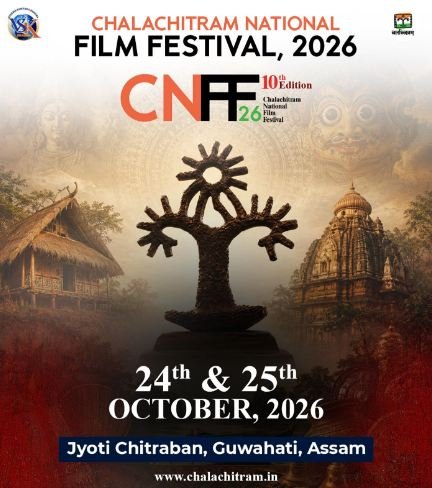
Guwahati, June 28: Film lovers, cine critics, producers and directors from eastern India will get a unique opportunity to experience short films and documentaries rooted in nationalism, Indian civilization, culture and heritage when the 10th edition of the Chalachitram National Film Festival, CNFF 2026, is held in Guwahati on October 24 and 25.
The two-day festival will take place at the Jyoti Chitraban Film Society premises at Kahilipara in Guwahati. Organised by Chalachitram, a subsidiary of Vishwa Samvad Kendra, Assam, the festival will showcase selected short-duration films and documentaries. The selected entries will be honoured with trophies, certificates and cash awards in the presence of distinguished film personalities, filmmakers and cine-goers.
The festival, held under the mentorship of Bharatiya Chitra Sadhna, was first launched as the Guwahati Film Festival in 2017. It was renamed in 2019 as the Chalachitram National Film Festival with the central theme “Our Heritage, Our Pride”.
Over the years, CNFF has emerged as a platform for films that engage with India’s civilizational legacy, indigenous society, heroes of the freedom movement, epics and mythology, national integration, cultural nationalism, women empowerment, traditional arts, environmental concerns, tourism, family values, social reformers, monuments, heritage sites, traditional sports, handicrafts, textiles, music, manuscripts, paintings, Yoga, meditation, Ayurveda and other aspects of Bharat’s cultural and social life.
According to the organisers, a jury board comprising artistes, critics, filmmakers, writers and professionals will select the award-winning entries. In the North East India category, five awards will be presented, including best short feature, best documentary, best director, best screenplay, best cinematography and best editing. In the All India category, two awards will be given for best short feature and best documentary.
The competition is open to both professional and new filmmakers. Entries must have a duration ranging from one minute to 25 minutes and should have been produced between September 1, 2025 and September 1, 2026.
The entry schedule includes an Early Bird window from June 10 to June 30 without any entry fee. The regular deadline will be from July 1 to July 20 with an entry fee of Rs 500, while the final deadline will remain open from July 20 to September 2 with an entry fee of Rs 1,000. Entries can be sent directly to the CNFF office through email at chalachitramne@gmail.com or submitted through FilmFreeway.com.
At a time when India hosts several notable national film festivals across different regions, CNFF has joined a growing list of platforms that celebrate diverse cinematic voices. These include the MAMI Mumbai Film Festival, Great Indian Film and Literature Festival, Asia Livelihood Documentary Festival, Alpavirama South Asian Short and Documentary Film Festival, Bangalore Queer Film Festival, Brahmaputra Valley Film Festival, Cinemela Film Festival, Flashpoint Human Rights Film Festival, Golden Jury Film Festival, Hyderabad Bengali Film Festival, Jagran Film Festival, Jeevika Film Festival, Kalakari Film Festival, Madhubani Film Festival, New Delhi Film Festival, National Science Film Festival, Patna Film Festival, Rajasthan Film Festival, Tigerland India Film Festival, Verite Film Festival and Vibgyor Film Festival, among others.
The 9th edition of CNFF was inaugurated by Dr Sunil Mohanty, Asom Kshetra Prachar Pramukh of the Rashtriya Swayamsevak Sangh, by lighting sacred lamps before the portraits of Bharat Mata, Dr Bhupen Hazarika, Zubeen Garg and Deepak Sarma. The previous edition showcased more than 30 short features and documentaries under competitive and screening-only categories.
The films screened in the 9th edition covered a wide range of social, cultural and emotional themes. Some explored the loneliness of old age, the search for meaning in life and the dignity of departure from the world. Others dealt with death, home, greed, fraud, family values, environmental responsibility, underprivileged lives and Bharat’s civilizational continuity.
Several entries focused on elderly professionals living in urban areas who deserve care and emotional support from society. Some films drew strength from folk tales, folk songs, marriage rituals and community traditions to reflect the anguish of modern life and the erosion of family bonds.
The festival also featured works on caste-based discrimination and the struggles of underprivileged individuals seeking dignity and justice. Films on slow learners and differently-abled children opened a sensitive window into the emotional world surrounding such children and their families.
Other entries explored matriarchal social traditions, ancient practices of magic, Assamese string puppetry, the legacy of Bharat’s textile traditions and rural stories of spirits that once shaped the imagination of village life. These themes attracted serious attention from film enthusiasts and critics.
The concerns of young people were also reflected in some films. These works portrayed youth struggling with psychological changes, isolation and social pressure. However, many of the stories ended with a positive message, showing young characters rediscovering love, affection, responsibility and a sense of belonging in society.
The closing ceremony of the 9th CNFF was graced by the then Assam Legislative Assembly Speaker Biswajit Daimary, along with several distinguished film personalities, dignitaries and cine-goers.
On behalf of the organising committee, VSK Assam secretary Kishor Shivam, CNFF president Nava Thakuria and secretary Bhagawat Pritam expressed hope that the festival would continue to encourage young and budding filmmakers to use cinema as a medium for social change, empowerment of the underprivileged and strengthening of patriotic consciousness across the subcontinent.