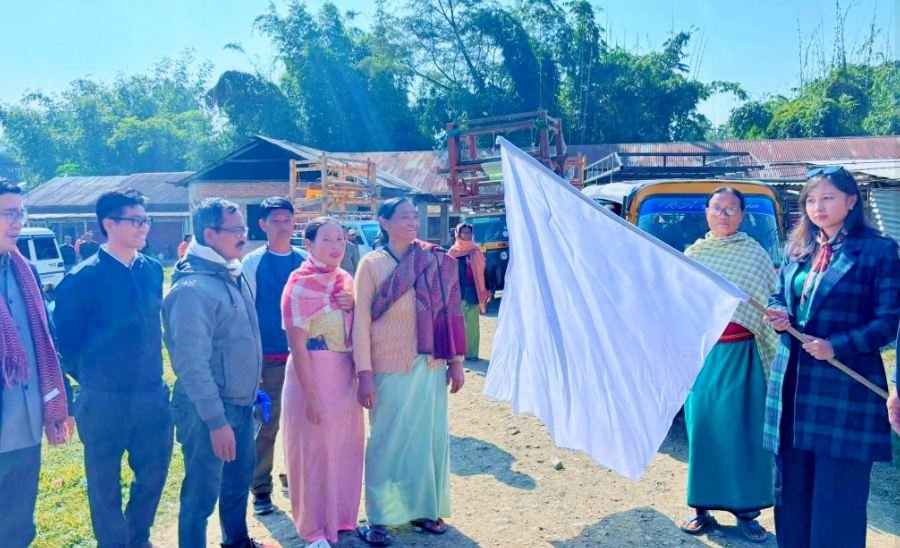
The photographs from Bishnupur last week were beautiful: 257 men, women and children belonging to 64 families boarding vehicles at Leimaram High School Relief Camp, waving goodbye to months of displacement, heading back to their ancestral Leimaram Waroiching ( Village No.27 – Sadu Koireng).
Deputy Commissioner Pooja Elangbam personally flagged them off and called it “a significant and meaningful moment.” She was absolutely right. Yet that moment of joy must not be allowed to become a full stop. It is only a comma.
Granting permission to return is the easiest part of governance. Delivering genuine rehabilitation is the hardest—and the most urgent. If the government believes its job ended the day these families crossed the village boundary, we are heading toward a second, entirely avoidable tragedy.
The ground reality awaiting these 257 citizens is harsh: Most houses in Waroiching stand as burnt shells—charred rafters, twisted tin sheets, and memories turned to ash. Without immediate reconstruction aid, families will sleep under tarpaulin or crowd into the handful of half-standing structures as winter approaches.
Livelihoods have been wiped out. Paddy fields lie overgrown, cattle and poultry are long gone, household items looted or destroyed. Men and women who once proudly fed their families through farming and small trades now stare at an empty horizon with no visible income.
Essential commodities remain painfully scarce. Clean drinking water is a daily struggle. Ration supplies are erratic. Medicines, cooking fuel, warm clothing—everything a family needs to live with dignity—are either missing or insufficient. Children are already falling ill; the elderly bear their suffering in silence.
In plain language, if roti, kapda aur makan—the three most basic rights of every citizen—remain cruelly out of reach even after the emotional “homecoming.”Then, this is not rehabilitation. This is abandonment wearing the mask of resettlement.
Official records confirm that the government has already disbursed ₹40,000 to each of the 74 families resettled in Waroiching during the first phase. Authorities noted that a proposal is underway to secure an additional ₹35,000 per household, while also reaffirming that monthly DBT support for every internally displaced person will remain in place until March 2026—even after resettlement. This pledge was presented as a crucial safeguard for families rebuilding their lives.
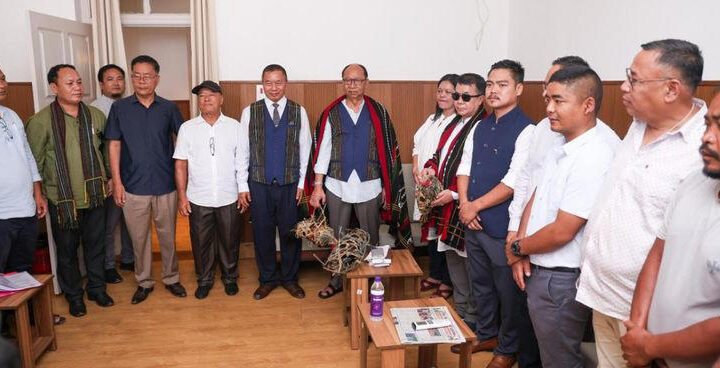
In her role as District Mission Director of the Manipur State Rural Livelihoods Mission (MSRLM), DC Pooja Elangbam handed over cheques worth ₹16.5 lakh to 11 Self-Help Groups under Shingel Nura VLF, Toubul. The support is expected to benefit 257 internally displaced persons, translating to roughly ₹6,400 per individual—an intervention aimed at strengthening livelihoods and providing a measure of stability for families rebuilding their lives.
Yet, despite welcoming the initiative, many of the newly resettled families voiced frustration that those returning in the second phase have not received the financial aid, reconstruction assistance, or security measures they were promised.
“We are thankful to be back, but how do we rebuild without the support we were assured? How do we sleep at night when fear still surrounds us?” one resident asked, capturing the uncertainty that continues to shadow the return.
The state government must wake up to the fact that return is merely Step One. True rehabilitation demands swift, visible and sustained action: immediate house repair and reconstruction through direct financial assistance, along with free supply of CGI sheets, cement and timber within the next 15 days so that construction can begin before Christmas; immediate restoration of livelihoods by guaranteeing 100 days of MGNREGA work starting this very month.
This must be followed with distribution of seeds, fertilisers, tools, poultry, livestock and interest-free recovery grants for small businesses; immediate and regular supply of essentials through fully stocked fair-price shops, weekly mobile medical units, free ration for six months, clothing and blanket kits, and temporary community kitchens and classrooms until permanent infrastructure is restored; and immediate, permanent security in the form of round-the-clock police patrolling, a fixed picket inside the village and a quick-reaction team stationed nearby so that no family ever again feels forced to flee.
The 257 individuals who returned last week have shown extraordinary courage. They trusted the government’s word and chose hope over fear. The very least the state can do is honour that trust with action, not applause.
Let no officer think that a flag-off ceremony and a few photographs discharge the government’s duty. Let no file gather dust while children sleep in the cold. Waroiching’s rehabilitation must not become another sad chapter in Manipur’s long list of unfinished promises. It must become a proud model of what decisive, compassionate governance looks like. These families have come home.
Now it is time for the government to truly bring them home—with hot meals on their tables, warm clothes on their bodies, solid roofs over their heads, and lasting peace in their hearts. The eyes of thousands still in relief camps are watching Waroiching.
Let them see success, not suffering. Let them see hope, not hesitation. The clock is ticking. The state must act—today.