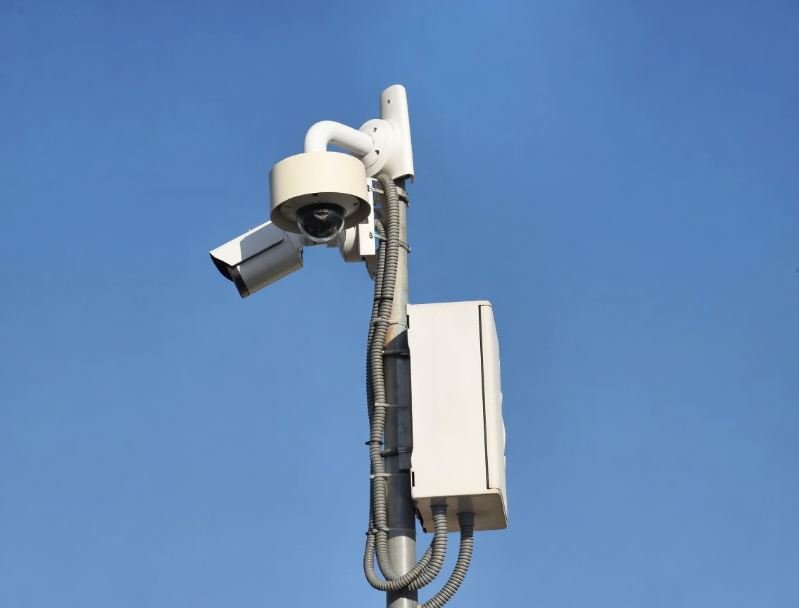
India is quietly replacing one set of watchful eyes with another. The government’s new rules on CCTV systems — stricter certification, mandatory origin disclosure, and tighter hardware trust requirements — are being presented as a decisive strike for national security. Chinese cameras, long dominant in the market, are being steadily pushed out.
In their place, a wave of Indian brands is rising fast, winning contracts, dominating retail shelves, and positioning themselves as the new guardians of our streets, offices, and borders. On the surface, this looks like a textbook success of Atmanirbhar Bharat — a proud shift from foreign dependence to domestic capability. But beneath the comforting rhetoric of self-reliance lies a more unsettling question. Are we truly securing India’s surveillance infrastructure, or are we simply handing control from one set of hands to another?
Let’s be clear. The security concerns are not manufactured. Foreign surveillance hardware, particularly from certain countries like Chinese cameras, carries genuine risks — vulnerable firmware, suspect chipsets, and the ever-present possibility of remote access or data exfiltration. In an age where cyber warfare and espionage operate in the shadows, leaving critical visual intelligence systems exposed would be irresponsible. The push for trusted sourcing and rigorous standards is, in principle, both necessary and overdue.
Yet good policy in India has a habit of serving multiple masters. When an entire market segment is disrupted almost overnight and a fresh set of domestic players suddenly finds itself riding a powerful tailwind, it is only responsible to look closer. Is this shift driven solely by the imperative of national security? Or are we also witnessing a calculated redistribution of economic power, influence, and — most importantly — control over the vast network of cameras now blanketing the country?
The transformation has been remarkably swift. Brands that were once mid-tier or barely visible are now scaling aggressively. Government tenders, institutional procurement, and even consumer markets are tilting heavily in their favour. The narrative writes itself: Indian innovation triumphing over foreign dominance.
But the ground reality is far more complex. Chinese cameras are labelled as manufactured by Indian companies. Many of these rising “Made in India” CCTV companies continue to rely on imported components, especially advanced sensors and semiconductors. Their software stacks and firmware layers are often only partially indigenous. Supply chains remain globally entangled rather than magically localised. And crucially, the ownership structures, funding sources, and strategic alignments behind several of these companies remain opaque — shielded from public scrutiny.
This raises uncomfortable but necessary questions. Are we nurturing a new generation of genuine Indian technology champions built on innovation and resilience? Or are we repeating a familiar Indian pattern — where protective policies create fertile ground for a handful of well-connected conglomerates to consolidate control over a strategically vital sector?
India has seen this story unfold before in telecom, infrastructure, defence manufacturing, and beyond. In each case, large industrial houses with deep pockets and proximity to power eventually emerged as the dominant players. Surveillance technology, however, is different in its implications. These are not just cameras. They are nodes in an expanding ecosystem of data collection, AI-powered analytics, facial recognition, behavioural mapping, and centralised command systems. Whoever ultimately controls this stack does not merely dominate a market — they shape what can be seen, recorded, remembered, and acted upon across the world’s largest democracy.
The deeper concern is not the nationality of the hardware, whether it is Chinese cameras or German cameras, but the concentration of power it enables. When surveillance infrastructure moves from foreign hands to domestic ones without sufficient transparency and safeguards, we risk replacing one form of vulnerability with another — potentially more insidious because it wears the comforting mask of sovereignty.
Major policy shifts of this magnitude rarely occur without influence. The speed of implementation, the precise design of the restrictions, and the clear set of beneficiaries invite legitimate scrutiny. Did powerful domestic industry voices help shape these regulations? Were certain players strategically positioned — through preparation or alignment — to capture the space being vacated? Is this regulation functioning purely as security policy, or as industrial policy cleverly cloaked in the language of national interest?
These are not accusations. They are calls for honesty. When the state uses its regulatory authority to redraw the boundaries of an entire industry, especially one as sensitive as surveillance, transparency is not a favour — it is a democratic necessity.
India urgently needs a deeper, more honest national conversation — one that moves beyond simplistic “ban foreign cameras” slogans. We must ask what a genuinely trustworthy surveillance ecosystem should look like. That conversation must include:
- Full public disclosure of beneficial ownership, funding trails, and complete supply chain mapping for every major player.
- Independent, rigorous audits and ethical hacking of both legacy and new systems, applied without favour.
- Robust, enforceable data protection laws covering collection, storage, access, and deletion of surveillance data.
- Independent oversight mechanisms capable of checking abuse, whether it comes from corporate boardrooms or government corridors.
Without these guardrails, we may end up solving the problem of foreign backdoors only to create a more dangerous domestic concentration of control — where a few powerful Indian entities hold disproportionate sway over the eyes and memory of the nation.
We stand at a critical crossroads. The ongoing shift in India’s CCTV market could mark a meaningful step toward genuine digital and physical security. But if it merely replaces Chinese cameras with unaccountable Indian ones, we will have traded one illusion of sovereignty for another.
The real issue is not Chinese cameras versus Indian cameras. It is about who ultimately controls the feed — and whether ordinary Indians will have any meaningful say in how that power is exercised. In a country where cameras are multiplying faster than public debate, the most important question is no longer simply what is being watched.
It is who is watching through them — and who, in the end, watches the watchers.
That question deserves rigorous answers before the lenses lock into place and the window for meaningful scrutiny quietly closes. The cameras are already rolling. The time to ask who really controls them is now.