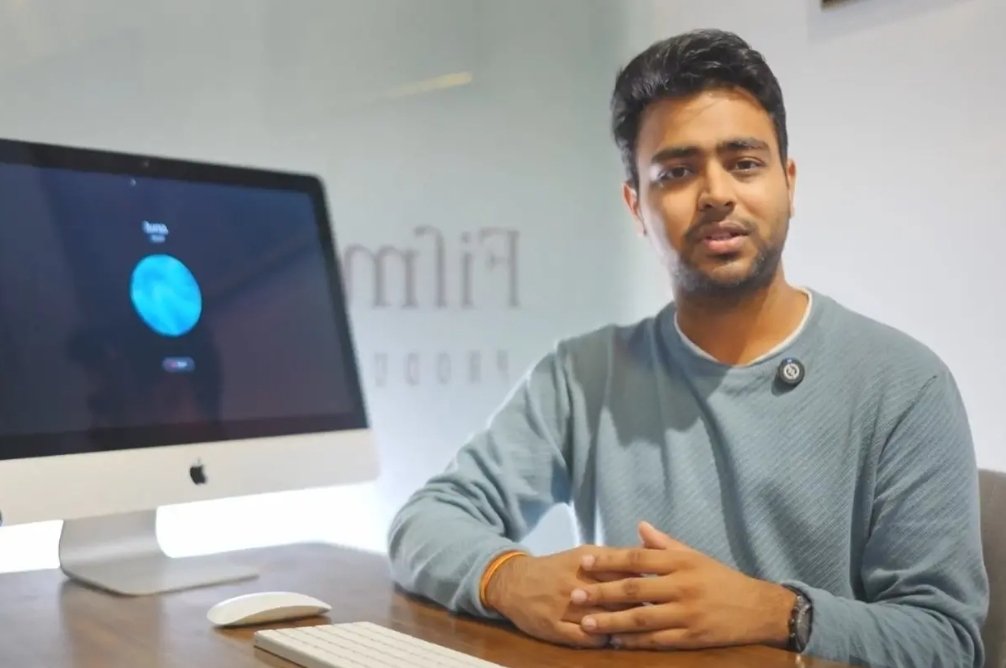
In a modest setup far from Silicon Valley’s glittering venture capitals, 25-year-old Sparsh Agrawal is redefining what it means for machines to sound human. The IIT-BHU graduate has launched Luna AI, a groundbreaking speech-to-speech foundational model that doesn’t just talk—it sings, whispers, pauses for dramatic effect, and infuses responses with genuine emotional nuance.
And he did it all under his startup Pixa AI, without a dime from big tech giants or flashy VC funding.Picture this: You’re chatting with an AI that croons a lullaby in a soothing whisper, hesitates thoughtfully mid-sentence like a friend pondering a tough question, or belts out a joyful tune with pitch-perfect emotion. That’s Luna in action. Unlike traditional voice assistants that clumsily convert speech to text and back—often resulting in robotic, delayed replies—Luna processes raw audio input directly into lifelike output. The result? Conversations that flow faster, feel more natural, and actually “get” the mood behind your words.
Early benchmark tests are turning heads: Luna outperforms global heavyweights like OpenAI’s GPT-4 TTS and ElevenLabs, delivering 50% lower latency and speech that independent evaluators describe as significantly more natural-sounding.”
Most AI voices today are like reading from a script—flat and mechanical,” Agrawal explains in an exclusive interview. “Luna listens to the tone, the pauses, the emotion in your voice and mirrors it back. It can sing a happy birthday song with excitement or whisper a secret like it’s sharing something intimate. We’re making AI more human than machine.”
Agrawal’s journey started in the dorms of IIT-BHU (Indian Institute of Technology, Banaras Hindu University), where he tinkered with machine learning projects amid late-night coding sessions. Fresh out of graduation, the Jaipur native bootstrapped Pixa AI, pouring his savings and sheer grit into developing Luna.
“I didn’t have a research lab or a USD 100 million runway,” Agrawal said, highlighting his journey of building Luna with limited resources. “I borrowed GPUs, cloud credits, and even took on credit card debt to build Luna. This is proof that world-class technology can come from India – built with resourcefulness, not just resources.”
What sets Luna apart in a sea of chatbots? Its end-to-end audio processing skips the text intermediary, slashing latency and preserving subtle vocal cues. Test demos show it handling complex tasks: responding to a frustrated user’s rant with empathetic calm, or improvising a melody on the fly based on lyrics you feed it. Early users rave about its potential in education (think interactive storytelling for kids), therapy (emotionally attuned companions), and entertainment (virtual singers that adapt to your vibe).
This isn’t Agrawal’s first rodeo. While at IIT-BHU, he contributed to open-source AI projects and even built prototypes that caught eyes at tech hackathons. But Luna marks a leap forward—one of the world’s first truly foundational speech-to-speech models accessible to indie developers. “Big tech has the resources, but they gatekeep innovation,” he says. “We’re proving you don’t need that to build something revolutionary.”
As AI races toward more immersive experiences, Luna’s indie origins highlight a growing trend: talented engineers from India’s premier institutes challenging the status quo. With Pixa AI now open for beta access, Agrawal hints at future updates, including multilingual support and integration with everyday apps.In an era dominated by funded behemoths, Sparsh Agrawal’s Luna AI is a refreshing reminder: sometimes, the most human breakthroughs come from the most unexpected places.