


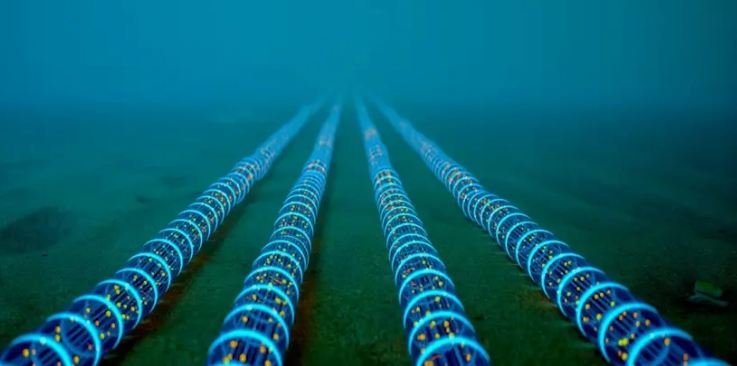
By threatening to slap “licensing fees” on undersea cable operators and claiming sovereign rights over the cables slicing through its offshore territory, Tehran has placed its finger on the digital kill switch of globalization itself.
Deep beneath the oily waters of the Strait of Hormuz, a silent fuse has been lit. While the world watches tanker traffic and missile launches, Iran has just activated a far more insidious weapon: the hidden arteries that keep the modern world alive.
This is not diplomacy. This is geopolitical blackmail at its most sophisticated — cold, calculated, and terrifyingly effective.
Iran’s latest move on undersea cable should send a chill through every capital, boardroom, and data center on the planet. By floating plans to charge operators for access to undersea internet cables in the Strait of Hormuz — and openly threatening to treat these cables as lying within its offshore territory — Tehran is not just posturing. It is declaring that it now holds a digital kill switch over a critical slice of the global internet.
Iran’s latest gambit—threatening to impose “licensing fees” on undersea cable operators traversing the Strait of Hormuz, while demanding that tech giants like Google, Meta, Microsoft, and Amazon submit to Iranian jurisdiction and hand repair monopolies to Tehran-linked firms—isn’t mere economic opportunism.
It represents a sophisticated evolution in asymmetric geopolitics. Emboldened by its ability to disrupt oil flows and test Western red lines in the ongoing shadow war, the Islamic Republic is now extending its chokepoint doctrine from hydrocarbons to bandwidth by using undersea cable as a powerful weapon.
This move signals Tehran’s intent to treat the seabed as a sovereign extension of its territory, weaponizing globalization’s physical underbelly against its adversaries.
More than 95% of all international data — financial trades worth trillions, military command streams, corporate secrets, and the everyday pulse of global communication — races through a fragile web of undersea cables. In the narrow 21-mile throat of Hormuz, critical routes converge dangerously close to the world’s most vital oil artery.
Key systems at risk include the AAE-1 (Asia-Africa-Europe 1), which links Southeast Asia to Europe via the Gulf and Egypt; the FALCON cable, connecting India and Sri Lanka to Gulf hubs and beyond; the Gulf Bridge International (GBI), tying together the entire region; Tata TGN-Gulf, and segments of the SEA-ME-WE family. Many of these vital lines hug the Omani side to avoid Iranian waters — until now.
Iran has stalked this vulnerability for years. It perfected choking oil flows. Now it applies the same lethal playbook to data.
Today: tolls and jurisdiction demands on Western tech giants. Tomorrow: harassment of repair ships, convenient “accidents,” or a quiet flip of the switch. Low cost. Plausible deniability. Global blackout potential.
In shadowed war rooms across Riyadh, Abu Dhabi, and Doha, alarms are screaming.
The Gulf monarchies — Saudi Arabia, UAE, Qatar, Bahrain, Kuwait — have bet their futures on becoming digital empires. These cables (AAE-1, FALCON, GBI) are the invisible lifelines feeding their cloud hubs, AI ambitions, and financial nerve centers. A sustained disruption wouldn’t just throttle their internet. It would shatter post-oil dreams and force them into desperate, humiliating negotiations with Tehran — or risky pivots toward Russia and China.
India stares into its own abyss. Its outsourcing empires, UPI-driven digital economy, and energy lifelines all depend on these same routes. Any cut to FALCON or AAE-1 would compound Red Sea wounds, hammer remittances and stock exchanges, and hand Beijing a golden strategic opening in the Indo-Pacific.
Europe and East Asia wait in the next ring of fire. Financial markets would convulse. High-frequency traders would go blind. International banks would seize up. And the Global South — clinging to the thinnest threads of redundancy — would plunge into prolonged darkness, with blackouts, collapsed services, and governments fighting to maintain control.
This fits Iran’s “forward defense” doctrine like a glove: raise the global cost of confrontation so high that no one dares strike. It echoes Russia’s murky Baltic cable operations and China’s creeping moves in the South China Sea — but with one blood-chilling twist. Iran is targeting infrastructure the entire planet shares.
For Washington and its allies, the dilemma is pure nightmare fuel. Deploy naval assets to guard invisible cables on the seafloor and risk igniting wider war. Stand down, and watch a revisionist power hold the global economy hostage.
New projects like 2Africa extensions and SEA-ME-WE-6 segments already stall in fear. The world fragments into rival digital fortresses. The seabed becomes the newest, darkest theater in the great power struggle.
We have treated the internet as an ethereal, borderless cloud for too long. Iran is forcing the world to confront the truth: the digital age rests on fragile glass threads lying on the seafloor in some of the most dangerous waters on Earth.
This undersea cable episode reveals the terrifying fragility of globalization. One hostile actor in a narrow strait can threaten the connectivity, commerce, and security of billions. And Iran has just shown it fully understands this vulnerability — and is prepared to exploit it.
The world should be terrified. Not because Iran will necessarily cut the cables tomorrow, but because it now possesses credible leverage to do so whenever it chooses. In the emerging era of hybrid conflict, controlling the physical backbone of the internet may prove as decisive as controlling territory or airspace.
Tehran’s cable strategy is a high-IQ, low-risk escalation ladder—profitable if tolerated, escalatory if challenged. It exposes an uncomfortable truth: in multipolar hybrid conflict, the victor may be the one who best maps and exploits the world’s hidden chokepoints.
The Gulf isn’t just an energy theater anymore; it’s ground zero for the battle over who controls the arteries of the information age.
The fiber is real. The threat is real. And the consequences of ignoring it will be felt by everyone, everywhere.


Naorem Mohen is the Editor of Signpost News. Explore his views and opinion on X: @laimacha.