


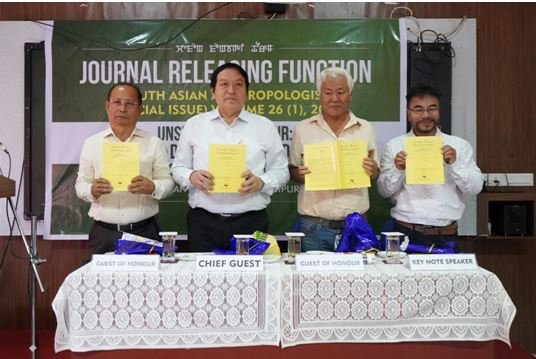
Imphal, August 07, 2026: The Department of Anthropology, Manipur University, on Friday released a special issue of the South Asian Anthropologist (SAAN) titled “Unsettling Manipur: Conflict, Displacement and Despair”, presenting a collection of evidence-based academic studies examining different dimensions of Manipur’s ongoing crisis.
The special journal was released during a function held at the Conference Hall of the Department of Anthropology in the presence of Vice Chancellor (In-Charge) Prof. R.K. Hemakumar Singh; Dean of the School of Human & Environmental Sciences Prof. M.C. Arunkumar; Chairman of the Research and Development Cell Prof. S. Jibonkumar Singh; Head of the Department of Anthropology Prof. Haobijam Vokendro Singh, faculty members, research scholars and students.
Addressing the gathering, Vice Chancellor (In-Charge) Prof. R.K. Hemakumar Singh said universities have a responsibility to produce objective academic research capable of helping society understand complex issues. He appreciated the Department of Anthropology for publishing a timely volume devoted to Manipur’s continuing unrest and expressed hope that the research would contribute to informed academic discussions beyond the state.
Delivering the keynote address, Prof. Haobijam Vokendro Singh said the special issue was conceived to move discussions on Manipur from speculation and misinformation to evidence-based academic inquiry.
“In an age dominated by social media narratives and AI-generated content, this volume represents a rigorous academic effort based on empirical findings rather than fiction or speculation,” he said. He described the publication as a “lighthouse” that seeks to distinguish credible knowledge from unverified narratives through carefully curated research.
According to Prof. Vokendro, the volume includes studies on media narratives surrounding the ethnic conflict, the demographic profile of drug peddlers in Manipur based on a retrospective analysis covering 2015-2024, and the psychological and physiological health conditions of internally displaced persons (IDPs).
He said one paper examines how selective presentation of events by sections of the media can influence public perception, while another analyses ten years of data on drug-related arrests to understand demographic patterns through empirical evidence. Another study compares stress levels and health indicators between IDPs and non-IDPs and offers findings that could assist psychologists and healthcare professionals in planning appropriate interventions.
Guest of Honour Prof. M.C. Arunkumar said the publication represents one of the first organised academic attempts to examine the ongoing situation in Manipur through scientific and evidence-based perspectives rather than competing narratives and speculation. He said the studies could open new avenues for interdisciplinary research into the causes, impacts and long-term consequences of the crisis.
Chairman of the Research and Development Cell Prof. S. Jibonkumar Singh noted that South Asian Anthropologist, first published in 1980, is among India’s oldest anthropology journals.
He also said universities must not only preserve knowledge but also generate research that addresses society’s pressing challenges with academic integrity, scientific rigour and commitment to truth.
The speakers observed that the prolonged crisis has left deep social, educational, economic and psychological impacts on the people of Manipur and expressed hope that the special issue would contribute to informed public discourse and encourage further evidence-based research on the state’s contemporary challenges.