


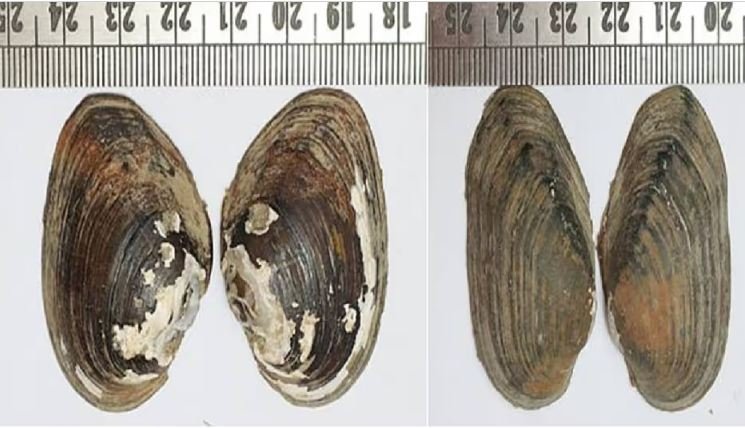
Imphal, 08 July: Researchers from Manipur University have discovered two new freshwater mussel species from Manipur, marking an important contribution to the scientific understanding of the region’s freshwater biodiversity and evolutionary history.
The research was carried out by Dr. Yambem Tenjing Singh, Prof. Naorem Mohilal Meitei, Samita Sorokhaibam Devi, and Dr. Bina Loukrakpam of the Department of Zoology, Manipur University. The team documented the freshwater mussel diversity of Manipur through an integrative approach combining morphological examination with DNA analyses.
The study identified six freshwater mussel species belonging to the subfamily Parreysiinae and spread across four genera: Indonaia, Lamellidens, Parreysia, and Radiatula. Among them, two species have been described as new to science: Indonaia manipurensis and Parreysia imphalensis.
The researchers also clarified the taxonomic status of Radiatula theobaldi, an endemic freshwater mussel species of Manipur, based on newly sequenced topotypes. This has provided fresh scientific evidence on the diversity, classification and evolutionary placement of freshwater mussels in the Indo-Myanmar region.
According to the study, Manipur’s freshwater mussel fauna represents a distinctive assemblage of endemic and allochthonous unionid species. This biodiversity has been shaped by ancient geological and biogeographical processes, including historical connections between freshwater systems of the Indian Plate and the Burma Terrane.
The time-calibrated phylogenetic reconstructions carried out by the researchers indicate broader biogeographical patterns linked to plate tectonics. The study traces divergence times back to the Cretaceous period and links the origin of Parreysiinae with the breakup of Gondwana.
Subsequent dispersal and vicariance events from the Cretaceous to the Miocene further shaped the present distribution of these freshwater mussels. The findings place Manipur within a wider evolutionary framework connecting South and Southeast Asian freshwater systems.
The study also recorded the aquatic leech Hemiclepsis myanmariana inhabiting the mantle cavity of the freshwater mussel Lamellidens generosus. This finding highlights a notable host-symbiont association in Manipur’s freshwater ecosystems.
Researchers noted that freshwater mussels are important ecosystem engineers. They help filter water, cycle nutrients and maintain the ecological health of freshwater habitats. Their presence, diversity and distribution are therefore significant indicators of freshwater ecosystem condition.
The study cautioned that this unique biodiversity, which evolved over millions of years, is increasingly threatened by habitat fragmentation, pollution and overharvesting caused by human activities. The researchers stressed the need for strengthened conservation measures to protect these ecologically significant species and their habitats.
The findings have been published in two internationally recognised peer-reviewed journals. One paper appeared in the Biological Journal of the Linnean Society in 2026, published by Oxford University Press, United Kingdom. Another was published in Ecologica Montenegrina in 2025 by the Institute for Biodiversity and Ecology, Montenegro.


Naorem Mohen is the Editor of Signpost News. Explore his views and opinion on X: @laimacha.