


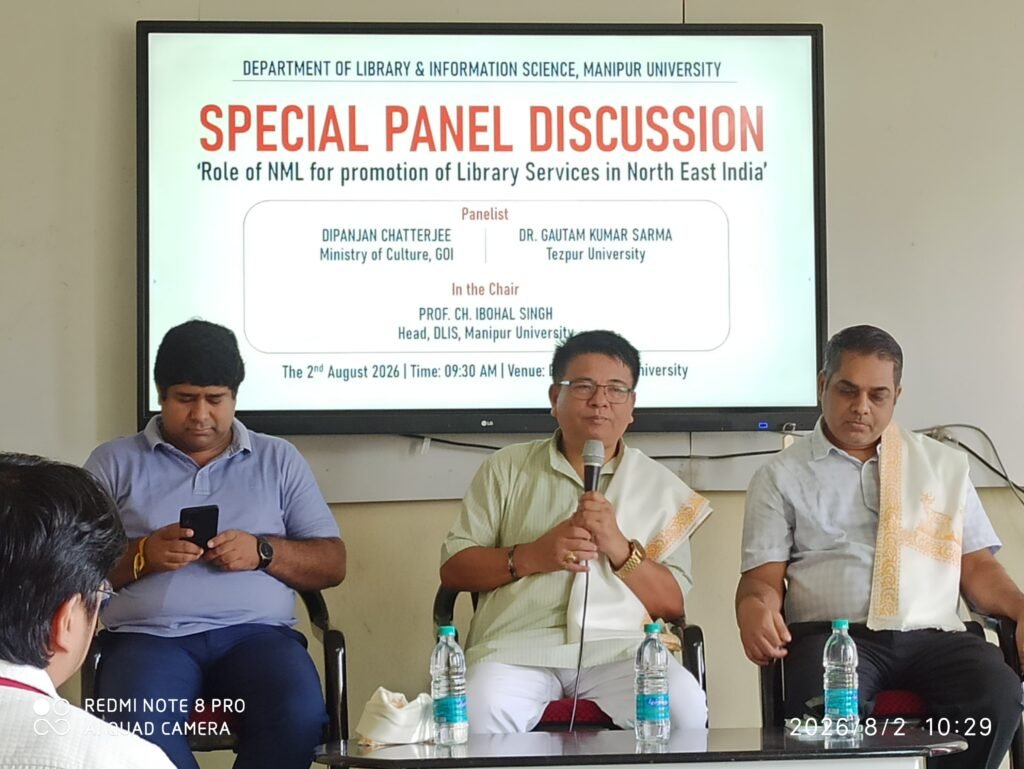
Imphal, August 02, 2026: A panel discussion on the “Role of the National Mission on Libraries in Promoting Library Services in North Eastern India” was held at the Department of Library and Information Science, Manipur University today. Faculty members, students of Library and Information Science, and public library personnel from Manipur and Arunachal Pradesh attended the programme.
The panel comprised Prof. Ch. Ibohal Singh, Head of the Department of Library and Information Science, Manipur University; Dr. Goutam Kumar Sarma, Deputy Librarian, Tezpur University; and Shri Dipanjan Chatterjee of the National Mission on Libraries, Ministry of Culture, Government of India.
The discussion focused on strengthening the public library system in the North Eastern states through coordinated support from the Raja Rammohun Roy Library Foundation, the National Mission on Libraries, academic institutions and state governments.
The panel noted that the Raja Rammohun Roy Library Foundation has been extending annual financial assistance to public libraries in North Eastern India under various development schemes on a 90:10 funding pattern. In Manipur, proposals are examined by the State Library Planning Committee, chaired by the Commissioner of Art and Culture, Government of Manipur, before being recommended for assistance under different RRRLF schemes.
Shri Dipanjan Chatterjee highlighted the role of the National Mission on Libraries in supporting the modernisation of public libraries through infrastructure development, technological upgradation, digital initiatives, advocacy programmes and professional capacity building.
He informed the gathering that the State Central Library, Imphal, had received Rs 2.23 crore, while the District Library, Senapati, had received Rs 87 lakh under the Mission. The assistance covered infrastructure improvement, technological upgradation, procurement of library resources, facilities for Divyangjan users and community outreach programmes.
The panel observed that public libraries are increasingly expected to provide modern information services through automation, digital access, reading promotion and community engagement. It also noted that effective utilisation of the infrastructure and financial assistance provided by the Government of India requires adequate professional manpower and sustained institutional support.
It was further pointed out that public libraries fall under the State List of the Seventh Schedule of the Constitution of India. Matters relating to their establishment, staffing and day-to-day administration, therefore, come under the purview of the respective state governments.
Dr. Goutam Kumar Sarma said that the modernisation of public libraries could be undertaken with relatively modest investment. A library with an existing building, books and electricity could be converted into an automated facility using the open-source KOHA Integrated Library Management System at an estimated cost of Rs 2 lakh to Rs 3 lakh.
He suggested that a pilot project be initiated to automate selected public libraries before the model is expanded across the State.
Prof. Ch. Ibohal Singh highlighted Manipur’s pioneering contribution to the library movement in the region. He said that while the public library movement in India began in 1907, the erstwhile princely State of Manipur witnessed the beginning of its own library movement in 1927.
He also recalled that Manipur was among the early states in India to enact public library legislation. He said the effective implementation of the long-pending provisions of the Manipur Public Libraries Act, 1988, supported by adequate professional manpower and institutional mechanisms, would significantly strengthen public library services in the State.
In his concluding remarks, Prof. Ibohal Singh, who is also President of the Manipur Library Association, suggested that the State Government consider engaging qualified graduates and postgraduates of the Department of Library and Information Science, Manipur University, as library interns on a stipend basis.
He proposed that such an internship programme could be introduced through a Memorandum of Understanding between the State Government and Manipur University. Similar internship models, he noted, are functioning successfully in several Central Government organisations and in different states.
Such an initiative would provide practical exposure to young library professionals while helping public libraries complete pending technical and professional work. It would also facilitate the optimum utilisation of infrastructure and financial assistance already made available to the libraries.
The panelists unanimously emphasised the need for continued collaboration among the Government of India, the governments of the North Eastern states, academic institutions and library professionals.
They observed that a stronger public library network would promote education, preserve the rich cultural heritage of the North East, disseminate knowledge, encourage reading habits, support research and lifelong learning, and ensure inclusive access to information for every citizen