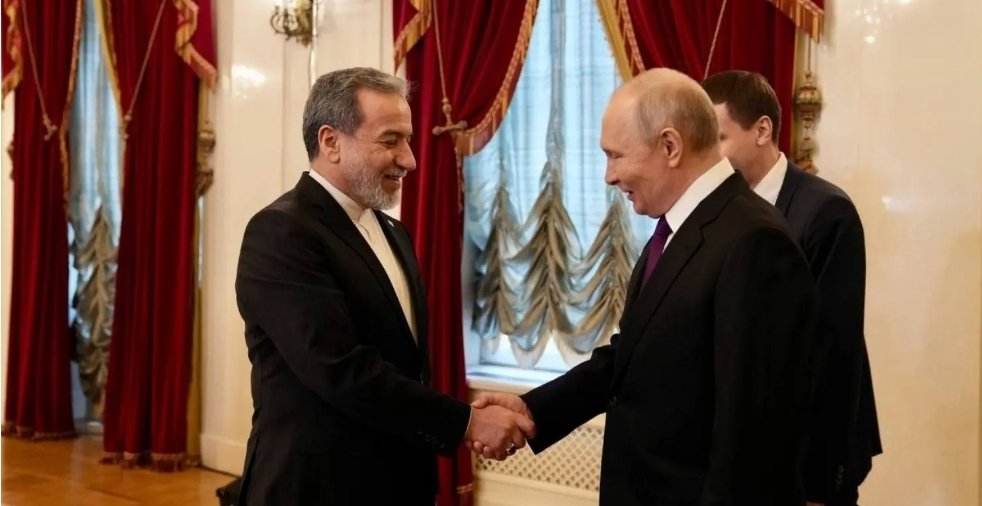
The deepening cooperation between Russia and Iran stands out as a defining development in the West Asian Geopolitics. Iranian Foreign Minister Abbas Araghchi’s high-level meeting with Russian President Vladimir Putin in St. Petersburg on April 27, 2026, is more than a routine diplomatic engagement — it signals a robust strategic convergence at a time when the region faces profound uncertainty following direct hostilities with the United States and Israel.
Araghchi, fresh from mediation efforts in Pakistan and Oman, conveyed Tehran’s appreciation for Moscow’s steadfast solidarity. “Recent events have evidenced the depth and strength of our strategic partnership,” he noted. This partnership, formalized through the Comprehensive Strategic Partnership Treaty signed in January 2025, is now being tested and strengthened in real-time amid stalled peace talks with Washington.
President Putin, during the nearly two-hour meeting also attended by Foreign Minister Sergey Lavrov, praised the Iranian people’s “brave and heroic” defense of their sovereignty. He pledged that Russia would “do everything that meets your interests and the interests of all peoples in the region” to achieve peace swiftly. Kremlin Spokesman Dmitry Peskov reinforced this by offering Russia’s good offices for mediation toward a “guaranteed peace” with no return to hostilities.
This is not empty rhetoric. Russia, despite its commitments in Ukraine, has positioned itself as a reliable counterweight to Western pressure. The alliance builds on decades of evolving ties — from military-technical cooperation to energy projects and shared resistance to unilateral sanctions.
In 2025, the landmark treaty expanded this into a 20-year framework covering defense, counter-terrorism, trade, and regional stability. Today, it manifests in diplomatic backing and potential practical support as Iran navigates a precarious security environment.
The timing of Araghchi’s visit is critical. US-Iran relations have oscillated between direct confrontation and tentative diplomacy. Reports indicate American and Israeli strikes on Iranian targets in 2025 and early 2026, coupled with a US blockade on Iranian fossil fuel exports.
Iran has responded by leveraging its control over the Strait of Hormuz — the chokepoint through which nearly 20% of global oil passes. Tehran recently proposed reopening the strait in exchange for ending hostilities and lifting the blockade, a move acknowledged even by the Trump administration.
However, deep mistrust persists. Iran demands written security guarantees that neither the US nor Israel will launch future aggressions — a demand Washington has been reluctant to meet. Experts widely view American negotiations as a mix of carrots and sticks: talks paired with sanctions, military pressure, and demands for Iran to abandon uranium enrichment. This approach, critics argue, undermines genuine diplomacy and perpetuates a cycle of escalation.
In contrast, Russia offers consistent support without such preconditions. Putin’s message is unambiguous: Moscow stands with Tehran, much like Beijing and other partners in the emerging multipolar order.
Araghchi described Iran as a “stable and powerful” state whose ties with Russia will only deepen, irrespective of external pressures. This resilience stems from shared experiences of Western sanctions and a mutual interest in a balanced West Asia free from hegemonic dominance.
The Russia-Iran axis challenges the post-Cold War unipolar framework. For years, Western policymakers portrayed Iran as isolated and Russia as weakened. Events in 2025-2026 have disproven both. The fall of certain proxy networks and regional churn (including shifts in Syria) have pushed Moscow and Tehran closer, not apart. Their partnership now serves as a stabilizing force — or at least a deterrent against further adventurism.
Energy security is central. The Strait of Hormuz remains a flashpoint. Any prolonged closure or blockade risks global economic shockwaves, affecting importers from Europe to Asia. Russia, itself a major energy player, understands this dynamic intimately.
By backing Iran’s position, Moscow indirectly safeguards alternative energy corridors and reinforces the principle that chokepoints should not become tools of coercion.
Militarily and technologically, cooperation has grown. Joint exercises, drone technology transfers, and intelligence sharing have practical value. While Russia avoids direct entanglement in the current US-Iran conflict, its diplomatic cover and potential logistical support provide Iran strategic depth. This aligns with broader Eurasian integration efforts, including the International North-South Transport Corridor (INSTC), which connects Russia, Iran, and India — a project of immense relevance to New Delhi.
These developments carry profound lessons. India maintains strong historical ties with Russia, dating back to the Soviet era, and pragmatic engagement with Iran, centered on energy, Chabahar Port, and connectivity. The Russia-Iran partnership does not force a zero-sum choice but highlights the virtues of multipolarity and strategic autonomy.
New Delhi has consistently advocated for a multipolar world where sovereignty is respected and no single power dictates regional outcomes. The Russia-Iran alignment reinforces this by creating space for independent actors. It counters narratives of inevitable bloc confrontation and opens avenues for trilateral cooperation via INSTC, which could transform trade routes bypassing chokepoints dominated by extra-regional powers.
India’s balancing act — deepening QUAD ties while preserving Russia relations and engaging Iran — exemplifies mature diplomacy. As West Asia churns, India benefits from a stable region anchored by strong local partnerships rather than imposed settlements.
A just peace in West Asia, respecting Iranian security concerns and regional balances, would serve Indian interests: secure energy flows, opportunities for reconstruction, and reduced spillover of extremism.
Some may label this axis as “anti-Western,” but that misses the point. It is pro-sovereignty. Nations facing sanctions and military pressure naturally seek reliable partners. Russia and Iran’s relationship, rooted in mutual respect rather than subordination, offers a model different from transactional alliances that often come with strings attached.
Putin’s offer of mediation is noteworthy. Russia, with its experience in complex conflicts and ties to multiple regional players, could facilitate de-escalation where direct US-Iran channels falter. Peskov’s emphasis on “acceptable” services to all parties suggests flexibility. For peace to endure, it must address core issues: Iran’s right to peaceful nuclear technology under safeguards, security guarantees, sanctions relief, and respect for regional sovereignty.
Superficial ceasefires or one-sided red lines will not suffice. Genuine diplomacy requires acknowledging Iran’s legitimate interests and the failures of past pressure campaigns. The 2025-2026 hostilities have demonstrated the limits of military solutions.
A sustainable framework must incorporate voices from Russia, China, and regional stakeholders — not sideline them.Looking ahead, the Russia-Iran partnership will likely expand in economics (bypassing sanctions via alternative finance), technology, and culture. For the Global South, this represents hope: that rising powers can shape outcomes rather than merely react to them. In an era of flux — from Ukraine to the Taiwan Strait to West Asia — such alliances promote equilibrium.
The Araghchi-Putin meeting signifies a fundamental truth, in today’s interconnected yet fragmented world, strategic partnerships based on shared interests and mutual respect endure. Russia’s support for Iran is not a threat to global stability but a necessary counter to unbalanced power plays.
For India and other emerging nations, it reaffirms the path of strategic autonomy — engaging all sides while prioritizing national interests and a multipolar architecture.Peace in West Asia remains elusive but achievable if pursued through inclusive diplomacy rather than coercion.
As Putin affirmed, Moscow will work toward that end. Tehran, backed by resilient alliances, enters negotiations from strength, not weakness. The coming months will test whether Washington adapts to these new realities or clings to outdated dominance.
In this flux, one thing is clear that the Russia-Iran axis is here to stay, shaping a more balanced, sovereign-centric world. Nations like India, watching closely from the subcontinent, stand to gain from a West Asia where partnerships trump pressure and dialogue triumphs over diktat.