In Manipur, a heartbreaking new low has been reached. The very places meant to heal wounds and save lives — hospitals and ambulances — are now caught directly in the line of fire. What should be sacred zones of care and compassion have turned into scenes of panic, choking gas, and rough handling. This is not just unfortunate collateral damage. It is a painful symptom of how deep the mistrust and chaos have sunk in our beloved state.
Recent days have brought reports that shock the conscience. In Bishnupur district, during clashes following the tragic bomb attack in Tronglaobi that claimed two young lives, central security forces reportedly fired tear gas shells and mock bombs inside or right into the compound of the Bishnupur District Hospital.
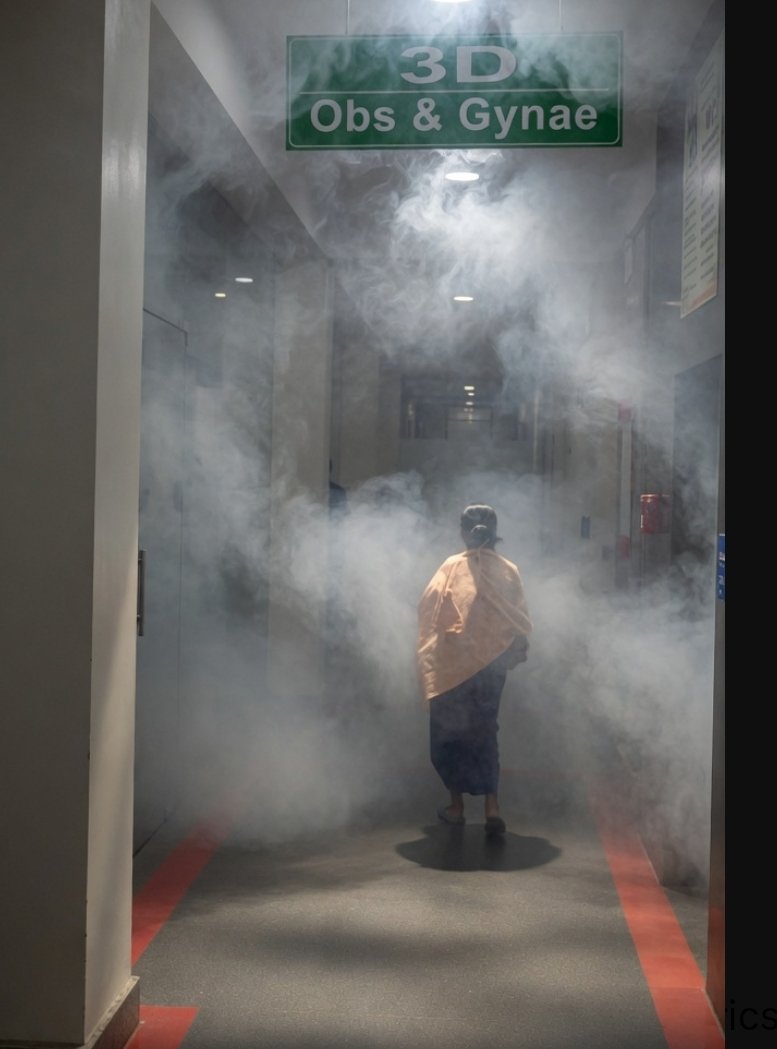
Patients, attendants, and medical staff suddenly found themselves struggling to breathe as acrid smoke filled the air. This happened while crowds protested nearby, blocking roads with burning tyres and stones. Instead of containing the unrest outside, the response spilled into the hospital itself — a place where the injured and the sick seek refuge.
Even more distressing is the incident at Mother’s Care Children Hospital and Research Centre in Sagolband, Imphal West yesterday. During a night torch rally and protest in the area, a tear gas shell landed inside the premises of this delicate facility. This hospital specialises in caring for pregnant mothers, newborns, and young children — the most vulnerable among us.
Imagine a mother in labour, an infant in an incubator, or a premature baby fighting for every breath, suddenly engulfed by tear gas. Panic spread among staff and patients. The one corner of the earth that should feel safest for a new life had become a place of fear. How did we reach a point where even the maternity ward is no longer spared?
The suffering does not end at the hospital gates. Ambulance staff, especially from private services, have repeatedly faced humiliation and physical assault while performing their sacred duty.
The All Manipur Private Ambulance Owners Association has raised strong complaints. Their crews — clearly identified with medical markings, rushing emergency cases through tense streets — have been blocked, slapped, struck, and manhandled by security personnel. In areas like Imphal East and Khurai Lamlong, ambulance drivers and attendants trying to transport critical patients have been treated as suspects rather than lifesavers.
One moment they are racing against time to save a life; the next, they are dodging batons or forced to stop for aggressive checks. These are ordinary citizens, often working under extreme pressure, who deserve protection, not harassment.
These episodes raises a fundamental question about the current security approach. If the forces suspect that protesters are using hospital compounds or clinics as escape routes or hiding places, then the responsible solution is not to turn the hospitals themselves into battlegrounds.
The first and wisest step must be to declare all hospitals and medical facilities as absolute No-Protest Zones. Such a declaration should come immediately through a formal government order. Every government hospital, private nursing home, maternity centre, and primary health centre must be notified as a protected medical zone.
A clear buffer area — say 200 to 500 metres depending on the location — should be enforced around each facility. No rallies, torch processions, stone pelting, tyre burning, or any form of agitation should be allowed inside these zones. Violators must be dealt with firmly, but outside the medical perimeter.
To make this practical and effective, proper guarding is essential. Dedicated security personnel — preferably a balanced mix of state police and central forces who have received specific briefing — should be posted at all entry points. CCTV cameras with real-time monitoring linked to district control rooms can help. Screening at gates should ensure only genuine patients, attendants, and staff enter.
This approach directly addresses the security concern. If protesters cannot enter or linger near hospitals, there will be no “escape route” to exploit. At the same time, it prevents the kind of indiscriminate actions that have already caused breathing difficulties and trauma inside Bishnupur District Hospital and Mother’s Care Hospital.
Guarding hospitals must be done with wisdom and restraint, not with the same heavy-handed tactics used in open streets. Personnel posted at medical facilities need clear instructions: respect the Red Cross or medical emblems, treat the entire premises as neutral humanitarian ground, and strictly avoid using tear gas, mock bombs, or chemical agents inside or immediately adjacent to hospital buildings.
Humanitarian corridors for ambulances must be created and strictly honoured. Pre-notified safe routes should allow ambulances free and quick passage during emergencies. Any security checkpoint must be trained to wave them through without delay or rough handling.
The repeated complaints from private ambulance owners show how urgent this is. Assaulting or blocking ambulance staff is not just wrong — it risks innocent lives that have nothing to do with the protests.
Even in the worst war zones of the world, certain basic rules of humanity are supposed to hold. The Geneva Conventions explicitly protect hospitals, ambulances, and medical personnel. They must be “respected and protected” in all circumstances.
Protection is lost only if the facility is actively used for military purposes — such as firing weapons from inside — and even then, only after proper warning. In World War II, despite the global carnage, attacks on clearly marked hospitals and Red Cross convoys drew strong condemnation.
In the long conflicts of the Middle East — be it in Syria, Iraq, Gaza, or Yemen — the world has repeatedly condemned strikes on healthcare infrastructure. International bodies, human rights groups, and even warring parties often pay at least lip service to medical neutrality.
Doctors treating the wounded, even from the “other side,” are generally accorded respect. Ambulances are given safe passage when clearly identified.
However, here in Manipur, a state within democratic India, the bar seems distressingly lower. Tear gas entering a children’s hospital or ambulance crews being manhandled has not yet triggered the kind of outrage or corrective action one would expect.
This suggests that security forces and those directing operations urgently need specialised counselling and training. They must learn nuanced protocols for civil unrest involving medical facilities. Crowd control methods suitable for open roads cannot be applied blindly next to a labour room or paediatric ward.
The current mentality appears reactive and broad-brush. When protests flare — whether over the tragic loss of children in Tronglaobi or other incidents — the response often becomes indiscriminate. In the heat of the moment, the distinction between agitators, bystanders, patients, and medical staff gets blurred. This deepens public alienation and makes reconciliation harder.
Innocent people who have already suffered so much ethnic strife, displacement, and violence now face the added terror that even when they fall sick or meet with an accident, the system meant to help them might itself become a source of harm.
The pain is deeply personal for many of us. In a place like Manipur, where community bonds are strong but trust in institutions has been badly shaken, seeing hospitals under siege feels like an attack on our collective humanity.
Pregnant mothers deserve a calm, safe environment to bring new life into this troubled world. Newborns fighting for breath should not have to inhale tear gas. Accident victims bleeding on stretchers should not have their ambulances stopped and their attendants slapped. Medical staff risking their own safety to serve others should not live in fear of the very forces deployed to maintain order.
To the highest authorities — the Union Home Ministry, the Chief Minister’s Office, the Director General of Police, and senior officers of central and state forces — this is an urgent appeal. First, notify all hospitals as No-Protest Zones with immediate effect, complete with buffer areas and proper guarding.
Second, issue written, unambiguous Standard Operating Procedures (SOPs) for any operation near medical facilities. These SOPs must explicitly prohibit tear gas, mock bombs, or excessive force inside hospital compounds unless there is an imminent and direct threat that cannot be handled otherwise — and even then, with maximum caution and after warning.
Third, involve community policing as a serious strategy. Train and empower local police and community liaison teams who understand the ground realities, the sensitivities of different areas, and the people. Joint committees involving hospital administrations, ambulance associations, civil society groups, and security officials can help in real-time coordination during tense periods. This can build trust and ensure that security measures enjoy local acceptance rather than breeding resentment.
Fourth, provide targeted training to all forces on protecting healthcare during unrest. Draw lessons from global best practices in crowd management that successfully safeguard medical neutrality. Invest in better non-lethal tools that allow precision without affecting nearby hospitals.
Fifth, enforce accountability. Every complaint of tear gas entering a hospital or assault on ambulance staff must be properly investigated. Findings should be made public, and guilty personnel held to account. This will restore some confidence that the system still values justice.
Manipur has endured too many wounds already. The cycle of violence, protest, and counter-action has claimed far too many innocent lives. Turning hospitals and ambulances into additional flashpoints only pours salt on those wounds.
If even the places where life is preserved and suffering is alleviated are no longer safe, then what hope do we leave for the future?
We must draw a clear line. Ambulances and hospitals must be taken out of the line of fire. Declare them protected zones. Guard them with wisdom, not just force. Train the forces to respect medical spaces even in the heat of conflict.
Listen to the genuine grievances of ambulance staff and hospital authorities. Combine firm security with community understanding.
Only then can we begin to reclaim the humanity that conflict has tried to erode. The mothers waiting to give birth, the infants struggling in neonatal care, the patients fighting illness, and the dedicated medical workers — they all deserve better.
They deserve to feel safe in the very places meant for healing.
All these three years, people have shown remarkable resilience through years of hardship. Now is the time for the authorities to match that resilience with thoughtful, compassionate governance.
When hospitals are in the line of fire, it is not just individual lives at stake — it is the soul of our society that suffers.