


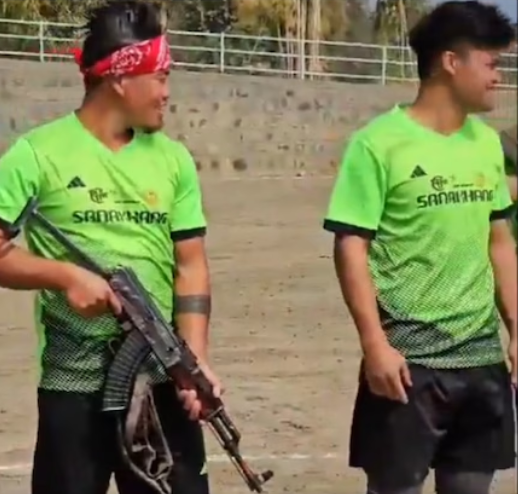
The SoO story began with a table offered to Kuki militants in 2005. By 2026, official records were citing low camp attendance, alleged arms movement, recruitment, extortion, ammunition procurement and FIRs. The State Cabinet and MHA correspondence now make SoO agreement, a major question of public accountability in Manipur.
The Suspension of Operations, or SoO arrangement with Kuki armed groups has returned to the centre of Manipur’s public debate after official records showed repeated alleged violations of ground rules during 2023-2026, low cadre presence in designated camps, continued stipend payments to cadres, and formal communications by the State Government to the Ministry of Home Affairs on the future of the agreement.
The issue is no longer limited to whether particular armed groups violated particular clauses. It now concerns the origin, management and consequences of a security framework that began as a tactical opening with Kuki militants in 2005 and later became a formal tripartite arrangement involving the Government of India, the Government of Manipur and Kuki armed platforms.
According to the submitted background, the first opening was created in 2005 when Kuki militants were brought to the table by central security actors at a time when Manipur Police Commandos and other State forces were actively pursuing valley based insurgent groups. The contrast remains politically significant. While valley insurgent outfits faced sustained operational pressure, Kuki armed groups were placed on a track that eventually gave them dialogue, designated camps, stipends and monitored recognition.
The formal tripartite SoO agreement with the Kuki National Organisation and United People’s Front was signed on August 22, 2008. A reference document notes that the agreement involved the Government of India and the Government of Manipur on one side, and KNO and UPF on the other, under a set of ground rules that included abiding by the Constitution of India, the law of the land and the territorial integrity of Manipur. It also referred to non involvement in atrocities and extortion, construction of designated camps, deposit of arms under a double lock system, financial assistance for armed groups, and submission of cadre lists, photographs and bio data.
The stated purpose of the SoO agreement was to reduce violence and bring armed groups under a regulated mechanism. Cadres were expected to remain in designated camps. Weapons were to be secured. Armed movement in public was prohibited. Recruitment, extortion, intimidation, road blockades, offensive operations and acquisition of additional arms were barred under the agreed ground rules.
Official records from 2023, however, raise serious questions over whether those rules were enforced with the necessary seriousness.
A document titled “Violation of Agreed SoO Ground Rules During the Year 2023” records that during joint inspection of SoO designated camps by security agencies in May and June 2023, cadre presence was “very low,” ranging from 27 percent to 60 percent. This was against the rule that not more than 20 percent of cadres should be outside camp on leave, out pass or PSO duty. The document describes this as a clear violation of agreed SoO ground rules.
The same record cites two incidents involving designated camps. On April 8, 2023, around 14 to 15 cadres of Kuki Independent Army allegedly raided Horeb Camp at Chngkhzou under Henglep Sub-Division in Churachandpur district and looted arms and ammunition from the arm kote belonging to UTLA, KNF(Z) and USRA. On May 9, 2023, the Camp Secretary of KNO/KRA reported that a large mob entered T. Gamnom designated camp of KNO/KRA and KLO/KLA near Saikul, after which the arm kote was burnt and army quarters were gutted. The document notes that these incidents occurred due to absence of cadres in required strength and failure of SoO groups to protect their own camps.
These camp-related findings matter because confinement to designated camps was the basic condition on which the SoO system rested. Once large numbers of cadres were absent, the agreement ceased to function as a reliable containment mechanism.
The State Government had already moved before the full eruption of violence in May 2023. In an emergency Cabinet meeting held on March 10, 2023, chaired by Chief Minister N. Biren Singh, the Cabinet reviewed the law and order situation in the backdrop of rallies held in Churachandpur, Tengnoupal and Kangpokpi districts. The Cabinet noted that the rallies were held in opposition to the State Government’s steps to protect forest resources and eradicate poppy cultivation. It approved recommending to the Central Government withdrawal from tripartite talks and agreements with the Zomi Revolutionary Army, the Kuki National Army and the Kuki Revolutionary Army.
This Cabinet decision is an important part of the chronology. It shows that concerns over the conduct of specific SoO groups existed before the May 2023 violence expanded into a statewide crisis. The Cabinet also recorded concerns over activities of Kuki Inpi and ITLF, noting that the rallies of March 10, 2023 were organised under the umbrella of Kuki Inpi and that activities on the ground were spearheaded by ITLF. It decided to closely observe their activities and possible association with militant groups and other anti-national organisations for a considered decision regarding legality.
The violation records then show a series of intelligence inputs after the outbreak of violence. One input dated May 6, 2023 stated that some KNA cadres with AK-47 rifles were seen moving in areas near Sugnu Bazar. The document treated this as violation of rules prohibiting movement in uniform or with arms in public, and rules requiring cadres to stay in designated camps.
Another input dated May 15, 2023 stated that ZRA and other Kuki underground groups were allegedly imparting basic arms training to local youths and volunteers in Churachandpur district. The record cited this as violation of rules prohibiting fresh recruitment and the raising of additional military or civil outfits.
The records include repeated allegations relating to acquisition of arms and ammunition. One input dated May 23, 2023 stated that KRA, a KNO SoO group, had allegedly set up a local gun and ammunition factory in the Saikul area and was planning to supply arms to villagers. The same record stated that a KRA functionary had shifted to Boljang in Kangpokpi district and was tasked to target vehicle convoys on NH-37 and attack Meitei villages in Imphal West bordering Kuki villages of Saitu Sub-Division.
Other entries referred to procurement attempts involving AK-47 and M-16 ammunition. A May 31, 2023 entry stated that a KRA commander was approaching an individual in Kohima for 500 rounds of AK-47 and M-16 ammunition. A June 5, 2023 entry stated that a KRA finance secretary had demanded 1,500 rounds of M-16 ammunition and AK magazines. A July 5, 2023 entry stated that 5,000 rounds of M-16 ammunition had been forwarded to a KRA camp location.
The reports also refer to training and recruitment. A May 26, 2023 input stated that about 34 new recruits of KNF were undergoing training at three centres in Kangpokpi district. Another report dated June 30, 2023 stated that ZRA/ZRO was imparting training to village volunteers numbering approximately 25 to 300 in the Misao Khavom jungle near Khuga Dam in Churachandpur district.
The State’s later communication to the Ministry of Home Affairs gave these concerns a more formal administrative shape. A January 2024 communication from the Superintendent of Police, CID(SB), Manipur, to the Joint Secretary (Home), Government of Manipur, on the extension of the SoO agreement with KNO and UPF enclosed brief notes on designated camps and strength, stipend paid to cadres, violation of SoO ground rules for 2023, and physical joint inspection reports of SoO designated camps for 2023.
The annexures recorded that the total verified strength stood at 1,122 cadres of KNO and 1,059 cadres of UPF, making a combined total of 2,181 cadres.
The stipend records also show the financial dimension of the arrangement. A Home Department letter dated December 21, 2022 referred to release of backlog monthly stipend to KNO and UPF cadres under the SoO agreement for February to November 2022. It placed the amount at Rs. 13,08,60,000, calculated at Rs. 6,000 per month per cadre for 1,122 KNO cadres and 1,059 UPF cadres for ten months. The letter also stated that if any cadre under SoO was arrested for a crime, his stipend must be stopped until the decision of the court.
This detail is significant because it shows that the SoO framework was not only a ceasefire. It involved public funds, official recognition of cadre strength and a monitoring obligation. If cadres receiving stipends or belonging to stipend-supported groups were later named in violation records, the matter becomes one of public accountability.
The MHA-related records also contain inputs predating May 2023. They refer to alleged tax collection by SoO groups in January, February and March 2023. Entries include KNO/KNA allegedly demanding Rs. 5 lakh from the NHIDCL office in Moreh, ZRO/ZRA and KNO/KNA collecting illegal monthly taxes from diesel autos in Churachandpur, ZRA collecting tax from timber trucks in Singhat, and KNF(P) serving monetary demands on institutions and collecting illegal tax from HDFC Bank in Kangpokpi.
The violation document also records alleged extortion during the crisis. On June 19, 2023, KNA and UKLF were reportedly demanding Rs. 5 to 6 lakh from each non-local community settling in Moreh town as party fund and for expenses of newly recruited cadres and volunteers. On June 21, 2023, KNF was reportedly demanding Rs. 5,000 per house from villagers of Charhajare, Motbung and Kalapahar in Kangpokpi district, with around Rs. 9 lakh allegedly already handed over by Kalapahar villagers. The same entry said cadres were openly moving with arms and threatening non-tribals.
There are also records of alleged attacks or planned attacks. On May 28, 2023, cadres of UKLF were reportedly involved in attacks at Sugnu Tangjeng Khunnou, Sugnu Napat and Sugnu Langching under Sugnu Police Station in Kakching district. On May 29, 2023, around 90 heavily armed Kuki-Hmar-Zomi militants and armed volunteers were reportedly planning to ambush Indian security forces and State police personnel around Dampi village under Kumbi Police Station in Bishnupur district.
On June 23, 2023, an input stated that a KRA-linked person was planning to attack Phayeng village in Imphal West wearing security force uniform. It also referred to plans by KNO/KNA along with recently trained persons to attack Itham, Moirangpurel and adjoining Meitei villages under Sawombung Police Station in Imphal East. A June 25 input stated that around 500 newly trained Zo-Kuki volunteers under ZRA at Singhat area were likely to target Meitei settlements along Kwakta, Tera Khongsangbi, Ngangkha Lawai and Kangmong in Bishnupur district.
The FIR records deepen the public concern. The SoO violation document lists 33 FIR cases registered during May and June 2023, largely based on complaints by residents of Torbung, Phougakchao Ikhai and adjoining areas. The complainants alleged that gun-toting Kuki armed militants under SoO were involved in looting, damaging, destroying or burning houses and properties during the early phase of violence.
One FIR cited in the record states that a mobile shop and repairing centre at Phougakchao Ikhai Awang Leikai was looted and damaged on May 3, 2023 by gun-toting Kuki armed militants under SoO agreement, with alleged loss of Rs. 15 lakh. Another complaint stated that a house at Torbung Bangla was burnt down on May 3, 2023 by gun-toting Kuki armed militants under SoO, with alleged loss of around Rs. 80.30 lakh.
Other FIR entries similarly record complaints from residents of Torbung Bangla alleging that houses were attacked, destroyed and burnt by armed persons described by complainants as Kuki militants under SoO with the Government. Several complaints state that household items, jewellery and other belongings were destroyed or stolen before houses were burnt.
These records must be handled with legal care. Intelligence inputs and FIRs are not convictions. They are allegations, complaints and operational inputs that require investigation and judicial determination. But they cannot be ignored because they point to repeated patterns across dates, places and categories of violation.
The Manipur Legislative Assembly subsequently took a formal position. On February 29, 2024, the Assembly passed Resolution No. 4, and the State Home Department forwarded it to the Ministry of Home Affairs on March 3, 2024 for information and necessary action.
Taken together, the chronology is important. Kuki armed groups were first given a table in 2005. The SoO was formalised in 2008. The State Cabinet raised grave concerns and recommended withdrawal from agreements with ZRA, KNA and KRA on March 10, 2023. Official records then documented alleged violations through 2023, including low camp attendance, armed movement, recruitment, training, extortion, ammunition procurement and attacks. The State later sent detailed SoO materials to the MHA in January 2024, including camp strength, stipend records, violation records and inspection reports.
The central issue is whether the SoO remained a peace mechanism or became a structure that weakened accountability.
For any ceasefire to retain public confidence, three conditions are essential. Cadres must remain confined. Weapons must remain controlled. Violations must produce consequences. The 2023 records suggest weakness on all three counts.
The SoO question is therefore not only a security file between Delhi and armed groups. It is now a matter of constitutional accountability in Manipur. Any peace process operating within the State must respect the authority of elected institutions, protect civilians and enforce the conditions under which dialogue was permitted.
If armed groups can receive stipends, retain camps, move outside designated areas, collect money, train recruits, procure ammunition and still remain inside a protected framework, public trust in law will collapse. The State’s own records show why that concern has become unavoidable.
The Government of India and the Government of Manipur must now treat the SoO records as the basis for a full institutional audit. This audit should verify cadre attendance, weapon inventories, out pass registers, stipend disbursement, FIR status, investigation progress and the role of each group during the violence. The Joint Monitoring mechanism must also be reviewed, because monitoring without enforceable consequences cannot protect peace.
The SoO began as a tactical opening. It became a formal agreement. The documents now show that it also became one of the most serious questions behind Manipur’s crisis.
The SoO arrangement was intended to suspend armed operations and bring Kuki militant groups into a regulated framework for political dialogue. The formal tripartite agreement of August 22, 2008 involved KNO and UPF, the Government of India and the Government of Manipur. It required adherence to the Constitution of India, the law of the land and Manipur’s territorial integrity, along with rules against atrocities, extortion and armed activity.
The controversy lies in the gap between the written rules and reported ground realities. Official records from 2023 cite low camp attendance, alleged arms movement, recruitment, extortion, ammunition procurement, attacks and FIR-based civilian complaints.
The issue matters because SoO was meant to reduce violence, not create a shield for armed mobilisation. The March 10, 2023 State Cabinet decision and the January 2024 communication to the MHA show that the State Government had serious concerns over the continuation and enforcement of the framework.
For Manipur, this is also a question of public trust. A ceasefire arrangement cannot remain credible if civilians believe that armed groups under protection are violating rules without consequences.


Naorem Mohen is the Editor of Signpost News. Explore his views and opinion on X: @laimacha.