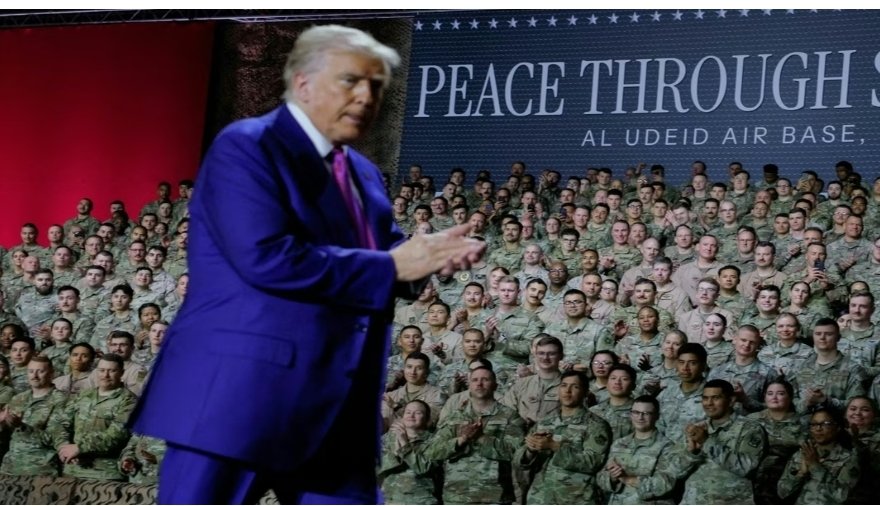
The Trump administration plans to funnel a $130 million donation from an anonymous ally of President Donald Trump toward paying military service members during the government shutdown, the Defense Department confirmed on Friday.
“The donation was made on the condition that it be used to offset the cost of Service members’ salaries and benefits,” chief Pentagon spokesman Sean Parnell said in a statement, adding that the money was accepted under the department’s “general gift acceptance authority.”
The move marks a striking departure from government procedure for funding the military, which traditionally relies on public funds appropriated by Congress. And it raised immediate questions about the donor’s identity and motivations for cutting the nine-figure check to the government.
Democrats also raised concerns about its legality, contending that the gift acceptance authority cited by the Pentagon only permits gifts for a handful of specific purposes — such as funding military schools, hospitals, cemeteries or to benefit wounded troops or the dependents of those injured or killed in the line of duty. Donations can also face additional, tighter restrictions if they come from foreign governments or organizations.
“Using anonymous donations to fund our military raises troubling questions of whether our own troops are at risk of literally being bought and paid for by foreign powers,” Delaware Sen. Chris Coons, the top Democrat on the Senate’s defense appropriations subcommittee, said in a statement. Coons’ words echo a broader unease rippling through Capitol Hill, where the specter of unchecked private influence looms large in an era of super PACs and shadowy superdonors. Yet, as the shutdown enters its fourth grueling week—now the longest since the 35-day impasse of 2018-19—this gift arrives not as a scandal, but as a stark indictment of a broken system.
In a town paralyzed by partisan brinkmanship, one faceless patriot has done what 535 elected officials could not: ensure that America’s warriors get paid on time.It’s a gesture that feels both audacious and quintessentially American—rooted in the DIY spirit of the Founding Fathers, who once funded the Continental Army with personal fortunes and loans from French sympathizers. But in 2025, with trillion-dollar deficits and endless culture wars, it also feels like a desperate improvisation.
President Trump teased the story himself on Thursday during a White House briefing, his trademark bravado laced with genuine gratitude. “I have a friend,” he boomed, gesturing expansively as if the donor were in the room. “A great guy, loves the country, loves the military. He said, ‘Donald, if there’s any shortfall, I’ll cover it.’ And today, he sent us a check for $130 million.” Trump, ever the protector of confidences, refused to name him: “He doesn’t want the recognition.”
For readers across the heartland—farmers in Iowa watching crop reports amid shuttered USDA offices, teachers in Texas grading papers without federal aid updates, or parents in Pennsylvania scraping by as IRS refunds stall—this episode cuts deeper than the usual Beltway drama. It’s a raw reminder that while politicians posture for cable news, real people pay the price.
And nowhere is that truer than on military bases, where the shutdown’s fallout hits like shrapnel: furloughed civilian spouses, frozen adoption reimbursements, and the quiet dread of a missed mortgage payment.Let’s humanize the stakes, because numbers alone don’t capture the quiet desperation.
Imagine Sergeant Maria Gonzalez, a 28-year-old single mother stationed at Joint Base Lewis-McChord in Washington state. She pulls 12-hour shifts maintaining Apache helicopters, fresh off a rotation in Syria where she dodged drone strikes and IEDs. Her base pay? About $35,000 a year, plus housing allowance that barely covers the two-bedroom apartment where her five-year-old son practices spelling bees.
During the last shutdown in 2019, Maria skipped meals to stock the pantry, relying on base food banks that saw lines snake around the block. Now, with daycare costs spiking and her car’s transmission on the fritz, that promised back pay feels like a cruel IOU. Or consider Petty Officer Jamal Washington in Virginia Beach, whose wife is a civilian contractor suddenly without hours. They’re dipping into savings meant for a down payment on their first home, all while he stands watch on the USS Eisenhower, projecting American resolve in the South China Sea.
These aren’t edge cases; they’re the norm for our 1.3 million active-duty troops, whose average enlisted salary hovers between $25,000 and $40,000 annually—modest even before the 20-30% premium for high-cost areas like San Diego or Fayetteville. Officers fare slightly better, but with families and deployments, the math is merciless.
The shutdown, triggered October 1 over Trump’s demands for $25 billion in border wall funding and reforms to “chain migration,” has already furloughed 400,000 Defense Department civilians and halted non-essential contracts. Troops work on, of course—guarding borders, patrolling seas, deterring adversaries from Tehran to Pyongyang—but the psychological toll mounts.
Veteran suicide hotlines report a 20% spike in calls during past lapses, as financial stress amplifies the invisible wounds of service.Into this fog of uncertainty strides our mystery benefactor, a Trump confidant whose nine-figure wire transfer on October 23 bypassed the congressional logjam.
Speculation swirls like smoke after a rally: Is it Elon Musk, the mercurial innovator whose SpaceX empire thrives on $4 billion in annual DoD contracts and who’s publicly hailed Trump as a “disruptor-in-chief”? Or Miriam Adelson, the 79-year-old widow of casino magnate Sheldon, whose family’s $100 million+ in GOP donations during Trump’s first term bought influence on everything from Jerusalem embassies to judicial picks? Her unyielding support for a robust military, rooted in her Israeli heritage and Sheldon’s hawkish legacy, fits the profile of quiet, consequential giving.
Perhaps it’s Howard Lutnick, the Cantor Fitzgerald CEO who rebuilt his firm after losing 658 souls on 9/11, emerging as a stealthy Trump fundraiser with $50 million pledged to super PACs this cycle. Lutnick’s survivor ethos—channeling grief into grit—mirrors the donor’s no-fanfare approach.
Other whispers point to Steve Wynn, the Vegas visionary whose Strip empire once hosted Trump fundraisers, or Harold Hamm, the Oklahoma oil baron who struck black gold and struck alliances with the president on energy independence. These aren’t idle guesses; they’re threads from Trump’s gilded Rolodex, where billionaires bond over deregulation and “America First.”
Whoever it is, they’ve shattered the $2,800-per-election cap that binds everyday donors, opting instead for a direct strike at the heart of national security.The mechanics of this largesse are as intriguing as the man behind it.
The Pentagon’s “general gift acceptance authority,” enshrined in a March 2025 directive, allows private funds for “morale, welfare, and recreation” initiatives—think gym upgrades or family retreats, not payroll padding. Salaries fall into a gray zone, more USO charity drive than federal ledger, prompting budget wonks to dust off the Antideficiency Act—a Gilded Age relic barring agencies from obligating unappropriated funds.
Heritage Foundation scholars nod approvingly, citing broad “benefit” language that could encompass pay offsets; Center for American Progress critics cry foul, labeling it a “plutocratic workaround” that invites audits and lawsuits. Congress, in a rare bipartisan spasm, fired off briefing requests Friday—Senate appropriators from both aisles demanding donor vetting, especially for gifts exceeding $10,000, which trigger ethics consults on conflicts like procurement ties or litigation.
The White House, true to form, punted to Treasury and DoD, who offered stonewalling worthy of a Cold War summit.These red flags aren’t manufactured; they’re etched in the scars of recent history. Trump’s orbit has long danced on the edge of propriety—from Saudi infusions at Mar-a-Lago galas to Qatari stakes in Jared Kushner’s 666 Fifth Avenue tower.
The 2016 Steele dossier’s echoes linger, as do Mueller’s probes into foreign emoluments. If this donor harbors overseas strings— a Gulf sheikh eyeing F-35 deals, or a European tycoon courting trade concessions—the implications could poison the well.
Senator Chuck Schumer amplified Coons’ alarm on the Senate floor, thundering that “anonymous billions from unknown sources erode the very democracy we fund with these troops’ blood and sweat.” Yet, as of Saturday morning, no smoking gun has emerged. The Pentagon’s green light implies rigorous internal scrubbing, and Trump’s breezy portrayal—“a great guy, loves the country”—paints a portrait of homegrown heroism, not hybrid warfare.
Here’s where the cynics falter: by fixating on footnotes, they obscure the flare illuminating the farce. This $130 million—peanuts against the $12 billion monthly payroll, a mere $100 per service member— isn’t a panacea; it’s a flare gun in a blackout.
It exposes the shutdown as less policy debate than ritualized tantrum, the 22nd such funding gap since 1976, with three under Reagan’s watch, two under Clinton’s, and this sequel scripted by Trump’s unyielding wall fixation. The plot? Familiar: MAGA demands for concrete barriers and immigration curbs clash with Democratic pleas for DACA dreamers and $15 billion in hurricane relief for Puerto Rico’s Maria scars and Florida’s Ian floods. Collateral: 800,000 feds idled, Yellowstone’s gates padlocked, FDA meat inspectors sidelined—potentially delaying lifesaving drug trials by weeks. The CBO tallies $2 billion weekly in economic drag, but the human ledger—delayed VA claims, shuttered Head Start classrooms—defies dollars.Finger-pointing favors no one.
Democrats’ Thursday blockade of a clean military-pay bill—only three blue senators defecting—weaponized valor for votes, a low blow even by shutdown standards. Republicans, gripping the Senate gavel and Oval swagger, could concede wall scraps without folding. This isn’t governance; it’s governance by tantrum, eroding faith in the marble edifice amid January 6’s ghosts and Dobbs’ divides.
For troops and kin, the bite is brutal. Base pantries in Quantico and Pendleton report tripled traffic, with families rationing diapers and dodging eviction notices. The donor’s check buys bandwidth—echoing World War I’s Liberty Bonds, when ordinary Americans loaned billions sans selfies.
Trump merits a nod: his team reprogrammed $8 billion from R&D slush last week, averting the first paycheck cliff. Now, this private infusion extends the runway, a populist irony for the billionaire-bashing boss who summons cavalry from his club.Detractors decry it as oligarchic overreach: “Billionaire bailouts for Beltway bungles? That’s not liberty; it’s lordship.” They channel Jefferson’s dread of “monied incorporations” and Madison’s faction fears, valid in a gerrymandered gridlock where filibusters filch progress.
But when the house burns, you don’t scorn the neighbor’s hose—you grab it. This donor didn’t usurp; he bandaged. He shames us: Why rely on phantoms when elected stewards slack?Payday ticks—October 31 looms, Congress reconvenes Monday.
Let this shadow gift galvanize, not gossip. Forge a pact: Wall dollars traded for DACA doors, storm aid lashed to debt hikes. Or bolder: Mandate auto-resolutions, etch balanced budgets, exorcise the shutdown specter.
To the ranks from Bragg to Bahrain: An unseen sentinel stands with you. To the Hill: Heed the echo. True fealty isn’t filibustered or hashtagged; it’s forged in the forge of sacrifice. This $130 million staunches a seep, but mirrors the malady. Scrutinize it, solons, and suture the republic ere another ghost foots the bill.
Anonymity? Not cloak, but crown. By veiling his visage, Trump’s ally unveils ours—affirming that America’s sinew pulses not in paneled chambers, but in the unspoken oaths of its stewards. Bless that ciphered champion. And bless the blue-star families he’s lit.