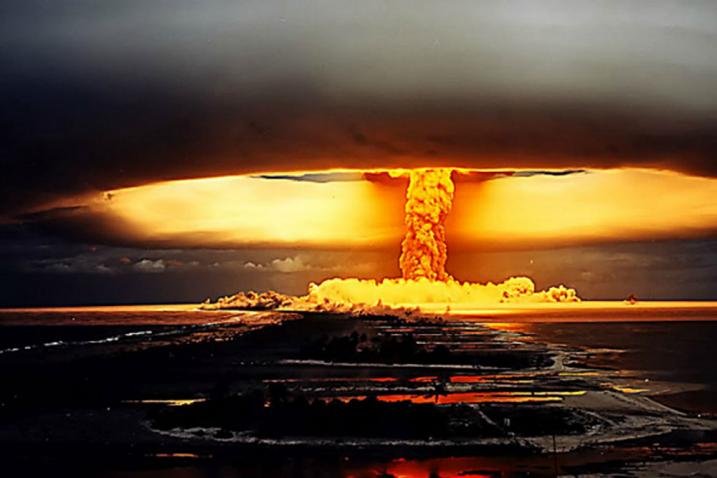
In a move that reverberates across the globe, President Donald J. Trump has ordered Pentagon for the resumption of underground nuclear weapons testing—the first such detonations on U.S. soil since 1992—ending a 33-year moratorium that had become a cornerstone of post-Cold War arms control.
The directive, issued late Tuesday from the Oval Office, instructs the Department of Energy and the National Nuclear Security Administration (NNSA) to prepare the Nevada National Security Site for a series of subcritical and, potentially, full-yield tests “as soon as operationally feasible.”
“America will no longer allow our adversaries to outpace us in nuclear capability while we tie our own hands,” Trump declared in a brief televised address. “China, Russia, North Korea—they’re all modernizing. We must verify, we must deter, and we must lead.”
The United States last conducted a nuclear explosion on September 23, 1992, under President George H.W. Bush. The ensuing voluntary moratorium, later formalized through the Comprehensive Nuclear-Test-Ban Treaty (CTBT) organization—though never ratified by the U.S.—signaled a de-escalation in the superpower arms race.Trump’s order marks a dramatic departure.
Administration officials say the decision stems from intelligence assessments showing rapid advances in Chinese hypersonic delivery systems and Russian “doomsday” torpedoes, coupled with doubts about the long-term reliability of America’s aging stockpile absent real-world data.“Stockpile stewardship through computer modeling has been remarkable,” said Dr. Lisa Gordon-Hagerty, former NNSA administrator now advising the transition team, “but nothing replaces the certainty of an actual test.”
Deep beneath the desert floor, 100 miles northwest of Las Vegas, tunnels and shafts dormant for decades are being re-surveyed. The NNSA has already mobilized diagnostic teams to Rainier Mesa and Pahute Mesa, historic sites of over 900 previous detonations.Initial tests, sources say, will be subcritical—using conventional explosives to study plutonium behavior without a fission chain reaction.
But the presidential directive leaves the door open for kiloton-range yields if “deemed necessary for stockpile confidence.”Environmental groups and downwind communities in Utah and Nevada immediately sounded alarms. “We are the collateral damage of the Cold War,” said Mary Dickson, a spokesperson for the Downwinders Advocacy Group. “Resuming testing is reckless and immoral.”
The announcement sent shockwaves through world capitals, eliciting a cascade of sharp rebukes and veiled threats. China accused the United States of “sabotaging global strategic stability” and vowed to accelerate its own nuclear modernization program. Russia’s foreign ministry issued a terse warning that it would “take reciprocal measures,” with state media openly speculating about resuming tests at the Novaya Zemlya archipelago.
United Nations Secretary-General António Guterres convened an emergency Security Council session, urging all nuclear powers to recommit to the Comprehensive Nuclear-Test-Ban Treaty framework and warning that “the ghosts of the Cold War must not be summoned anew.” Even close allies voiced unease: Japanese Prime Minister Sanae Takaichi, speaking from Delhi during bilateral talks with India, delivered a rare public rebuke, declaring that any return to nuclear testing “undermines decades of trust-building in the Indo-Pacific.”
Democrats decried the move as “dangerous showmanship.” Senate Minority Leader Chuck Schumer vowed to block funding, while arms-control advocates warned of a new arms race.Yet hawks in both parties praised the decisiveness. “Deterrence isn’t theoretical,” said Senator Tom Cotton (R-AR). “If our warheads can’t be trusted to work, neither can our alliances.”
The Pentagon has requested an emergency $2.8 billion supplemental for test infrastructure, diagnostics, and safety upgrades. The first subcritical experiment could occur as early as spring 2026.For now, the Nevada desert—scarred by a thousand ghosts of the atomic age—stands ready once more. Whether Trump’s gamble strengthens America’s shield or shatters the fragile peace of the nuclear taboo remains the question of the hour.