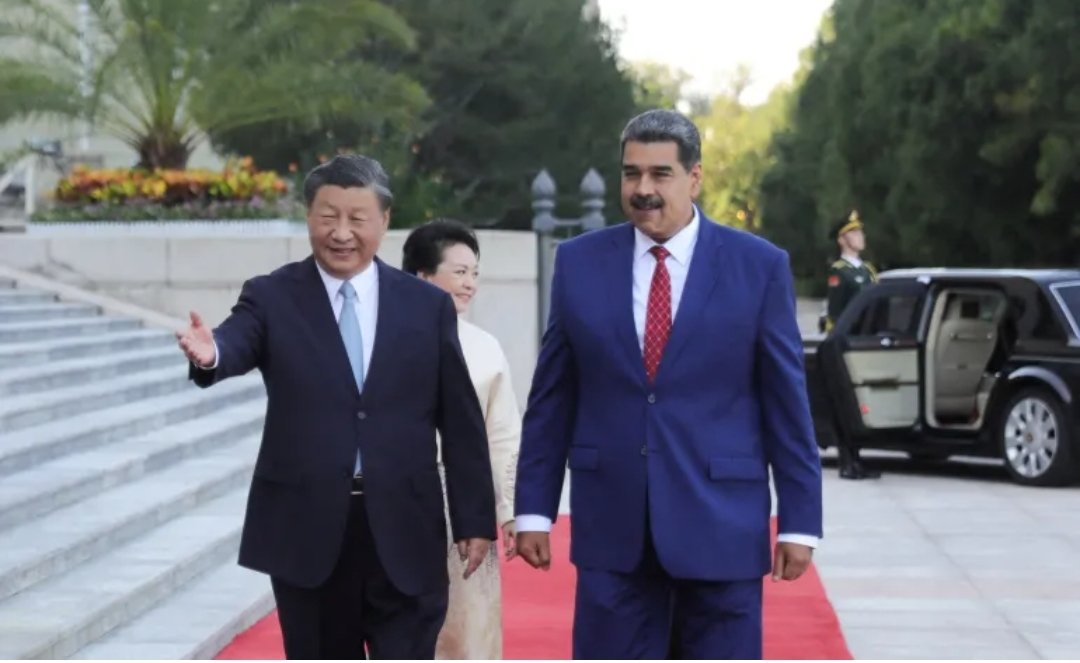
Venezuela represents one of China’s most emblematic partnerships in Latin America, often described as an “all-weather strategic partnership” forged under Hugo Chávez and strengthened under Maduro. It symbolizes Beijing’s “win-win” diplomacy in the Global South, countering U.S. influence through economic ties rather than military alliances.
However, Nicolás Maduro, the man who had defied Washington for years, was now a prisoner in New York, captured in a audacious U.S. special forces raid on Caracas just three days earlier.
For China, this is not merely the fall of a distant ally—it is a humiliating exposure of the limits of its economic power. Beijing had built one of its deepest and most symbolic trade relationships with Venezuela, pouring in more than $60 billion in peak oil-backed loans during the 2007–2015 boom years.
Yet when the moment of truth arrived, when American boots hit the ground and seized the president himself, China could do nothing but issue stern condemnations from afar.
This stark inability to protect a partner in which it had invested so heavily—economically, politically, and strategically—lays bare the fragility of Beijing’s “no-strings-attached” model and sends a chilling message to the entire Global South about the real cost of aligning too closely with a rising power that promises much but, when push comes to shove, cannot shield you from the still-dominant superpower.
When the news broke on January 3, 2026, that U.S. special forces had stormed Nicolás Maduro’s residence in Caracas, captured him and his wife in a lightning raid, and whisked them off to face trial in New York, my first reaction was disbelief.
By January 6, as Maduro appeared shackled in a Manhattan courtroom pleading not guilty to narco-terrorism charges, the full implications began to sink in. This was not just another chapter in Venezuela’s long tragedy—it was a seismic event with direct consequences for China, and by extension, for every emerging power, including India, that seeks room to manoeuvre in a unipolar shadow.
I have followed China-Venezuela ties closely because they mirror, in many ways, Beijing’s broader playbook in the Global South—a playbook India both competes with and cautiously learns from. The relationship began flourishing in the early 2000s under Hugo Chávez, who saw in China a counterweight to American dominance.
What started as ideological sympathy quickly became a massive economic embrace. Total Chinese commitments to Venezuela over two decades crossed $106 billion, making it one of the largest recipients of Beijing’s overseas lending.
In exchange, Caracas promised up to a million barrels of oil per day—crude that fed China’s refineries at discounted prices, especially valuable after U.S. sanctions isolated Venezuelan oil from Western markets.
By 2025, China was importing roughly 470,000 barrels per day from Venezuela, accounting for about 4-5% of its seaborne crude imports. This wasn’t just commerce; it was strategic hedging. Venezuela’s heavy sour crude is ideal for China’s complex refineries, and the discounted rates helped Beijing weather global price volatility.
Outstanding debt had shrunk to an estimated $10-20 billion after years of partial repayment through oil shipments, but that remaining exposure is still substantial for Chinese policy banks like the China Development Bank and Exim Bank.
The partnership went beyond oil. China invested in Venezuelan infrastructure—railways, housing projects, power plants—and even supplied defence equipment: K-8 trainer aircraft, radars, armoured vehicles, and riot-control gear worth hundreds of millions of dollars.
After U.S. arms embargoes, Venezuela’s military became increasingly dependent on Chinese (and Russian) systems. Beijing’s support extended to the diplomatic arena, where it repeatedly shielded Maduro from UN condemnation and portrayed Venezuela as a victim of Western regime-change efforts.
This model was always fascinating—and cautionary. India too seek energy security and diversified partners. We buy Venezuelan oil when sanctions allow, and we watch China’s Belt and Road Initiative with a mix of rivalry and pragmatism.
But the January 3 raid changes everything.With Maduro removed and a transitional government under Vice President Delcy Rodríguez navigating uncharted waters—while President Trump boasts of “running Venezuela” and unlocking its vast reserves—the risks for China are immediate and severe.
A pro-U.S. administration in Caracas could classify Chinese loans as “odious debt” incurred by a dictatorial regime and refuse repayment or demand harsh renegotiation. Oil flows could be redirected to American refineries, forcing China to scramble for costlier alternatives at a time when global markets remain tight.
Chinese-operated fields in the Orinoco Belt and joint ventures with PDVSA could face nationalisation threats or unfavourable contract revisions.More than the financial hit—potentially billions in write-offs—the real damage is strategic.
This operation exposes the Achilles’ heel of China’s non-intervention doctrine. Beijing invests heavily in politically aligned but economically fragile regimes, gaining influence and resources, but when Washington decides to act unilaterally, China is left issuing strongly worded statements while the ground reality shifts dramatically.
Nationalists on Chinese social media are already drawing uneasy parallels to Taiwan: if the U.S. can decapitate a government in America’s backyard, what might it attempt elsewhere?
Yet the fallout extends far beyond bilateral ties. I see this as an indirect warning shot aimed at every developing nation that has grown economically dependent on China. The message from Washington seems clear: deep trade and debt relationships with Beijing can make you vulnerable if you are perceived as part of an anti-Western axis.
Consider China’s key partners across Africa and Asia. In Africa, Angola owes around $21 billion, much of it oil-backed in a structure almost identical to Venezuela’s. Ethiopia carries $6-7 billion tied to dams and railways. Zambia and Kenya have struggled with debt service on Chinese-funded infrastructure, from mines to standard-gauge railways.
Djibouti, host to China’s only overseas military base, is burdened by loans for ports and free zones. The Democratic Republic of Congo has traded critical minerals for massive Chinese investment.
In Asia, Pakistan’s $26-30 billion exposure under the China-Pakistan Economic Corridor is the crown jewel of the Belt and Road. Sri Lanka’s handover of Hambantota Port on a 99-year lease after default became a global symbol of “debt-trap diplomacy”—a term Beijing rejects but which resonates in Western capitals.
Since the 2021 Military coup in Myanmar, Beijing has backed the junta with arms, diplomatic cover, and billions in Belt and Road projects like the China-Myanmar Economic Corridor and Kyaukphyu port. Yet relentless civil war has seen Chinese assets attacked, pipelines threatened, and factories burned, leaving Beijing able only to urge “stability” without real protection.
Laos has Chinese debt approaching a quarter of its GDP, largely from the high-speed railway linking it to China.These countries often vote with Beijing in international forums, support its positions on Xinjiang or Hong Kong, and embrace “no-strings-attached” financing as an alternative to IMF conditionality.
But the Maduro capture is a chilling wake-up call for them. It demonstrates that heavy reliance on Chinese capital can paint a diplomatic target on your back.
Many of these nations remained conspicuously quiet in the immediate aftermath—unlike Russia, Iran, Cuba, and some Latin American leftists who echoed China’s condemnation. Their silence speaks volumes: fear of U.S. sanctions, awareness of their own debt vulnerabilities, and a quiet calculation that provoking Washington is unwise.
India too maintains cordial ties with both the U.S. (our Quad partner and largest defence supplier) and China (our biggest trading partner despite border tensions). We buy Russian oil at discounts, Venezuelan crude when possible, and Middle Eastern supplies in huge volumes.
We have stayed neutral on many U.S.-China flashpoints, advocating multipolarity and strategic autonomy. The Venezuela episode reinforces why that balanced approach remains vital. Aligning too closely with any single pole risks becoming collateral damage in great-power contests.
For China itself, this crisis demands urgent, proactive engagement. Beijing cannot afford to remain passive. It must use every diplomatic lever—bilateral talks with the interim Venezuelan leadership, mobilisation at the UN Security Council, coordination with BRICS and CELAC partners—to protect its assets and debt claims.
It should push for international legal safeguards against unilateral regime-change operations and accelerate diversification of energy sources (deeper ties with Russia, the Gulf, Africa). Most importantly, China needs to reassure its Global South partners that it can shield them from Western pressure—a tall order after this very public setback.
One thing is clear: the Caracas raid is not an isolated Latin American drama. It is a significant moment in the evolving global order, a stark reminder that economic interdependence with rising powers can invite risks in an era of renewed American assertiveness.
For China, it is a multibillion-dollar wake-up call. For the rest of the emerging world—India included—it is a lesson in the enduring perils of choosing sides in a world that increasingly demands you pick one.