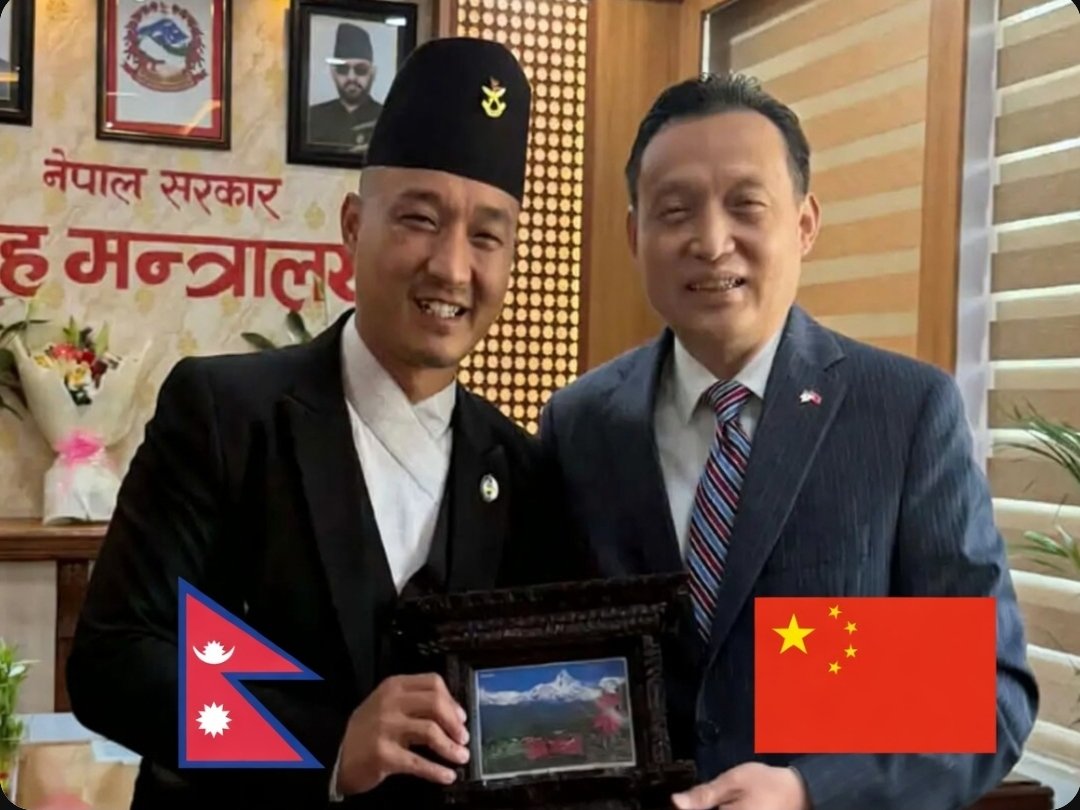
The courtesy meeting between Nepal’s Home Minister Sudhan Gurung and Chinese Ambassador Zhang Maoming on April 13, 2026, was no ordinary diplomatic handshake. It was a clear signal that Kathmandu is actively tilting towards Beijing — and New Delhi has every reason to feel alarmed.
In the meeting, Gurung went out of his way to reaffirm Nepal’s firm commitment to the One China Policy. He assured China that Nepali territory will not be used for any anti-China activities. At the same time, he pressed for faster implementation of Chinese-assisted projects, including the long-delayed Nepal-China railway, smoother bilateral trade, and Chinese help in strengthening Nepal’s security agencies along the border.
The two sides also agreed to step up cooperation against criminal activities at the border and casually dismissed recent reports of disruptions at the Tatopani crossing as “misleading”.
This is not routine neighbourhood diplomacy. This is practical, forward-looking cooperation that pulls Nepal closer into China’s strategic orbit.
What makes this meeting particularly worrying is the man at the top — Prime Minister Balendra Shah, popularly known as Balen Shah. Before becoming PM in March 2026, Shah, as mayor of Kathmandu, consistently took positions that strained relations with India.
He proudly displayed the controversial “Greater Nepal” map in his office — a map that claims large parts of Indian territory in Uttar Pradesh, Bihar, and Uttarakhand, including the sensitive Kalapani, Lipulekh, and Limpiyadhura areas.
He created controversies over Indian films, pushed cultural nationalism against perceived Indian influence, and at times sounded openly resentful of India’s role in Nepal.
PM Balen Shah’s past record made one thing very clear: he saw India not as a trusted friend and civilisational neighbour with open borders, but as a big brother whose influence needed to be checked.
Now, barely a month into his prime ministership, his Home Minister is already deepening security and infrastructure ties with China. While the new government talks of “balanced diplomacy” or positioning Nepal as a “bridge” between India and China, the warmth and speed shown towards Beijing suggest something else — old anti-India sentiments are quietly shaping policy preferences.
For India, the implications are serious. Nepal is not just another neighbour; it is a vital Himalayan buffer state. Every Chinese project, every security cooperation agreement, and every public reaffirmation of the One China Policy chips away at India’s traditional influence in Kathmandu.
The proposed Nepal-China railway and enhanced border coordination could eventually reduce Nepal’s economic dependence on India and create new strategic vulnerabilities along India’s northern frontier, especially in the sensitive tri-junction areas.
India has always treated Nepal with a special relationship — open borders, deep cultural ties, and massive trade advantages. But when Nepal’s leadership starts prioritising Chinese infrastructure and security assistance while carrying a history of friction with India, New Delhi cannot afford to remain complacent.
The timing is especially concerning. This high-level engagement with China happened so early in Balen Shah’s tenure. It sends a message that the new government is comfortable moving closer to Beijing even as it maintains a formal relationship with India.
India’s response must be calm but firm. New Delhi should fast-track pending projects in Nepal, address legitimate Nepali concerns on trade and connectivity with fairness, and actively reinforce the mutual benefits of the India-Nepal partnership.
At the same time, it must clearly convey that any compromise on India’s core security interests in the Himalayas will not be taken lightly.Bottom line: Nepal’s latest meeting with the Chinese Ambassador is not a minor diplomatic event.
It is a strategic move by a government whose top leader has long carried anti-India baggage. The Himalayan buffer is showing fresh cracks, and India must read the signals correctly and act before Chinese influence in Nepal becomes too deep to reverse.