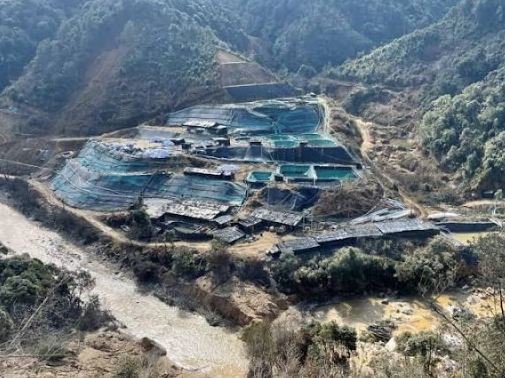
The arson incident in K. Songlung II (or Songlung Kholui) in Kangpokpi district, Manipur, on January 26, 2026 has sparked sharply conflicting narratives that reveal deeper issues of land disputes, illegal activities, and ethnic tensions in Manipur.
Reports indicate that structures, variously described as houses, farmhouses, or temporary huts were set ablaze, with the Kamson groups of Zeliangrong United Front (ZUF) claiming responsibility. The group described the action as a targeted enforcement against illegal poppy cultivation, unauthorized encroachments, and related structures in what it asserts is ancestral Inpui Naga territory near Waphong Inthan.
The Foothills Naga Co-ordination Committee (FNCC) has since backed this position, issuing a clarification that no recognized village was attacked. Instead, they argue the site consisted of only a handful of rudimentary farmhouses (as few as 3–5), used for large-scale poppy farming with hired labor, and not a legally constituted village.
Under the Manipur (Hill Areas) Village Authority Act, 1956, a village requires at least 20 tax-paying households for official recognition, a threshold these structures do not meet.
No record of “K. Songlung-II” appears in the Manipur Gazette or official village lists for Kangpokpi, reinforcing claims that it is not a formally established settlement.
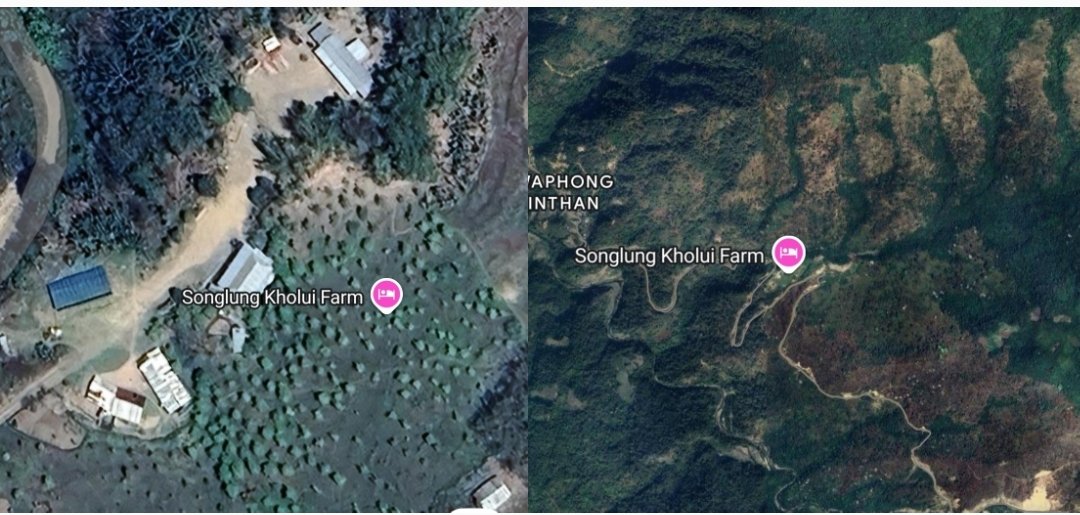
Satellite imagery from Google Maps supports this picture, showing limited human settlement. Only 4–5 scattered farmhouses amid fruit trees (possibly oranges or litchi, as per some social media posts), surrounded by significant deforestation on surrounding hillsides.
While imagery may not reflect the most recent changes (potentially lagging by a year or more), it aligns with the FNCC’s assertion of land clearance for orchards and illicit cultivation rather than a thriving village community.
The orange trees, if bearing fruit, imply planting occurred over five years ago, raising questions about long-term encroachment without intervention.
This is not an isolated event. Official records show repeated anti-narcotics operations in the Songlung area in late 2025, exposing it as a known hotspot for poppy plantations in forest zones.
Joint drives by Manipur Police, Assam Rifles, CRPF, and others targeted the site multiple times:November 2, 2025: Poppy over ~30 acres destroyed in Songlung and nearby areas (e.g., Lhangjol, Waphong), with three farm huts burned; an FIR (No. 311125, GSPM PS) was registered for cultivation.
November 8, 2025: Another destruction operation reported by Manipur Police.
November 20, 2025: ~10 acres eradicated, with three makeshift huts destroyed; estimated opium yield worth crores.
These actions occurred in or near protected forest areas like Kangchup–Leimakhong–Irang, where non-forest use violates the Forest (Conservation) Act, 1980.
The pattern suggests persistent illegal activity despite enforcement, pointing to governance failures in curbing poppy cultivation on disputed or forest land.
Kuki civil society organizations, including the Committee on Tribal Unity (CoTU), Sadar Hills Chiefs’ Association (SAHILCA), and others, have vehemently countered these claims. They insist K. Songlung-II is a recognized Kuki village under a named chieftainship, with permanent homes (not mere farmhouses) and no links to poppy.
They condemned the arson as an attack on civilians, leading to shutdown calls, threats to block National Highways, and a 24-hour ultimatum for arrests and compensation.
The truth likely lies in the gray area between these accounts. The site’s small scale and lack of official village status undermine claims of a full “village” being razed, yet the destruction of homes—however makeshift—on Republic Day understandably fuels outrage and fears of targeted ethnic intimidation.
Poppy cultivation remains a corrosive force in the hills, fueling violence, funding armed groups, and devastating forests while enriching traffickers.
Authorities must urgently investigate: Verify land records and historical claims (including pre-1918 Inpui habitation and subsequent abandonment), assess deforestation extent, determine if orchards mask poppy fields, and enforce forest laws consistently.
Silence from the Forest Department or PR administration on long-standing encroachments only breeds mistrust. Ending the cycle requires impartial action against illicit cultivation wherever it occurs, respect for ancestral boundaries, and rejection of misinformation from all sides.
Yet key questions persist for CoTU, SAHILCA, and allied groups to address transparently if their claims are to hold true.
How can a site with only 4–5 visible farmhouses (per Google Maps and reports) meet the statutory threshold of 20+ households for formal village recognition under the 1956 Act?
If official documentation exists—gazette notifications, household lists, or revenue records—why has it not been publicly presented amid the conflicting accounts?
What explains the extensive deforestation evident around these structures, in a protected forest-adjacent area?
Who authorized the clearing of hill slopes for orchards or any cultivation? No evidence has emerged of Forest Department or district permissions for such non-forest use, raising concerns over unchecked encroachment and environmental damage.
These are not peripheral issues but central to credibility. Repeated official anti-narcotics drives in the exact location treat it as illicit farmland with makeshift huts, not an established village.
If it is a legitimate settlement, the mismatch with legal standards and enforcement patterns demands explanation. If deforestation and possible poppy links are involved, accountability for forest violations is overdue.
The state and central authorities must now cut through the fog and conduct an impartial site survey, verify land and village records, quantify cleared acres, and enforce laws uniformly—without favoritism toward any community.
Mislabeling farmhouses as a “village” to inflame tensions serves no one; nor does ignoring forest destruction and drug cultivation.