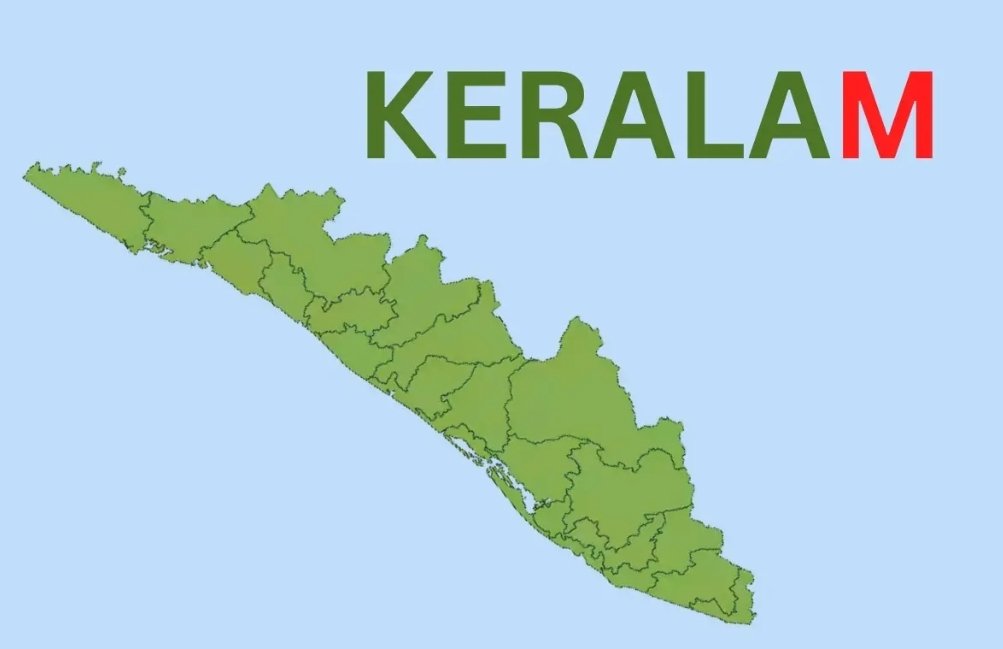
The Union Cabinet on Tuesday formally approved the Kerala government’s proposal to rename the state as Keralam, a decision that triggers the constitutional process to align the state’s official title with its deep linguistic and cultural roots.
Union Minister Ashwini Vaishnaw announced the resolution following a cabinet meeting chaired by Prime Minister Narendra Modi. Notably, the session was the first to be held at Seva Teerth, the government’s newly inaugurated Prime Minister’s Office complex in Delhi—a symbolic venue for a decision rooted in cultural reclamation.
The approval stems from a unanimous resolution passed by the Kerala Legislative Assembly on June 24, 2024, which emphasized that “Keralam” (കേരളം in Malayalam script) is the authentic, native name used by Malayalees for centuries.
The term derives from “Kera” (coconut tree) and “alam” (land), evoking the state’s iconic coconut groves, lush landscapes, and historical identity as the “Land of Coconuts.” In contrast, “Kerala” appeared in the First Schedule of the Constitution following the linguistic reorganization of states on November 1, 1956—an anglicized version shaped by colonial mapping and English administrative conventions.
For generations, locals have quietly noted the mismatch: in poetry, Thullal performances, folk songs, and casual conversation, the name has always carried that soft, resonant final “m.”
With Cabinet clearance secured, the next steps unfold under Article 3 of the Constitution. President Droupadi Murmu will refer the Kerala (Alteration of Name) Bill, 2026 to the Kerala Legislative Assembly for its formal views (a proviso requirement). Upon receipt, the bill advances to Parliament for debate, passage in both houses, and eventual Presidential assent.
Once enacted, “Keralam” will officially supplant “Kerala” across government documents, educational materials, road signs, currency notations, passports, airline tickets, international treaties, and global references—ushering in a subtle but profound shift in how the world addresses the state.
The decision lands at a politically charged juncture. Kerala Assembly elections are widely anticipated in April–May 2026, and the move has ignited debates on symbolism versus substance.
Proponents, including Chief Minister Pinarayi Vijayan’s LDF government, celebrate it as a triumph of linguistic pride and decolonization—restoring phonetic dignity to a state renowned for its high literacy, progressive social indices, and vibrant cultural heritage.
It aligns with broader national efforts to honor regional identities, much like past renamings (e.g., Bombay to Mumbai, Madras to Chennai).Skeptics, however, view the timing as strategic optics.
With the state grappling with post-landslide reconstruction in Wayanad (where 2024 disasters left deep scars and ongoing rehabilitation needs), fiscal pressures, youth migration to Gulf countries and elsewhere, agrarian distress, and unseasonal weather patterns affecting agriculture and tourism, some question whether a name change diverts attention from urgent governance priorities.
Adding levity to the discourse, Congress MP Shashi Tharoor—ever the wordsmith—took to social media with characteristic wit: “All to the good, no doubt, but a small linguistic question for the Anglophones among us: what happens now to the terms ‘Keralite’ and ‘Keralan’ for the denizens of the new ‘Keralam’?”
The post exploded online, spawning humorous alternatives like “Keralamite” (evoking a tiny organism) or “Keralamian” (sounding like an exotic mineral from the periodic table). Tharoor’s quip underscores how even serious identity shifts in Kerala often arrive wrapped in humor and linguistic playfulness.
At heart, this is more than administrative housekeeping—it’s a phonetic and emotional homecoming. The addition of that gentle “m” restores the name’s natural rhythm in Malayalam, the language that has shaped the state’s soul through millennia of trade, migration, syncretic traditions, and radical reforms.
Kerala—soon to be Keralam—endures as that narrow, emerald corridor wedged between the misty Western Ghats and the Arabian Sea: a cradle of ancient spice routes, temple architecture blending Dravidian and Kerala styles, serene backwaters dotted with houseboats, world-class Ayurveda wellness, electrifying Onam festivities, and a populace that debates politics, literature, and cinema with unmatched passion.
The transition won’t unfold overnight; maps, software, and global habits take time to adapt. Yet February 24, 2026, stands as a milestone: the day “if” turned decisively to “when,” and a beloved homeland began to be called by its truest name—in its own accent, with quiet pride.