Manipur conflict has already been discussed through the familiar language of ethnic tension, land rights, illegal immigrations, administrative failure, armed mobilisation and narco terrorist. These are real and serious factors. They cannot be ignored. But another question now demands careful attention: in a state where rare earth elements, chromium, nickel, cobalt, platinum group elements, limestone, hydrocarbons and other mineral resources are drawing increasing strategic interest, could a divided society become easier for powerful corporate actors to negotiate with?
This question does not claim that Manipur conflict was created for minerals. Such a claim would require evidence, documents, financial trails, corporate disclosures, land records and credible investigation. But it does suggest that conflict, once prolonged, can create conditions that favour external interests. A fractured society loses collective bargaining power. Displaced communities struggle to defend long-term land claims. Local institutions become weak. Public consent becomes fragmented. In such a situation, resource negotiations can begin not with a united people, but with wounded groups seeking security, compensation, recognition or survival.
The conflict in Manipur is increasingly viewed by many geopolitical observers not merely as an ethnic clash, but as a political movement tied to the demand for a separate administration in Kuki-dominated areas. This demand has persisted for nearly three years and has raised difficult questions about land, territorial control and future resource governance. Given the growing attention on Manipur’s rare earth, chromite, nickel-cobalt, platinum group elements, hydrocarbon and other mineral potential, it is reasonable to ask whether powerful corporate interests may eventually find advantage in negotiating with a divided and weakened society. This does not prove corporate involvement in the conflict. But it makes the silence around resource interests, territorial demands and future extraction deeply troubling.
This demand, in effect, challenges the existing territorial and administrative integrity of Manipur. Beyond the violence, displacement and distrust, a serious question remains unanswered: why has the Centre remained silent for nearly three years without a clear and firm response to those advancing demands that would break Manipur’s constitutional structure? In any democratic country, grievances may be discussed, negotiated and addressed. But the attempt to convert ethnic conflict into territorial and administrative separation demands greater scrutiny, especially when silence can be read as tolerance and delay can deepen suspicion among communities already living in fear.
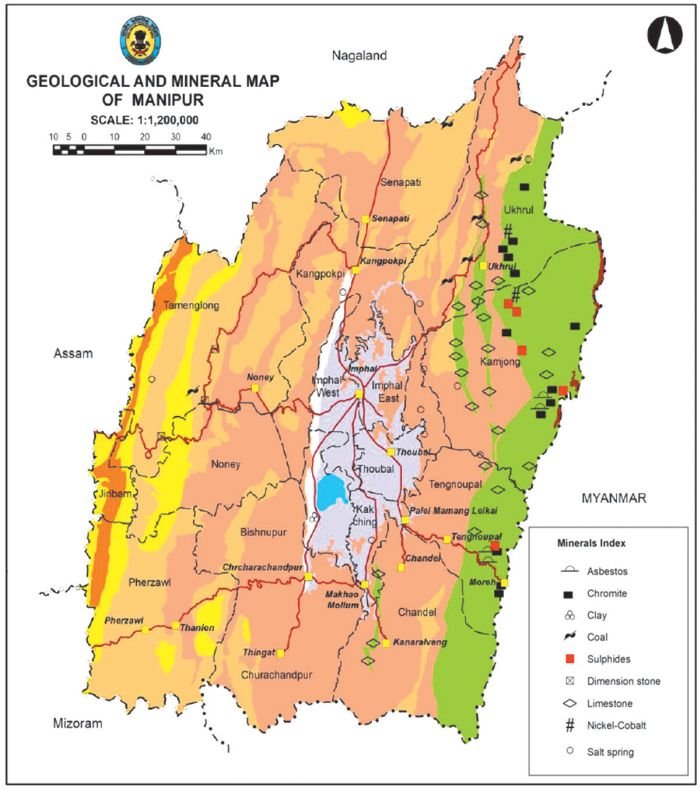
This is the corporate question behind Manipur’s divided society. Rare earths and critical minerals are now central to global power, clean energy, defence production and high technology manufacturing. The Northeast, long known for hydrocarbon reserves, is increasingly being examined for strategic minerals. Manipur’s eastern ophiolite belt across Ukhrul, Kamjong, Tengnoupal and Chandel has been identified for chromium, nickel-cobalt and platinum group element potential, while other parts of the state show prospects for limestone, serpentinite, base metals, titanium-vanadium-magnetite and possible rare earth bearing formations.
That mineral profile changes the nature of the debate. It does not prove conspiracy. But it makes silence dangerous. The real issue is not only what lies beneath Manipur’s soil. It is whether the people above it will remain united, informed and institutionally protected enough to decide the terms of any future resource development. A divided Manipur may be easier to bargain with. But it will also be more vulnerable.
India’s policy direction on critical minerals is already clear. The National Critical Mineral Mission seeks to strengthen exploration, mining, processing, recycling and value chain development for critical minerals. This is part of India’s wider attempt to reduce dependence on external supply chains and secure materials that will shape future industry, clean energy, defence preparedness and technological power.
The Northeast has entered this conversation because of its geology and location. The Geological Survey of India, under intensified survey and exploration programmes, has identified significant deposits and prospects of rare earth elements, vanadium, nickel, cobalt, chromium and associated strategic minerals in the region. These resources are being examined in relation to India’s clean energy transition, high technology manufacturing and mineral self-reliance.
Manipur sits at the centre of this discussion for reasons that are geological as much as geopolitical. According to GSI-linked reports, Manipur’s unique location within the Indo-Myanmar Range gives it significant mineral potential. Much of central and western Manipur is dominated by sedimentary sequences such as the Eocene-aged Disang Group and the Oligocene-aged Barail Group. These formations include splintery shales, greywacke, sandstones and conglomerates, indicating a prolonged sedimentary basin environment favourable for resource accumulation.
The most strategic mineral interest lies along Manipur’s eastern frontier. The Jurassic-Cretaceous ophiolite suites of Manipur, remnants of ancient oceanic crust tectonically uplifted onto the continental margin, form the backbone of the state’s critical mineral potential. These ophiolitic belts stretch across Ukhrul, Kamjong, Tengnoupal and Chandel districts. They have been identified as a chromium, nickel-cobalt and platinum group elements potential belt.
This area is marked by clustered occurrences of podiform chromite and serpentinised peridotite that host chromium, nickel and cobalt. GSI reports indicate a reserve of 1,360 million tonnes of refractory and metallurgical grade chromite in Manipur, placing the state among the most promising chromium locations in the country. The ultramafic rocks in this belt are also associated with platinum group elements, particularly in podiform chromitites.
To understand these resources better, detailed geochemical surveys and petrographic studies have been taken up to examine nickel and cobalt enrichment in the state’s ophiolite complexes. These initiatives form part of the broader Critical Mineral Assessment Programme, which is also evaluating lateritic profiles for possible rare earth, nickel and cobalt content.
Manipur’s mineral profile does not end with critical metals. Cement-grade limestone reserves of more than 69 million tonnes have been identified in Ukhrul, Chandel and Tengnoupal districts. A substantial serpentinite resource, commercially marketed as Green Marble, occurs across the eastern ophiolite belt and offers potential as a dimensional stone. Other recorded resources include clay and lignite deposits in Kangvai valley, base metal and copper occurrences in tertiary sediments, and an isolated titanium-vanadium-magnetite occurrence in the southern zone.
Manipur’s subsurface significance also extends to oil and gas. The state forms part of the broader Assam-Arakan Basin and associated fold belt system, one of Northeast India’s important hydrocarbon provinces. The Directorate General of Hydrocarbons describes the Assam-Arakan Basin as a Category-I basin and notes that its basinal facies occur across the Patkai range, Naga Hills, parts of North Cachar hills, Manipur, Surma valley, Tripura, the Chittagong hills and the Chin hills of Myanmar. It also states that the Schuppen belt possesses high hydrocarbon potential worthy of intensive exploration.
It was also reported that the Schuppen Belt is believed to hold about 600 million tonnes of crude oil and natural gas, though such figures should be treated as reported potential rather than confirmed commercial production in Manipur. This matters because even underexplored hydrocarbon prospects can shape how land, infrastructure, security, corporate entry and public consent are viewed in a conflict-affected state.
This is why Manipur conflict must be examined with a wider lens. Mineral wealth does not automatically cause conflict. But mineral wealth in a divided society creates a dangerous political economy. In Manipur, land is never merely land. It is ancestry, identity, livelihood, customary authority, political power and historical memory. A hill is not just a geological formation. A village is not only a settlement. A road is not only infrastructure. A forest is not simply an environmental asset. Every physical space is tied to community claims, legal ambiguity, administrative history and collective emotion.
This is why any future discussion of rare earth exploration, chromite mining, nickel-cobalt extraction, platinum group elements, limestone development, hydrocarbon exploration, mineral transport, processing clusters or industrial corridors in Manipur will inevitably pass through ethnic, territorial and constitutional questions.
If communities remain divided, displaced, armed and distrustful, they will enter any future negotiation from a position of weakness. They may not speak as united citizens of one state. They may speak as wounded groups seeking security, compensation, recognition or survival.
That is where the danger lies. Powerful corporations do not always need to create conflict. Often, they only need to wait for conflict to weaken society. When communities are divided, collective bargaining becomes difficult. When displaced people are struggling for relief, long-term land questions become secondary. When local institutions lose credibility, outside actors can negotiate through intermediaries. When mistrust hardens between communities, each group may accept terms that appear to protect its immediate interest but weaken the collective future of the region.
This pattern is visible in many mineral-rich regions of the world. In parts of Africa, enormous mineral wealth has not always produced local prosperity. Instead, weak governance, fragmented communities, opaque contracts, armed conflict and corporate leverage have often allowed external actors to extract value while local populations bear environmental and social costs. UN Trade and Development has warned that choices made today will determine whether critical minerals support economic transformation or reinforce commodity dependence.
Manipur should study that experience carefully. The question is not only whether rare earth elements, hydrocarbons or other minerals exist in commercially viable quantities. That is a technical matter requiring scientific survey, public disclosure and expert scrutiny. The more serious question is whether the people of Manipur will remain strong enough, united enough, informed enough and institutionally protected enough to decide the terms of any future resource development.
If exploration comes tomorrow, who will speak for the affected communities? Which land records will be accepted? Which customary authorities will be recognised? Which displaced families will still have a voice? Which environmental safeguards will apply? Which companies will be allowed to enter? Will contracts be public? Will benefits remain local? Will processing and research facilities be built in the region, or will Manipur merely become another source of raw material?
These questions must be asked before corporate proposals, feasibility studies, investment summits, exploration licences and technical partnerships arrive.
Manipur’s present ethnic division creates the most dangerous condition for resource politics: fragmented consent. A divided society can be made to sign separately what it may have rejected collectively. One community may be told that a project will protect its land. Another may be told that the same project will bring jobs. A third may be told that resistance will isolate it from development. Under such conditions, negotiation becomes less about justice and more about managing fear. This is how resource frontiers are often opened.
The people of Manipur must not allow their suffering to become the bargaining ground for future corporate ambition. The conflict has already destroyed homes, separated communities, damaged institutions, disrupted education, weakened livelihoods and deepened mistrust. It must not also weaken the people’s collective claim over land, rivers, hills, forests, minerals, hydrocarbons and development.
This is not an argument against development. Manipur needs development. The Northeast needs industry, employment, research institutions, modern infrastructure and technological investment. India also needs critical minerals and energy security for its strategic future. No serious country can ignore this reality. But development without trust is not development. It is extraction.
If chromite, nickel, cobalt, platinum group elements, rare earth elements, limestone, serpentinite or hydrocarbons are to be explored or developed in Manipur, the people of the state must not be reduced to spectators. They must not be consulted only after survey maps are drawn, contracts are drafted and corporate actors are already positioned. They must be part of the conversation from the beginning. The future of Manipur cannot be negotiated over the heads of its people.
There is also an environmental question that cannot be ignored. Rare earth processing is complex and can generate toxic waste if not handled responsibly. Chromite mining carries environmental and health risks, especially when waste management and water protection are weak. Nickel, cobalt and platinum group element exploration also require careful handling of geological, ecological and social impacts. Hydrocarbon exploration, too, raises questions of drilling safety, forest access, water contamination, land compensation and long-term liability.
The Northeast is ecologically sensitive. Its rivers, forests, biodiversity and community livelihoods cannot be placed at risk through careless extraction. Any future mineral or hydrocarbon policy must include strict environmental assessment, waste management, independent monitoring, public hearings, local scientific participation and long-term liability for damage. The burden cannot fall on local people while profit travels elsewhere.
This is where the role of the state becomes important, not as the object of blame, but as the guardian of public interest. The Government of India and state institutions must ensure that no corporate or external interest benefits from Manipur’s division. That responsibility requires transparency, regulation, disclosure, environmental scrutiny and protection of community rights. Silence is no longer enough.
In a wounded society, silence becomes fertile ground for suspicion. If there is no immediate mining or hydrocarbon plan in Manipur, the public should be told clearly. If surveys are only preliminary, that should be clarified. If certain data is sensitive for strategic reasons, the authorities should still provide enough institutional clarity to prevent rumours from becoming social poison. In conflict zones, information management is not a bureaucratic luxury. It is a peace requirement.
No mineral or hydrocarbon project should reward ethnic separation. If one community sees development while another sees dispossession, the project will become another source of conflict. Development in Manipur must be designed to rebuild trust, not institutionalise division.
This is the larger lesson from Africa and other mineral-rich regions. Resource wealth without social unity can become a curse. Critical minerals and hydrocarbons without community power can produce dependence. Investment without transparency can generate resentment. Corporate entry into a fractured society can turn weakness into opportunity for others. Manipur must therefore treat the resource question not as conspiracy, but as governance.
Who controls information? Who controls land? Who speaks for displaced people? Who negotiates with companies? Who monitors environmental damage? Who receives the benefits? Who carries the burden?
These questions are not anti-national. They are necessary for national integrity. A confident democracy should not fear public scrutiny over minerals, land, environment and corporate power. On the contrary, transparency strengthens legitimacy.
The unresolved tragedy of Manipur is that communities that once shared markets, roads, institutions, festivals, schools and public spaces have now been pushed into separation. Violence has created physical distance, but suspicion has created something deeper. It has weakened the possibility of collective decision-making. That weakness must not become the opening through which future corporate negotiations enter.
A divided Manipur may be easier to bargain with. It may be easier to persuade one group at a time. It may be easier to secure consent through fear, compensation or selective promises. But such a Manipur will not be at peace. It will only be more vulnerable.
The real test is whether Manipur can recover enough unity to speak before corporate interests arrive with maps, contracts, consultants, survey data and promises.
Rare earth elements, chromium, nickel, cobalt, platinum group elements, hydrocarbons and other minerals may shape the future of technology, defence, clean energy and industrial power. But in Manipur, the first rare resource that must be protected is not beneath the soil. It is public trust.