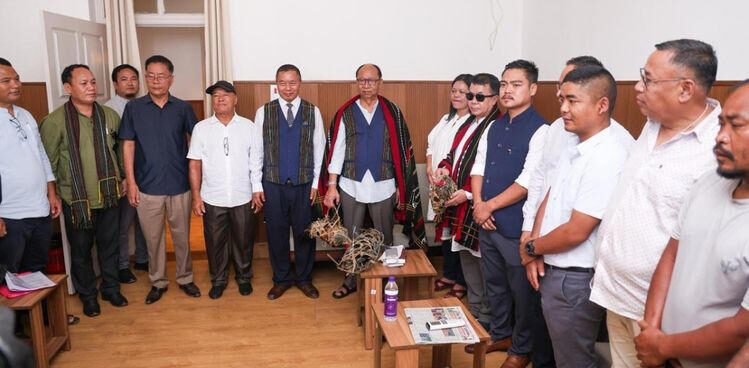
The visit of representatives of the Unified Zou Organisation, Zomi Chief Association and Zomi Council to Imphal on July 31 must be viewed with seriousness. It was not an ordinary courtesy call. It was the first time since the outbreak of ethnic violence in May 2023 that Zomi Delegation travelled together from Churachandpur to Imphal to meet the Chief Minister of Manipur.
In a state fractured by fear, suspicion and separation, every such movement carries symbolic value. Their meeting with Chief Minister Yumnam Khemchand Singh at the Chief Minister’s Secretariat was described by the government as a sign of improving law and order and the gradual restoration of free movement between communities. The delegation raised issues concerning Churachandpur district, expressed support for peace efforts, discussed confidence building and submitted a proposal for a Multi-Utility Hall in Churachandpur.
These are positive developments. They should not be dismissed. When people who have stayed away from Imphal for nearly three years decide to come, meet the elected head of government and speak of peace, the gesture deserves recognition. The statements made by Zomi Council chairman Vumsuan Naulak and Secretary Mary Jones also reflected a desire to reopen channels of communication. In any conflict situation, dialogue must begin somewhere. Movement itself becomes a message.
But peace cannot be measured only by one direction of movement. Barely a day later, two Meitei men, identified as Junia Shyam and Rajesh Heisnam of Singjamei, were detained by Kuki-Zo volunteers after they allegedly entered the Gamgiphai buffer zone during the early hours of August 1. They were travelling in a Maruti van bearing school vehicle markings and reportedly told the volunteers that they were going to Senapati. Local sources alleged that they appeared to be under the influence of alcohol. The volunteers later handed them over to Saparmeina Police Station.
The handing over to police without reported physical harm may have prevented a more serious incident. That must be acknowledged. In the prevailing security atmosphere, any late-night movement through sensitive zones can create suspicion.
But the larger question cannot be avoided. Why is one movement celebrated as a sign of peace, while the reverse movement is treated as intrusion? Where are these buffer zones?
If Kuki, Zomi, Thadou and other communities can come to Imphal for medical treatment, meet political leaders, approach government offices and return safely, that is a welcome development. It reflects the minimum condition of a functioning state. No citizen should be denied medical care, administrative access or political engagement on the basis of community identity.
The same principle must apply when Meiteis travel through or near Kangpokpi, Churachandpur, Moreh or other areas now considered sensitive. If they are stopped, detained and handed over to police merely for crossing a zone or travelling on a road, the claim of restoring normalcy becomes weak. Peace cannot be selective. Constitutional rights cannot depend on the ethnic identity of the traveller. This is the real discomfort behind the Gamgiphai incident.
Since May 2023, Manipur has lived under an abnormal arrangement where geography has slowly hardened into ethnic jurisdiction. Areas are no longer understood simply as districts, roads, towns or villages. They are increasingly described as spaces belonging to one community or another. The language of “our area” and “their area” has entered daily life. This is dangerous for the future of the state.
No democratic government can allow public roads, security zones or district boundaries to become instruments of ethnic permission. A security zone is a security mechanism. It is not a border between two countries. It is not a customs barrier. It is not a community checkpoint with sovereign authority. It exists to prevent violence, not to create permanent separation.
If any citizen violates a lawful security protocol, the police and authorised security forces must act. If a person travels at an unsafe hour, enters a restricted area or behaves irresponsibly, the law must take its course. But the law must be applied by the state, not by ethnic volunteers acting as gatekeepers of territory. This distinction matters.
In Manipur today, many such incidents are explained away as practical necessity. The argument is that local volunteers know the ground situation better, that security forces cannot be everywhere, and that community vigilance prevents violence. There may be limited truth in such explanations during moments of immediate danger. But a temporary security practice cannot become a permanent political arrangement.
Once community volunteers decide who may pass and who may not, the authority of the state begins to shrink. Once ethnic identity becomes the first test of movement, citizenship loses meaning. Once a person is treated as a trespasser because he belongs to another community, the road to reconciliation becomes longer.
The state government, central security agencies and civil society organisations must confront this contradiction honestly. It is not enough to publicise visits to Imphal as signs of peace. The test of peace lies in whether a Meitei can travel safely beyond the valley, whether a Kuki-Zo person can come to Imphal without fear, whether a Naga traveller can move without suspicion, and whether ordinary citizens can cross districts without being treated as potential enemies. The present situation does not meet that test.
There is also a deeper institutional issue. When representatives from Churachandpur reach Imphal and meet the Chief Minister, the visit is interpreted as political confidence building. When Meiteis move toward Kangpokpi or cross sensitive points such as Phougakchao Ikhai, suspicion is immediately raised. This unequal public response creates resentment. It produces the impression that one side’s movement is peace while the other side’s movement is provocation.
Such perception, if allowed to grow, will damage every peace initiative. Peace requires reciprocity. It requires visible fairness. It requires the state to show that all citizens stand under the same constitutional protection. No community should feel that the administration welcomes one side in the capital but cannot secure the other side’s movement in the hills or along national highways.
Medical treatment is a particularly important example. If Kuki, Zomi, Thadou or other community members come to Imphal hospitals, they must be protected. Hospitals cannot become ethnic institutions. The same must apply to Meiteis needing medical access, official work, family visits, education, trade or travel through hill areas. Essential services and public roads must remain above ethnic contestation.
The moral and administrative principle is simple. A citizen travelling peacefully should not be presumed guilty because of his community identity.
The Gamgiphai incident also brings back the question of language. Words such as “intrusion” and “trespassing” must be used with care. A citizen cannot trespass into his own state merely by travelling through a district, unless he enters a legally prohibited place or violates a specific lawful order. If there are notified restrictions, they must be clear, public, uniform and enforced by authorised agencies. If restrictions are informal and community-defined, they cannot be treated as law.
This is where the government must act with clarity. Ambiguity is dangerous. Citizens must know which routes are open, which areas require escort, which hours are restricted and which authority is responsible for clearance. The rules cannot change from one checkpoint to another. They cannot depend on the mood of local volunteers or the identity of the traveller.
For nearly three years, Manipur has lived with separation. Separate habitations, separate relief camps, separate political claims, separate security anxieties and separate narratives have hardened the crisis. The longer this condition continues, the more difficult it becomes to restore common civic life. Children will grow up without meeting classmates from other communities. Traders will lose old markets. Patients will fear hospitals. Officials will hesitate to travel. Roads will become psychological borders. This is not peace. It is managed separation.
The visit of the Zomi delegation to Imphal should therefore be seen as a beginning, not as proof of normalcy. It must be followed by equal confidence building in the opposite direction. If Zomi leaders can meet the Chief Minister in Imphal, Meitei citizens must be able to travel through sensitive routes under state protection. If Kuki-Zo patients can access hospitals in Imphal, common Meitei and officials must not be treated as intruders in hill districts. If one community’s arrival in Imphal is welcomed as reconciliation, the other community’s movement beyond the valley must not automatically invite detention.
The government has a duty to ensure this balance. Civil society organisations also carry responsibility. They must not turn peace into a selective narrative. If they genuinely support normalcy, they must support safe passage for all communities, not only for their own. The credibility of peace initiatives will depend on whether they can defend the rights of those they distrust.
Manipur does not need symbolic peace alone. It needs enforceable peace. It needs roads secured by law, not by ethnic discretion. It needs hospitals open to all, officials accessible to all and districts connected to all. It needs buffer zones that prevent violence without becoming permanent barriers to citizenship.
The state must make one principle non-negotiable: no part of Manipur is outside the Constitution of India. This does not mean reckless movement should be encouraged. It does not mean security concerns should be ignored. It does not mean communities should be insensitive to the wounds of the last three years. It means that restrictions must be lawful, temporary, transparent and equal. Anything else will deepen division.
The two incidents, read together, reveal the central contradiction of Manipur’s present condition. A delegation from Churachandpur reaching Imphal is treated as a sign of peace. Two Meitei men moving through a sensitive zone are treated as suspected intruders. The first event gives hope. The second exposes the limits of that hope. Manipur must decide whether it wants peace as a ceremony or peace as a system.
Ceremonial peace allows meetings, photographs, statements and selective visits. Systemic peace restores roads, trust, police authority, equal protection and ordinary movement. The state cannot afford to confuse the two.
The way forward is not difficult to identify. The government must publish clear movement protocols for sensitive areas. Community volunteers should not exercise authority over citizens. Medical, educational, official and emergency movement must be guaranteed without ethnic discrimination. Confidence building must be two-way, visible and monitored.
Above all, political leaders must stop presenting one-sided movement as normalcy. Normalcy means movement without fear in both directions.
Manipur’s peace will not be restored by allowing one community to enter Imphal while another remains trapped by suspicion outside the valley. It will be restored only when every citizen, Meitei, Kuki, Zomi, Thadou, Naga or any other, can travel under the protection of law rather than the permission of identity.
Until then, the question will remain: what kind of peace allows one road to be open in one direction and closed in the other?