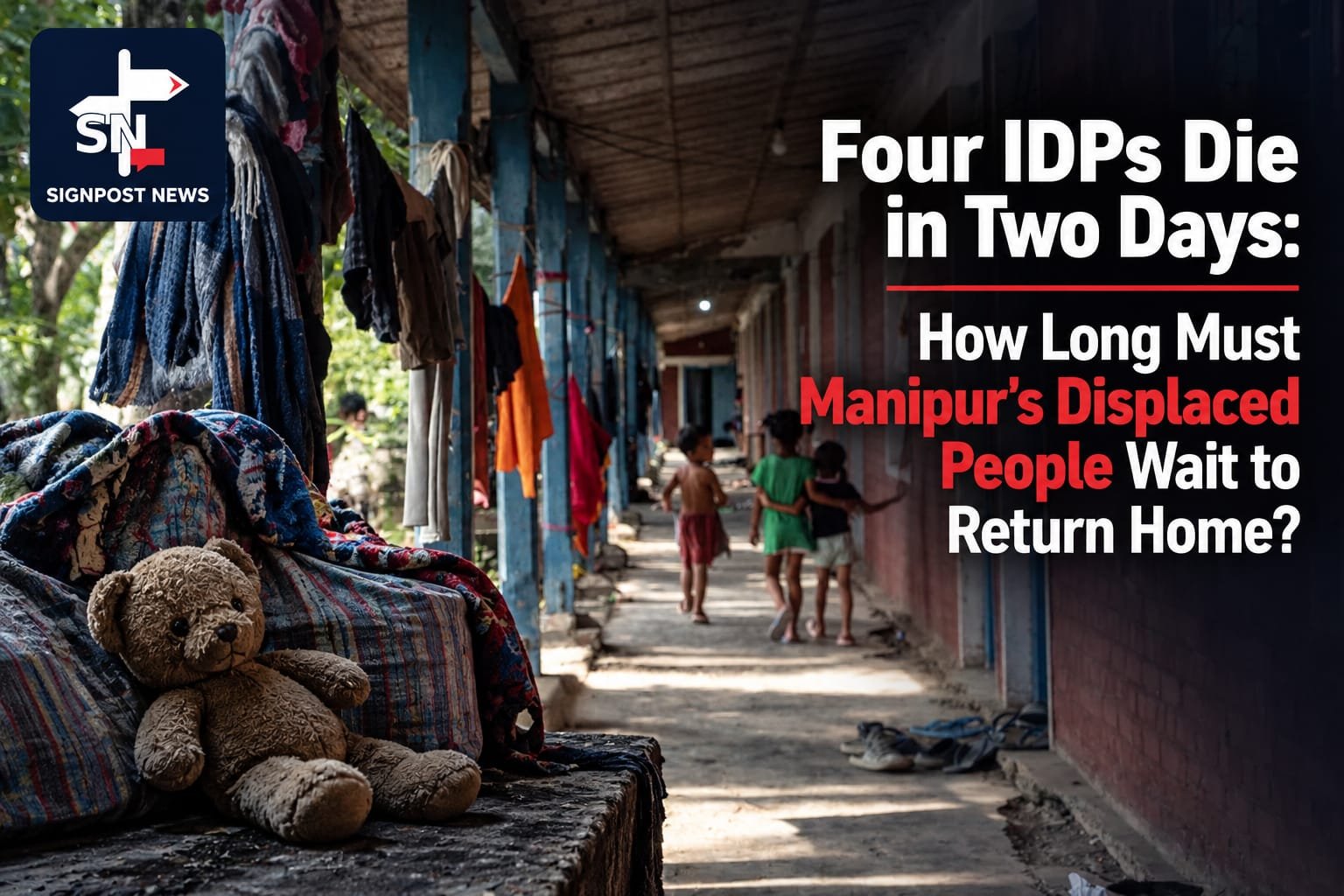
Four internally displaced peoples have died within two days in relief camps in Bishnupur district. Two reportedly died after consuming poison. The four had came from different localities and had their own families and personal struggles. Yet they shared one painful reality. They had been uprooted from their homes by the violence that engulfed Manipur in May 2023, and more than three years later, they were still living in temporary shelters. The deceased have been identified as Salam Hemanta of Phougakchao Ikhai, Tongbram Ibungo of Churachandpur, Moirangthem Muhindro of Khuga Tampak and Thouram Ratan of Churachandpur’s Mandop Leikai.
But the tragedy raises a question that Manipur can no longer afford to avoid. How long must displaced families continue living in relief camps before their suffering becomes a matter of urgent public accountability? When violence first forced thousands of people from their homes, relief camps were established as an emergency arrangement.
Families arrived with whatever they could carry. Many believed that their displacement would last a few weeks or perhaps a few months. They expected that the government would eventually restore security and help them return. Three years have passed. For many families, that return remains uncertain.
A child who entered a camp at the age of five is now eight. Students have spent crucial years of their education away from familiar surroundings. Parents who once earned their living through farming, small businesses or ordinary employment have had to depend on assistance. Elderly people have endured years of uncertainty without knowing whether they will ever see their homes again.
Displacement is not merely the loss of a house. It is the gradual disruption of everything that makes ordinary life possible. A family may receive food, bedding and financial assistance through DBTs. Yet these cannot fully replace the independence of earning a livelihood, the comfort of living among neighbours or the dignity of raising children in one’s own home. And when displacement continues year after year, temporary arrangements begin to resemble permanent abandonment.
Earlier reporting based on information obtained under the Right to Information Act indicated that at least 731 internally displaced persons had died in Manipur relief camps over approximately three years. That figure must be understood carefully. It does not establish that all these deaths resulted directly from displacement, inadequate medical care or violence. The causes, ages and circumstances of the deaths need separate examination.
Nevertheless, the reported number is deeply troubling. Hundreds of people who had survived the initial violence subsequently died while their families were still displaced. How many received adequate medical treatment? How many suffered from chronic illnesses? How many were elderly people whose health deteriorated during prolonged displacement?
How many deaths, if any, could have been prevented
- These are questions that deserve answers through a transparent, camp-wise and medically informed review
- The four deaths now reported in Bishnupur district make those questions even more urgent
- There is another dimension to this tragedy that cannot be measured through death statistics alone
- How many people in relief camps are silently struggling with depression, anxiety, financial insecurity and the fear of an uncertain future? How many parents feel helpless because they cannot provide the lives they once promised their children? How many young people have lost confidence that normal life will return?
We cannot presume to know what drove any particular individual to take an irreversible step. But the reported suicide deaths should compel the government to examine whether mental-health support, counselling and timely intervention are adequately available to displaced families. A relief camp cannot be considered safe merely because it provides shelter and food. The emotional and psychological wellbeing of its residents matters equally.
A people’s government must now answer
When the elected government headed by Chief Minister Yumnam Khemchand Singh assumed office in February 2026, people hoped that the restoration of a popular government would accelerate the process of rehabilitation and resettlement. The responsibility before the government was never limited to maintaining administrative order. It included restoring confidence among communities, ensuring security and creating the conditions necessary for displaced families to return to their homes.
The government may point to rehabilitation assistance, financial support and families who have already been resettled. Such measures deserve recognition where they have genuinely helped people. But they cannot obscure the continued suffering of those who remain in camps.
For a family that has spent more than three years away from home, another announcement or assurance means little unless it brings a visible improvement in their lives. The question is no longer whether the government intends to rehabilitate displaced families. The question is when, how and under what security guarantees that rehabilitation will be completed.
People cannot be expected to return to unsafe areas merely to reduce the official number of displaced persons. Equally, they cannot be left indefinitely in relief camps because the state has been unable to create conditions for their safe return. The government must confront both responsibilities.
The Supreme Court has already raised the alarm
The deaths in Manipur’s relief camps are not an issue that has escaped the attention of the country’s highest court. On September 17, 2026, the Supreme Court considered a report submitted by the committee headed by former Justice Gita Mittal. According to information placed before the Court, 640 deaths had been reported across relief camps in eight districts, including 34 unnatural deaths. Post-mortem examinations had been conducted in only 20 of those 34 cases, while investigations had been completed in just four of the 25 registered criminal cases.
The Supreme Court directed the Manipur Chief Secretary to explain the circumstances of the deaths, the gaps in investigations and the differing amounts of compensation provided to bereaved families. It also directed the Manipur State Legal Services Authority to ensure proper investigations and measures to protect displaced persons. The figures before the Supreme Court and those disclosed earlier under the RTI Act come from different official reporting exercises. They should not be treated as identical or combined into a new death toll.
But both sets of figures point towards the same urgent need: a comprehensive accounting of deaths among displaced people, the circumstances in which they occurred and the adequacy of the state’s response. Now, with four more deaths reported within two days, the government must explain what additional safeguards have been introduced since the Supreme Court’s intervention.
Rehabilitation must be more than a government announcement
The government has not been inactive. According to a State Home Department report published in September, 31,823 displaced persons had returned to their homes, while 28,899 were still staying in relief camps and temporary locations as of September 3. The report also recorded expenditure on rehabilitation, housing construction and repairs. These are meaningful steps. But rehabilitation cannot be measured by expenditure alone.
A family cannot rebuild its life simply because money has been sanctioned. It needs a secure home, access to education, medical facilities, employment and the confidence that it will not be forced to flee again. For those who cannot yet return, the government must provide something better than indefinite uncertainty. Every displaced household deserves to know what is preventing its return, what measures are being taken to remove those obstacles and what support will be available in the meantime.
Four lives must not become another forgotten headline
Manipur has become accustomed to receiving terrible news. When people are killed in violence, political leaders issue condemnations. When a family loses its home, assistance is announced. When displaced people die in relief camps, their names appear in the newspapers. Then another incident occurs, and public attention moves elsewhere. This pattern must end.
Salam Hemanta, Tongbram Ibungo, Moirangthem Muhindro and Thouram Ratan should not be remembered merely as four additional entries in the statistics of Manipur’s humanitarian crisis. Each was a person whose life had already been disrupted by displacement. Their families now face losses that no rehabilitation package can undo.
The government must establish the circumstances of these deaths, ensure that the families receive appropriate assistance and examine whether failures in healthcare, camp management or access to psychological support contributed to any of the tragedies.
It must also publish a credible rehabilitation roadmap, with clear responsibilities and measurable progress. Manipur cannot continue treating relief camps as an acceptable long-term substitute for homes. Nor can society accept the deaths of displaced people as an unavoidable consequence of a conflict that began more than three years ago.
Peace cannot be declared complete while thousands remain unable to return home. Rehabilitation cannot be called successful while families continue to live without a clear future. Four people have died within two days. Two deaths are reported as suspected suicides. Their individual circumstances must be established with care and dignity.
But one question is already before the government. How many more displaced people must die before the right to return home becomes a reality rather than another promise?