The Rajya Sabha MP from Manipur and the incumbent Manipur BJP President A Sharda Devi’s campaign against the Congress MP Angomcha Bimol Akoijam raises questions about political judgement, consistency and public trust. The campaign against the Congress MP also raises an uncomfortable question for A Sharda Devi’s leadership: is the BJP weakening its opponent, or giving people another reason to rally behind him?
A political party should be able to recognise when its attack on an opponent begins to work against itself. In Manipur, the BJP needs to consider whether its campaign against Congress MP Angomcha Bimol Akoijam is reaching that point. What the party presents as a demand for accountability is being portrayed by his supporters as an attempt to silence him. The demonstrations in his support do not establish a statewide Congress wave. They do, however, raise a question the BJP cannot dismiss: has its own intervention helped turn a controversy surrounding one parliamentarian into a rallying point against the ruling party?
The sequence matters. On October 10, BJP workers marched through Imphal demanding Bimol’s resignation. State BJP president and lone Rajya Sabha MP from Manipur, A. Sharda Devi presided over the preceding meeting and flagged off the march. Protesters subsequently shouted slogans opposite Congress Bhavan. This was a campaign publicly backed by some of the state BJP leadership.
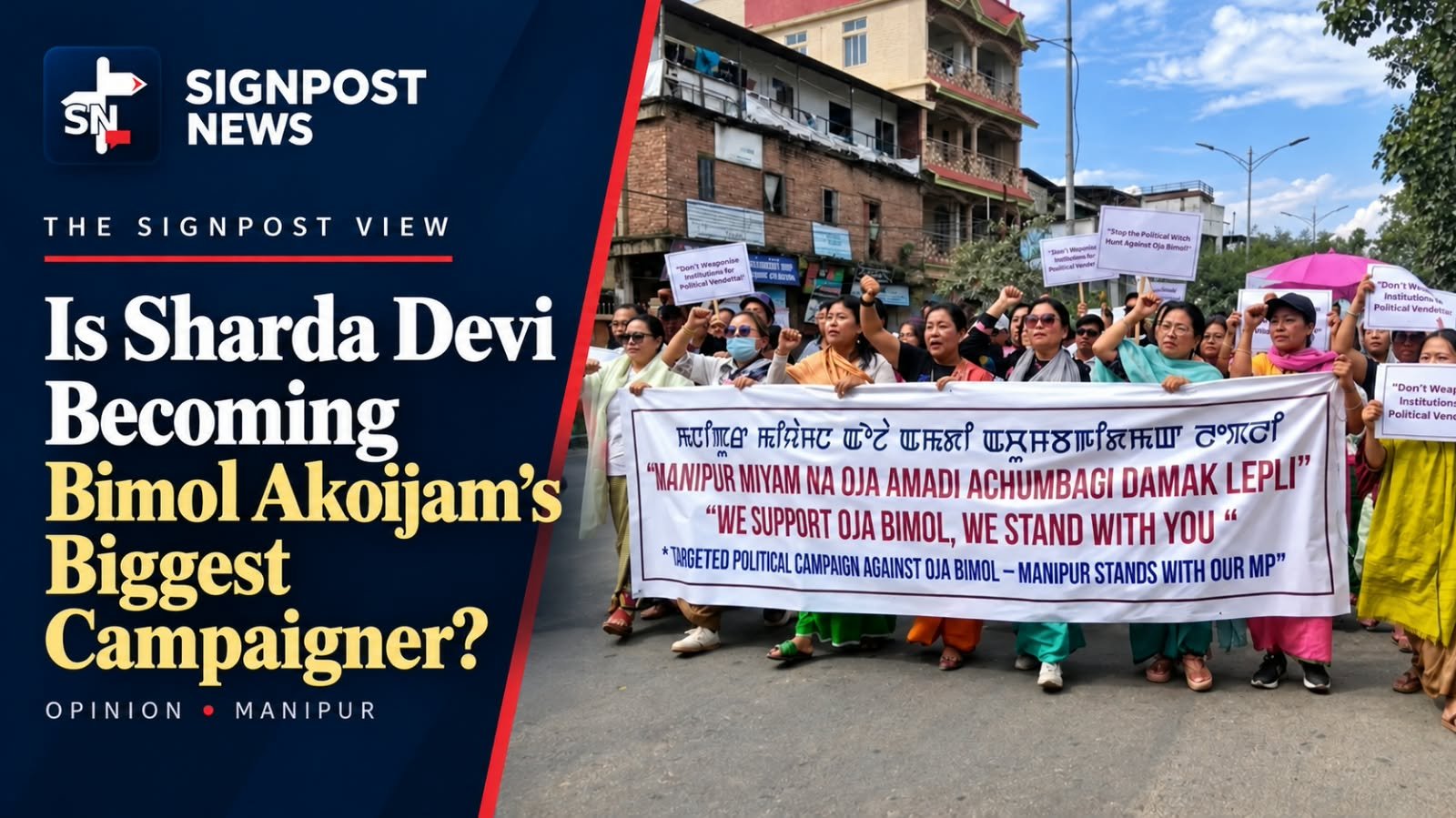
Four days later, supporters of Bimol marched towards the BJP office in Imphal before police stopped them. Participants described the allegations against him as political targeting. Their assertion does not establish that the allegations are false. But their mobilisation shows that the BJP’s campaign has encountered a visible counter-response, rather than producing an uncontested political advantage.
Before examining that political consequence, the underlying matter deserves clarity. JNU dismissed Prof Bimol on October 9 following an internal inquiry into sexual harassment allegations. The university maintained that it had followed due process. Bimol disputed the proceedings and challenged claims about his cooperation with the inquiry. These competing positions must be reported fairly. Neither a demonstration against him nor a demonstration supporting him can settle the allegations.
The complainants deserve dignity, protection and a fair examination of their complaints. Prof Bimol is also entitled to contest the findings through the appropriate processes. His popularity cannot establish innocence, just as the intensity of a party campaign cannot establish guilt. Public accountability requires evidence and procedural fairness, including when the person concerned holds elected office.
The BJP also has a legitimate argument that cannot simply be brushed aside. Allegations involving a public representative are matters of public concern, and political parties are entitled to demand accountability. A Sharda has said that the memorandum submitted to President Droupadi Murmu by BJP women MPs sought due process and protection for complainants. Those are legitimate objectives. The question is whether the wider political campaign serves those objectives, and how that campaign is being received in Manipur.
There are two possible miscalculations here. The first is the decision to invest the authority of the state party leadership so heavily in a confrontation with one opposition MP. Every intervention increases his visibility. Every demand for his resignation invites another round of discussion about his political role. If the intention is to diminish his standing, the possibility of producing the opposite result should be obvious. An opponent under sustained attack can become the person around whom otherwise scattered dissatisfaction gathers.
The second is the decision to carry that confrontation into the streets. A march produces images, slogans and an immediate opportunity for counter-mobilisation. Once supporters respond, the argument expands beyond the original allegations. It becomes a contest over who is being heard, who is being targeted and whose concerns deserve political attention. The October 14 mobilisation suggests that this wider contest is already taking shape.
That does not mean every person who supports MP Bimol has become a Congress voter. Some may support his parliamentary interventions. Others may object to what they regard as a public trial. Still others may be expressing dissatisfaction with the State BJP. These positions can overlap without amounting to a durable electoral alliance. Congress would be mistaken to treat sympathy for one leader as an automatic mandate for the entire party.
Nevertheless, the opportunity for Congress is apparent. A controversy that might have left its MP politically isolated has instead produced public demonstrations in his support. The BJP cannot control how people interpret its actions merely by repeating its intended message. A campaign framed by its organisers as accountability can be experienced by others as political overreach.
A useful question arises here: are A Sharda and some of her party colleagues providing Angomcha Bimol with publicity and a common cause that his own party would otherwise have had to build?
The deeper concern is public trust. A ruling party’s conduct is judged alongside its responsibilities. People are entitled to ask why leaders demonstrate urgency on one issue and what comparable urgency they bring to the problems affecting ordinary lives. If the BJP’s campaign reinforces a perception that defeating an opponent commands more attention than answering citizens, its political cost could extend well beyond MP Bimol.
For that reason, course correction should mean a return to responsible public conduct: accurate statements, respect for complainants, respect for the respondent’s right to challenge findings, and acceptance that evidence must determine the outcome. The same standards must apply regardless of party affiliation. Congress, too, must avoid turning public support into a substitute for scrutiny.
The Signpost View is that the BJP risks strengthening the political figure it seeks to weaken. The evidence presently supports a warning about backlash, rather than a declaration that Congress has swept Manipur. But a party does not need to wait for an election result before recognising a damaging pattern.
Manipur deserves leaders whose commitment to accountability extends beyond their opponents. The BJP’s credibility will ultimately depend on what it can answer for in its own conduct and governance. No number of slogans against MP Bimol can answer those questions on its behalf. Centre must understand the present political winds sweeping Manipur now!